
Chavismo 2.0: Nicolasito Maduro, a key figure in Venezuela’s new era
Nicolás Maduro’s only son inherits part of his father’s power but has long been viewed as cut from a different cloth
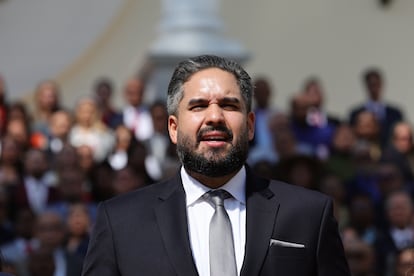

The scene bore the weight and pomp of a coronation before God. Delcy Rodríguez, left hand raised, right hand resting on the Bible, the book set upon a maroon cushion with gold trim. She wore an aquamarine dress. Jorge Rodríguez, left hand raised, purple tie, glasses. A man swearing in his younger sister as interim president of Venezuela, children of a father murdered while in police custody in the 1990s, when they were minors, with their whole lives ahead of them. The two would later visit their father’s grave, but first they stood there, frozen, in the most symbolic moment of their lives. Between them, his hands resting on the lectern, guarding the Bible, his expression grave, stood Nicolás Maduro Guerra.
The only son of Venezuela’s president, captured early Saturday morning in a spectacular operation by U.S. special forces, is poised to play a significant role in the new power structure currently unfolding. Delcy Rodríguez, in the absence of her former boss, is leading the country as interim president. “She’s going to be important, even more so than she was before, and she wasn’t insignificant,” says someone familiar with the movements in Chavismo’s upper echelons. Her presence among the Rodríguez family sends the message that even though Maduro is in New York, 2,485 miles from Caracas, imprisoned and publicly displayed in shackles, his regime is not dead.
Nicolasito, as he is sometimes called, is 35 years old and deviates from the classic image of Chavismo. On his cell phone, he has the apps for EL PAÍS and The New York Times. He represents a new generation, Chavismo 2.0, those who didn’t experience Hugo Chávez’s coup and subsequent rise to power with such intensity. Days before the July 2024 elections, Nicolás told this newspaper that if Edmundo González Urrutia, the opposition candidate, won, they would have no problem relinquishing power. Diosdado Cabello, the regime’s number two, seemed to reprimand him the next day: he said, without mentioning him directly, that the revolution had to be stronger than ever and that young people hadn’t lived through the hard times, the times of resistance.
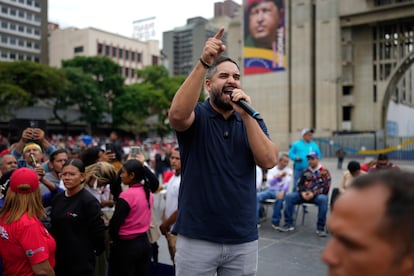
His career has been linked to Chavismo from a very early age. At 22, he was head of inspectors for the Presidency of the Republic, and at 23, coordinator of the National Film School. Now, he is a deputy in the National Assembly and in charge of religious affairs for the PSUV, the ruling party. He also participated in the dialogues in Mexico between Chavismo and the opposition, seeking a political agreement that never materialized. Jorge Rodríguez was the main voice, but Maduro effectively put his name on the dialogues through his son. Maduro Guerra has also served as an advisor to his father, keeping him informed of state affairs and intrigues at the Miraflores presidential palace. An active social media user, he would tell him what was happening on Instagram and other platforms.
There’s some truth to what Cabello, leader of the most hardline Chavismo, the one confined to the barracks, said — in case there’s any doubt, he hosts a program on public television called Con el mazo dando (With the Sledgehammer). Maduro Guerra belongs to a different breed. As a teenager, Commander Chávez recommended he do his military service, but he preferred to study economics and music in the Venezuelan orchestra system, which was directed by the renowned José Antonio Abreu. His father wasn’t a military man either, but as imposing as he is, he’s both jovial and intimidating. He exudes a different energy.
Maduro Guerra has positioned himself at the forefront, alongside the Rodríguez family, at a confusing time. U.S. President Donald Trump claims to be in charge of Venezuela, but in practice, Delcy Rodríguez is the de facto president, surrounded by the same people as Maduro. Many believe that, under threat from the White House, the new Chavista power structure will comply with Trump and meet all his demands, but such assumptions in Venezuela are quickly overshadowed by the ever-changing reality.
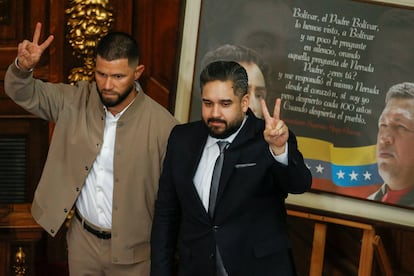
At the National Assembly, on the day of Rodríguez’s inauguration, Maduro Guerra stole the show. Visibly moved, on the verge of tears, he addressed his father and the First Lady, Cilia Flores, his father’s second wife: “And to you, Dad, I say, you made all of us, in the family, strong people. We are here fulfilling our duty until you return. The country is in good hands, Dad, and soon we will embrace each other here in Venezuela. And you will see the children. Cilia [referring to her three children]. You will see them, we will see them. Long live Venezuela! Long live the homeland!”
If anyone doubted whether the Maduros thought the Rodríguez siblings had betrayed them, that mystery vanished at once. He addressed the new president by her full name, “Delcy Eloina,” in a gesture of camaraderie. “My unconditional support [addressing her] for the difficult task ahead of you. Count on me, on my family. Count on our resolve to take the right steps in this responsibility that falls to you today. [We are] in absolute unity to achieve the goals of peace in Venezuela and move the country forward. May Nicolás and Cilia return!”
The opposition watched the scene unfold on television in astonishment. U.S. Secretary of State Marco Rubio had spent months touting María Corina Machado, the undisputed leader of the anti-Chavista movement, as the person who would lead a transition in the country. According to reports in the U.S. media, his advisors told Trump that Machado did not control the military and that there was a risk of rebellion. On the day of Maduro’s capture, Machado wrote that she and Edmundo González, the candidate who stepped in after she was barred from running in the July 2024 presidential elections, were “prepared to assert” their “mandate and take power.”
After Maduro boarded a helicopter, was taken to a frigate, and later escorted in shackles to a plane bound for New York, some predicted the fall of Chavismo at that moment. It had only hours left, they said. That hasn’t been the case, and a logical succession has taken place under the Chavista statutes: Vice President Delcy Rodríguez is now in charge. The relationship with the United States, the way things operate, is currently a mystery. What is certain is that, in this new world, both similar to and different from the old one, Nicolás Maduro Guerra will play a fundamental role. Nicolasito has grown up.
Sign up for our weekly newsletter to get more English-language news coverage from EL PAÍS USA Edition









































