
Trump clarifies who is ultimately in charge in Venezuela: ‘Me’
In an interview with NBC, the US president said that other officials including State Secretary Marco Rubio and Defense Secretary Pete Hegseth will help oversee the country’s management
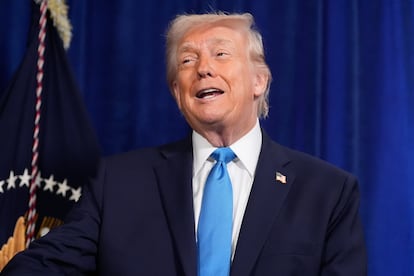

U.S. President Donald Trump has confirmed what was already a strong suspicion: there will be no elections in Venezuela over the coming 30 days, as stipulated by Venezuelan law in the event of a forced replacement of the head of state. Instead, the Trump administration will oversee the South American country while it rebuilds the oil sector, a task that the U.S. president estimates will take under 18 months. During that time, a group of his top officials will coordinate the Venezuelan administration. But Trump made it clear who will bear the ultimate responsibility: himself.
In an interview with NBC two days after Operation Absolute Resolve captured President Nicolás Maduro and his wife, Cilia Flores, at a military base in Caracas, and on the same day that the Chavista leader appeared in Manhattan federal court where he pleaded not guilty to four charges of cocaine importation conspiracy and weapons offenses, Trump expanded on details about how he plans to take charge of Venezuela.
Now that Washington has agreed to negotiate with the country’s acting president Delcy Rodríguez, elections in the near future are completely out of the question. “We have to fix the country first. You can’t have an election. There’s no way the people could even vote,” the president stated. “No, it’s going to take a period of time. We have — we have to nurse the country back to health.”
Just as he has ruled out an election in the near future, Trump has also rejected a new government led by the opposition movement, which is headed by María Corina Machado, the 2025 Nobel Peace Prize laureate. The Washington Post reported that the president did not want to put her in charge of Venezuela—despite the fact that the United States considers that the opposition won the June 2024 elections—because Machado was honored with the award that Trump badly wanted to receive himself. In his statements to NBC, Trump denied this theory: “She should not have won it,” he said. “But no, that has nothing to do with my decision.”
Some U.S. media outlets have reported that Trump was seriously disappointed with the Venezuelan opposition after the movement failed to oust Maduro from power in 2019, despite the support of the U.S. administration he led at the time.
The priority Trump has established in all his statements is to rebuild the oil sector, the country’s economic engine, which holds reserves of 300 billion barrels underground and represents a major U.S. interest. Trump said the effort will require a massive investment measured in the billions of dollars. Although U.S. oil companies will bear the brunt of this expenditure, Trump suggested the U.S. government could subsidize it.
“A tremendous amount of money will have to be spent and the oil companies will spend it, and then they’ll get reimbursed by us or through revenue,” he told NBC.
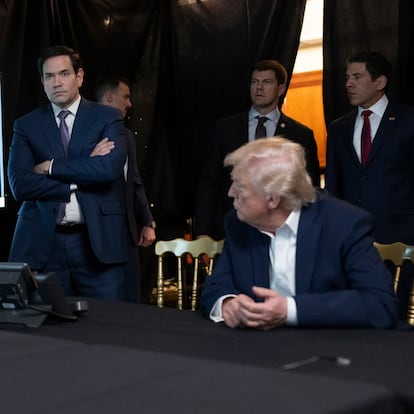
A group of four highly trusted officials will help oversee the U.S. intervention in Venezuela: Secretary of State Marco Rubio; Pentagon chief Pete Hegseth; deputy White House chief of staff Stephen Miller; and Vice President J.D. Vance. “It’s a group of all. They have all expertise, different expertise,” he noted.
But he also clarified that there should be no doubt about who will be ultimately in charge of this oversight: “Me,” he stated.
Rodríguez, who was sworn in to lead Venezuela, has been cooperating with Washington, according to Trump. But the president maintains that there were no prior contacts with her before Maduro’s fall, a statement that contradicts reports published in the U.S. media. Trump also stated that his administration will soon decide whether to lift the sanctions against Rodríguez who, until Monday, was the vice president of the Chavista regime.
He declined to specify whether he had spoken directly with Rodríguez at any point, only confirming that Rubio, his key foreign policy advisor and the son of Cuban exiles, had been in contact with her and has a personal interest in the region. “Their relationship has been very strong,” he explained. The U.S. Secretary of State “speaks to her fluently in Spanish.”
Asked if there was any deal with any official in Venezuela to remove Maduro, Trump replied: “Well, yeah, because a lot of people wanted to make a deal, but we decided to do it this way.” He also asserted that the operation was carried out without the help of the inner circle of people closest to the Chavista leader.
Initially, Trump said, he and his team thought a second wave of attacks might be necessary. “We’re prepared to do it,” he said. “We anticipated doing it, actually.”
But Trump denies that the United States is at war with Venezuela: “We’re at war with people that sell drugs. We’re at war with people that empty their prisons into our country and empty their drug addicts and empty their mental institutions into our country.”
He also insists that his supporters back him wholeheartedly, despite basing his election campaign in part on the promise of keeping the U.S. out of wars, and despite some isolated criticism—such as from his former ally in the House of Representatives, Marjorie Taylor-Greene, who claims that ultraconservative voters elected him to end wars, not to start conflicts.
“MAGA loves it. MAGA loves what I’m doing. MAGA loves everything I do,” Trump said. ”MAGA is me. MAGA loves everything I do, and I love everything I do, too.”
His critics, both Republicans and Democrats, have pointed out that the president did not seek Congressional authorization, as is required for acts of war, before giving the green light to the operation in Venezuela. His administration argues that it was unnecessary because, in their view, it is not a military action, but a police operation to arrest a drug trafficker. Washington considers Maduro not to be the legitimate president of Venezuela and accuses him of being the head of the Cartel of the Suns.
Trump’s explanation is different. ”We have good support congressionally. And Congress knew what we were doing all along, but we have good support congressionally. Why wouldn’t they support us?” Asked what Congress knew, and whether lawmakers received advance notice of the plans, the president declined to answer. “I don’t want to get into that, but people knew.”
Sign up for our weekly newsletter to get more English-language news coverage from EL PAÍS USA Edition









































