
Venezuela is foreshadowing the new world order that Trump wants to impose
The military operation against Maduro is the most representative example of the foreign policy that the US president intends to extend
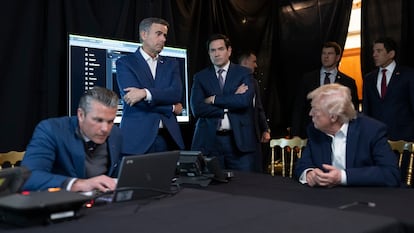

Donald Trump based his presidential campaign on the promise of non-intervention in foreign wars, of not sending U.S. forces back into protracted conflicts like those in Iraq or Afghanistan, and of not getting involved in reconstruction efforts in those countries. Since taking office, he has bombed Houthi positions in Yemen and ISIS positions in Syria, and has attacked Iran and Nigerian territory. But his intervention in Venezuela without congressional authorization, in the style of the coups that Washington perpetrated for decades in Latin America, is—because of its ambition, its scope, and its disregard for international rules—the most representative of the new world order the Republican president wants to impose.
In his remarks from his private residence in Mar-a-Lago on Saturday, just 10 hours after the attack that captured President Nicolás Maduro—now held in New York awaiting trial—Trump announced that Washington would “run” Venezuela. The Caribbean nation will thus become, for an indefinite period, a kind of protectorate where American oil companies will reign supreme. And where local leaders will have to do as the United States commands or “pay a very big price,” as he stated in a telephone interview with The Atlantic magazine.
Secretary of State Marco Rubio has corroborated it. For now, the United States will maintain pressure in the form of a blockade—a “quarantine” was the term used by Rubio—on oil tankers departing from Venezuela. And the military deployment in the Caribbean will continue, in a return to the gunboat diplomacy that Washington employed for the last two centuries.
Although Trump has been frank in acknowledging that oil is one of the main reasons for the operation, these go far beyond the energy sector; and certainly beyond the fight against drug trafficking, with Washington accusing Maduro of being a narco kingpin. In Venezuela, the Republican administration is putting its worldview into practice.
It is a vision in which the United States is the natural hegemonic power in the Americas and no other country can challenge its dominance. It is a return of the view of Latin America as Washington’s backyard and of the doctrine proclaimed two centuries ago by then-president James Monroe.
This is what the administration describes as the “Trump Corollary to the Monroe Doctrine,” the vision unequivocally outlined in the new White House National Security Strategy published last December. Following Maduro’s capture, the U.S. president and his team have openly embraced this approach in their public statements.
It is a vision in which human rights are disregarded. The Americas become the priority for the United States in foreign policy, to the detriment of the rest of the world. Allied governments are rewarded, while dissenting ones are punished. The criterion applied to these dissenters is force. And neither China nor Russia, two allies of Venezuela, can exert any influence.
“IIn the 21st century, under the Trump administration, we are not going to have a country like Venezuela in our own hemisphere, in the sphere of control, and the crossroads for Hezbollah, for Iran, and for every other malign influence in the world — that’s just not going to exist,” Rubio asserted in an interview on CBS’s Face the Nation this past Sunday. “This is the Western Hemisphere. This is where we live. And we’re not going to allow the Western Hemisphere to be a base of operations for adversaries, competitors, and rivals of the United States, simple as that,” he explained in another interview on NBC’s Meet the Press.
“Other countries in the region should be deeply concerned as it becomes clear that this doctrine involves imposing U.S. domination throughout Latin America by using murky accusations of narco-terrorism as an excuse for constant aggression,” says Alexander Main, director of International Policy at the Center for Economic and Policy Research (CEPR).
In his press conference this Saturday, Trump alluded to Mexico, where he has threatened to take action against drug trafficking organizations. He also warned Colombian President Gustavo Petro, one of his ideological nemeses with whom he has had numerous online exchanges, to “watch his back.” In both cases, the threats are more pronounced given that both governments are allies of Washington.
Meanwhile, Rubio has declared that he believes that without Venezuelan oil, the regime in Cuba will not be able to survive. In a domino effect, the regime of Daniel Ortega in Nicaragua would also succumb.
In contrast, during recent elections in Latin America, Trump boasted of having supported “the man who won in Honduras (Nasry Asfura), the man who won in Chile (José Antonio Kast), the man who won in Argentina (Javier Milei).”
The next few days will be crucial in determining what happens next. Trump has made it clear that, after his regime-change maneuver in Venezuela, he will not hesitate to order similar actions in the region. However, this hardline stance is not without risks. And in Venezuela, the U.S. president’s foreign policy success is at stake.
“deposing Maduro is the easy part—what comes next is where the trouble often lies. The United States learned this the hard way during previous regime change operations in Afghanistan, Iraq and Libya, where early tactical achievements failed to produce strategic success and instead paved the way for expensive occupations and unintended consequences. A split in the Venezuelan military, an expansion of criminal groups in the country, civil war, and the emergence of an even worse autocrat are all possible scenarios. None of these would bode well for regional stability or U.S. interests in its sphere of influence,” explains analyst Dan DePetris in a statement from the organization Defense Priorities.
Conspicuously absent from the statements of Trump and his team, as well as from the National Security Strategy, is any mention of the opinions of people living in the countries and subject to this new Pax Americana. Lee Schlenker, an analyst with the Global South program at the Quincy Institute for Responsible Statecraft, has a warning about this new version of the Monroe Doctrine: The original one, proclaimed in the 19th century, “encouraged the anti-American nationalist, revolutionary, and insurgent movements that characterized much of the 20th century in Latin America.”
Sign up for our weekly newsletter to get more English-language news coverage from EL PAÍS USA Edition









































