
Venezuelan opposition redefines its strategy with one priority: The return of its leaders in exile
The anti-Chavista movement, headed by María Corina Machado, has taken Donald Trump’s snub in stride and is preparing to claim a space in a lengthy transition
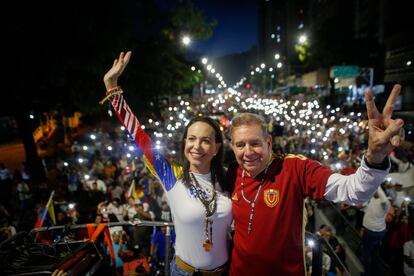

The vast majority of the Venezuelan opposition is in no doubt: the transition to democracy began early Saturday morning after the U.S. military incursion into Caracas and the capture of Nicolás Maduro. However, the outlook darkened as the hours passed, and the main anti-Chavista leaders, headed by María Corina Machado, adjusted their priorities in response to Donald Trump’s affront. While the initial reaction of the opposition leadership was a willingness to immediately replace Chavismo, the harsh reality imposed by the Republican president’s choice of Delcy Rodríguez ultimately redefined their strategy. The priority is no longer seizing power, but returning to Venezuela.
This represents not only a minimum condition for beginning a cycle of change, even under the tutelage of the White House, but also an urgent political necessity for the opposition in exile. And today, as U.S. Secretary of State Marco Rubio has also emphasized, there are no longer any top-level leaders of the Democratic Unitary Platform (PUD) in Caracas. Machado, forced to live in hiding to evade the regime’s persecution, left almost a month ago to receive the Nobel Peace Prize in Oslo, and before the Delta Force attack, she was waiting for the opportune moment to return. Now she makes no secret of her intention to “return as soon as possible,” as she stated on Saturday on the conservative Fox News network, the outlet she chose to give her first interview since the capture of the Venezuelan president and to address Trump voters.
Edmundo González Urrutia, the candidate who challenged Maduro at the polls on July 28, 2024, has been in exile in Spain for over a year, from where he continues to claim an electoral victory recognized by the main bodies of the international community, from Washington to Brussels. On Sunday, he elaborated on the argument of strategic patience put forward by former Caracas mayor Antonio Ledezma, also based in Madrid, in an opinion piece published in EL PAÍS. González Urrutia shared photos on social media of a meeting with former Spanish prime minister Felipe González and noted that “democratic transition processes are neither linear nor simple,” but rather “require experience, historical vision, and the ability to distinguish between the urgent and the essential.” “Democracy is built on firm principles and responsible decisions, even in the most complex contexts,” he added.
These absences are compounded by other significant ones, such as that of Leopoldo López, who has been living in exile in Madrid since 2020, and Juan Guaidó, who in 2019 engaged in a months-long power struggle with Hugo Chávez’s successor, proclaiming himself interim president, and who now resides in Florida. In Venezuela, most opposition figures have been effectively sidelined for months due to government repression, operating clandestinely or from prison, where approximately 900 political detainees remain.
In addition to their release, they are all demanding security guarantees for their return home, a task they entrust to the United States. A source familiar with the movements within the opposition leadership explains that they expect the imminent arrival of a contingent of American officials and the reopening of the U.S. Embassy, closed since 2019. “The landing won’t be so much ‘boots on the ground,’ but rather ‘ties tied,’” jokes an opposition official.
A mirror of the Spanish Transition?
Meanwhile, the urgency of regime change has been replaced by a long-term perspective. The mirror of the Spanish Transition, to which the conversation between González Urrutia and Felipe González alluded, is a path embraced by many on both sides of the Atlantic even before Maduro’s downfall. “Now it’s as if we were in 1975. Franco had just died, the Moncloa Pacts took two years to negotiate, and we had to wait three for the Constitution to be approved,” the same source summarizes. While acknowledging the differences with that episode, even Santiago Carrillo, general secretary of the Communist Party of Spain, returned to Spain in disguise and under clandestine conditions. But in that situation, there was no Trump, nor was it a process being controlled remotely from the White House.
The U.S. president, on the other hand, confirmed that there will be no elections in the short term, arguing that Venezuela’s democratic decline makes it impossible to hold elections with guarantees. This assertion is not without merit, since Chavismo effectively controls all the levers of the state. This absolute control not only of the Armed Forces, but also of the judiciary, the electoral authority, the ailing public services, and the struggling oil industry, was the true force that allowed Maduro to eliminate his rivals from any kind of fair political competition.
Now it is Trump, the very person to whom Machado dedicated her Nobel Prize, who has sidelined her. But while many in the opposition are still trying to come to terms with the blow, most are aware of the need to regain the initiative and lay the groundwork for reclaiming their space during a lengthy transition. Machado was the last anti-Chavista leader to unite all the forces demanding change under a single purpose. At the end of 2023, she swept the coalition’s primaries, and her support did not wane even though she was barred from running in the presidential elections. The candidacy of Edmundo González, her chosen successor, was eventually accepted by very disparate factions, and this consensus held until last May.
Then, a group of genuinely opposition figures, albeit with tactical differences, broke the unity by running in the parliamentary elections. They were led by former presidential candidate Henrique Capriles, Stalin González (who was once Guaidó’s second-in-command), and Tomás Guanipa, brother of Juan Pablo, who is currently detained. All of them were sworn in on Monday as members of the new National Assembly, which opened its session with the swearing-in of Delcy Rodríguez as interim president of Venezuela. And all of them aspire to play a leading role in this phase. However, only the return to Caracas of the exiled leaders and the release of political prisoners will ultimately reshape the bloc’s next steps, its internal power dynamics, and its future leadership.
Sign up for our weekly newsletter to get more English-language news coverage from EL PAÍS USA Edition









































