
Hope gives way to uncertainty among Venezuelan exiles in the US after Maduro’s capture
The community of more than half a million fears for the future of their immigration processes, which have been in legal limbo since Trump eliminated TPS and other protections
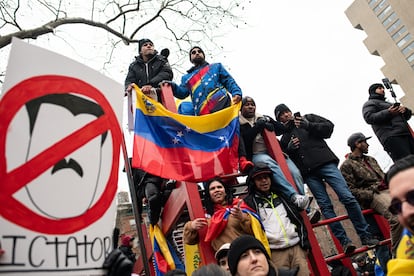

The capture of Nicolás Maduro by U.S. forces has opened a new chapter of uncertainty for many Venezuelan exiles in the United States, for whom the lack of clarity regarding a democratic transition and the possibility of further military action are dampening any thought of returning to their country. This ambiguity is compounded for hundreds of thousands of people who are in limbo after the Trump administration canceled temporary immigration protections, as well as for asylum seekers who fear their cases will be affected by the changing circumstances in Venezuela.
“In the last 48 hours, the community has been in complete panic,” says John De La Vega, a Venezuelan lawyer in Miami who says he has received calls from “hundreds of people” worried about their immigration cases since news broke that a commando unit had captured Maduro in a surprise attack last weekend. “The main uncertainty is: If Maduro has been captured, will my asylum case fall apart? Will the government stop approving asylum cases because of this situation?” says De La Vega.
On the other hand, for many, the news revived hopes that Temporary Protected Status (TPS) for Venezuela would be restored after the Trump administration canceled it last year, leaving more than 600,000 Venezuelans in immigration limbo, many of them residents of South Florida, the lawyer added.
This decision was compounded by the cancellation of the humanitarian parole program that had allowed more than 100,000 Venezuelans to live and work legally in the United States for a period of two years.
Maduro and his wife, Cilia Flores, were indicted in the Southern District of New York on narcoterrorism charges. Trump has stated that the U.S. will run the country: “We’re going to stay until such time as the proper transition can take place.” He also asserted that the U.S. military is “prepared to do a second wave” of attacks, although “we probably won’t have to do it.”
But the situation inside Venezuela remains uncertain. Vice President Delcy Rodríguez assumed the interim presidency, but it is unclear who effectively controls the military and security structures that sustained Chavismo for more than two decades. Key regime figures, such as Diosdado Cabello, considered the number two in Chavismo, and high-ranking military officers continue to operate within the country, fueling fears of reprisals and a further narrowing of political space.
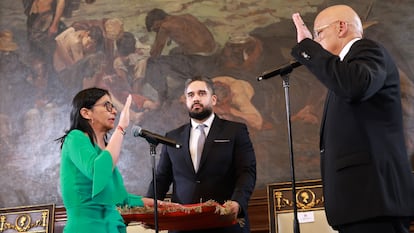
Among the diaspora, many believe that the conditions that forced them to flee remain in place, and the country’s immediate future remains uncertain.
One person who lost her TPS status and doesn’t see returning as an option is Rossaly Nava, a 43-year-old Venezuelan who has lived in the U.S. for 10 years. Nava, originally from Maracaibo, was involved with the opposition and had to flee the Chavista regime. Her former boss, a member of parliament, remains detained in Venezuela on charges of treason and other offenses. “This doesn’t guarantee that I can return,” she says. “Maduro isn’t looking for me, but there are those directly responsible, like Diosdado Cabello and his torturers, who know perfectly well who I am. I can’t return until I’m certain that those who attacked me won’t be there.”
When she had TPS, “I was protected,” she explains, but today she only has an asylum process that began 10 years ago. “I consider myself at risk of being returned to a country that is not ready to protect those of us who were linked to the opposition,” she adds.
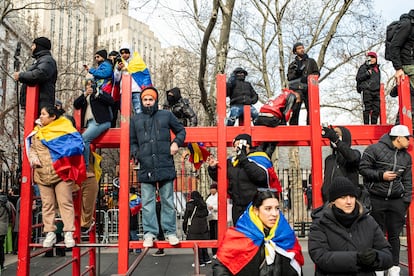
On Saturday, a crowd in Doral, the Miami-Dade city with the largest Venezuelan diaspora in the country, where many backed Trump in the hope that he would remove Maduro from power, celebrated the latter’s capture. That enthusiasm, however, has given way to discontent following the end of immigration protections, amid an anti-immigrant offensive that has sown fear in the community.
Following Maduro’s capture, Miami Mayor Eileen Higgins called on the Trump Administration to reinstate TPS for Venezuelans. But that hope was dashed on Sunday when Homeland Security Secretary Kristi Noem—who canceled TPS for Venezuela four months ago, claiming it was contrary to the national interest—stated that the country is “more free than it was yesterday” and that those who lost TPS could apply for asylum instead.
“That only confused the community even more,” says Helen Villalonga, president of Amavex, a human rights organization, who says that “many people have contacted her” seeking clarification because “they believe they can now apply for asylum, but asylum is not requested from within the United States.”
Furthermore, Villalonga maintains that Venezuelans need protection now more than ever. “Before, we didn’t have an invasion; now we do.”
The confusion also extends to the subject of deportations. In mid-December, the Venezuelan government claimed that the U.S. had suspended deportation flights to Venezuela, a claim denied by Washington. Following Maduro’s capture, a DHS spokesperson confirmed to EL PAÍS that the flights are not suspended.
Patricia Andrade, founder of Venezuela Awareness, warns about the deportations, saying, “You can’t send people to a country that remains unstable, where orders have been given to imprison those who support Trump’s actions.” She says her contacts in Venezuela describe an apparent normalcy, but that “there is a lot of fear” among the population, that paramilitary groups are in the streets, and that Chavistas are “shoring up the few followers they have left.”
Last month, the Trump Administration suspended immigration processing for citizens of a list of countries that includes Venezuela. However, De La Vega, the lawyer, clarifies that asylum has not been eliminated, but rather that “what is suspended is the decision-making process, the government’s approval or denial of cases.” Nevertheless, he warns that the situation is extremely volatile. “We have to wait. The situation in Venezuela is going to change day by day, almost hour by hour.”
Sign up for our weekly newsletter to get more English-language news coverage from EL PAÍS USA Edition









































