
Cubans look to Venezuela fearfully after Trump’s incursion: ‘We could be next’
Island residents are trying to figure out what the fall of Chavismo could mean for them, and whether Cuba might be Washington’s next target as suggested by State Secretary Marco Rubio
When Nicolás Maduro and his wife were captured and taken out of Venezuela by U.S. military forces in the early hours of Saturday morning, a group of young Cubans were celebrating a birthday at a house in Havana’s Vedado neighborhood. They were sharing music, jokes and drinks when the hostess noticed an alert on her phone. News of the U.S. strike on Caracas, part of the operation to capture the Venezuelan leader, sparked a conversation that dominated the rest of the evening. From initial shock, the mood shifted to fear. “Cuba could be next,” some of the guests said as they watched videos of an event that—despite having been predicted so many times—had seemed improbable to many until then.
“The first reaction was disbelief,” says the hostess of the party, a 26-year-old Havana native who asked not to be named for fear of reprisals. “Maduro is a dictator who was illegitimately occupying power, but the United States has no right to carry out a military intervention in any country. It’s difficult to take sides in these circumstances: on the one hand, you feel a certain excitement that things will change and that the new scenario will be positive. On the other hand, we know that these kinds of foreign interventions don’t end well. The fear of them bombing your city and killing your people becomes terrifying,” she reflects.
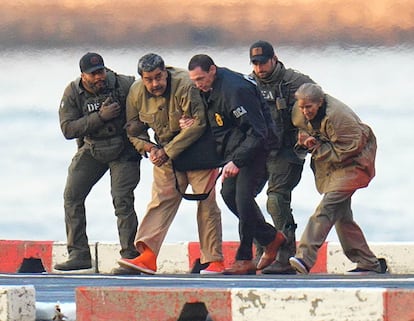
Two days after the operation that resulted in Nicolás Maduro and his wife, Cilia Flores, being imprisoned in a Brooklyn jail, the Cuban government issued a statement of condolence for the deaths of 32 Cuban military personnel who were part of the Venezuelan president’s security detail at the time of his capture, and declared two days of national mourning on the island. Meanwhile, the population is trying to decipher what the fall of an ally that was in decline—but an ally nonetheless—will mean for them, and the possibility that the island could be Washington’s next target, as suggested by Donald Trump and his Secretary of State, the Cuban-American Marco Rubio.
Rally at the anti-imperialist platform
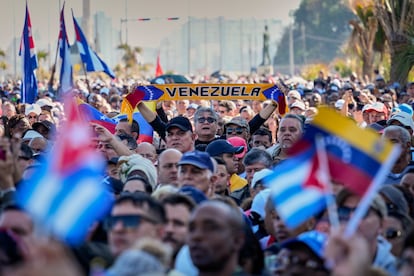
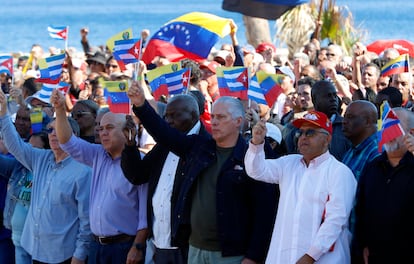
On Saturday, as Cubans were waking up, they learned of the U.S. military operation in Venezuela, either through the television channels available on the island—Cuban Television, Telesur or Russia Today—through messages sent by relatives abroad, or via social media, where memes and AI-generated images alluding to the arrest circulated nonstop. Simultaneously, Cuban authorities called for a rally in front of the U.S. diplomatic mission on the island, at the Anti-Imperialist Tribune, facing Havana’s Malecón. By mid-morning, thousands of people, summoned by the Cuban government, gathered on the esplanade to express their support for Chavismo and to demand proof of life for the captured Bolivarian leader, whom U.S. authorities had not yet presented.
Cuban President Miguel Díaz-Canel denounced the U.S. military incursion into Venezuela as an act of “state terrorism,” reaffirmed the continent as a “zone of peace,” and asserted that it was “a time for defining positions,” in which Cuba would stand with Venezuela, a country for which he declared he was prepared to shed his own blood. Among those listening to these words was Karla Picart, a professor at the School of Communication at the University of Havana. “They (the U.S.) have taken off their masks and are no longer even trying to hide it,” she said, referring to the press conference given that same day by Trump, in which he stated that his country would take control of Venezuela and its oil industry until there was a reliable transition.
At that press conference, held at his Mar-a-Lago resort hours after Maduro’s capture, Trump also said in answer to reporters’ questions that they would eventually talk about Cuba because, he asserted, “it’s a failed nation.” Trump appeared alongside Marco Rubio, for whom, as the son of immigrants from the island, the Cuban cause is personal, and who warned that if he lived in Havana and were in government, “I’d be concerned.”
The ideological differences among Cubans, both on and off the island, are evident even in how they describe what happened with Maduro. While Cuban authorities and their supporters speak of the Venezuelan president’s “kidnapping,” many Cubans in exile, and even some on the island, celebrate the U.S. operation with memes or impassioned posts predicting the same fate for the Cuban authorities.
Cristal, a 30-year-old Havana resident, reflects along these lines. “So now it turns out that María Corina [Machado] doesn’t have the support of the United States?” she laments. “I understand the feelings of many Venezuelans who are happy with what has happened. They got rid of that guy, a dictator who has imprisoned so many people, who has violated human rights. And I don’t care if it’s the result of foreign intervention: Venezuelans, and us Cubans, have already lost that patriotic feeling of putting sovereignty above all else. People who are hungry and in need want something better for their lives and they don’t care how it comes. I think many Cubans are seeing hope, even in something that might not be hopeful at all.”
As the hours pass, the tangled web of the conflict unravels in some areas and becomes more entangled in others. “The watchword now is uncertainty,” says Fabio Fernández, a historian and professor at the University of Havana, who makes no secret of his doubts about whether Chavismo can consolidate without Maduro in power. “You think about these issues and the uncertainty quickly shifts to Cuba,” he adds. For the researcher, the situation could open a new reality for the island with unforeseen implications. “Will the commitments between Cuba and Venezuela be maintained? Will Venezuelan oil continue to arrive in Cuba? What will become of the Cuban collaborators in the country? How will these collaborators be relocated if, suddenly, the ties are severed? What will be the economic impact of all this on Cuba? These are complex questions, and if the answer is that Chavismo collapses and Venezuela changes, the implications for Cuba will be dire.”
Although Venezuelan aid to Cuba has fallen considerably in recent years in line with the Venezuelan economic crisis, the latest information on daily oil shipments, according to PDVSA documents, dates from September 2025, when Venezuela sent 52,000 barrels per day during the month, the highest figure of the year.
The historian hypothesizes that if Chavismo falls definitively, Cuba could plunge into a crisis far greater than the current one. And to make matters worse, he says, the island is “in the crosshairs of Trump and Marco Rubio,” as they themselves have acknowledged. “It’s an exercise in the politics of force, a revival of the Monroe Doctrine, where the United States marks the boundaries of its sphere of influence. It’s an action that responds to a time, internationally, when it seems that the great powers are defining their spheres of influence, where they don’t allow anyone to move at a different pace than the one they dictate.” For now, Cubans, attentive to what is happening in Venezuela, are trying to predict and understand the frenetic pace being set by the U.S. president.
Sign up for our weekly newsletter to get more English-language news coverage from EL PAÍS USA Edition









































