
Eileen Higgins, the ‘gringa’ who returned Miami to the Democrats after three decades
The mayor-elect, who will take office on December 18, focused her campaign on affordability and immigrant rights, presenting herself as a counterweight to Trump in a predominantly Latino city
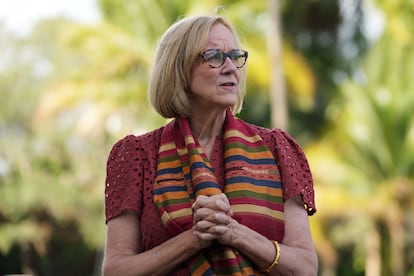

The political DNA of Eileen Higgins, Miami’s mayor-elect, is deeply Democratic. Her agenda, her career, and her civic alliances reflect a worldview aligned with the party’s progressive ideals, which celebrated her victory as its own. Not just as a local triumph over a candidate backed by U.S. President Donald Trump in a city that hadn’t seen a Democratic mayor in three decades, but as a sign that the Democratic Party remains relevant a year after its defeat in the 2024 presidential election — and that it can reconnect with voters through a platform focused on affordability, immigration, and social justice.
“When you have a great candidate who’s focused on the issues of the people and solutions for the people, along with an organized party doing year-round organizing, consistently showing up in communities, with the resources to communicate to the electorate, it produces wins,” says Nikki Fried, chair of the Florida Democratic Party. “This is going to be a great example of not just what happens in South Florida, but what can happen across the state.”
The Miami mayoralty is a nonpartisan office — no formal party affiliation appears on the ballot — but the race was seen as another battle over the future of the Democratic Party, particularly because Miami-Dade County — a blue stronghold for decades — voted Republican in the last election.
The battle intensified last month when Trump endorsed former city manager Emilio González, a Republican. The president offered his support after the Democrats scored major victories in New York, Virginia, and New Jersey, outcomes widely interpreted as a repudiation of his policies. The Democratic National Committee, in turn, backed Higgins — an unusual move at the municipal level — turning the local race into a battle of endorsements and a national barometer of political sentiment.
Higgins, 61, won on Tuesday with nearly 60% of the vote, becoming the first woman to hold the office of Miami mayor and the first Democrat — and first non-Cuban or Cuban-American — to reach City Hall in 28 years. She will take office on December 18.
Ken Martin, chairman of the Democratic National Committee, hailed the victory as “another warning sign for Republicans.” “Voters are fed up with their out-of-touch agenda, which is raising costs for working families across the country,” he told EL PAÍS.
An unusual path
Higgins’ personal and professional journey is uncommon in Miami local politics. She was born in Dayton, Ohio, and raised in Albuquerque, New Mexico, where she studied mechanical engineering. She worked as an engineer in manufacturing plants before earning an MBA at Cornell University in New York, and later spent time as a marketing executive in the private sector.
In 2006, she served as the Peace Corps director in Belize — a U.S. international volunteer program for developing countries — and worked as a U.S. State Department diplomat in Mexico and South Africa. This international experience preceded her entry into local politics when she moved to Miami and became involved with organizations advocating historically progressive causes, such as gun control, social justice, and climate action.
Higgins began breaking the mold in Miami in 2018, when she was elected commissioner of Miami-Dade’s District 5 — a district where 70% of residents are Hispanic, covering neighborhoods like Little Havana — and earned the nickname “the gringa.” From this peripheral position, she built her political agenda.
As commissioner, she pushed for greater government intervention to address the housing crisis and claims to have contributed to the creation of around 7,000 affordable housing units. She also promoted policies to protect tenants against evictions, expedite permits, and expand incentives for home ownership.
She continued with the same approach after the pandemic. Following the Covid-19 health crisis, Higgins directed federal funds from the U.S. government’s American Rescue Plan (ARPA) into an initiative to support small businesses called Elevate District 5.
Florida Senator Shervin Jones, from Miami Gardens, a longtime friend who lived in the same building as Higgins, says she has always been “consistent.” “She’s not the kind of leader who says something and doesn’t do it. She believes in what comes out of her mouth, and she follows through.”
On social media, Higgins presents a carefully balanced image of her personal and professional life, with family photos and trips to Europe alongside meetings with Democratic politicians at events and campaigns. On her blog, however, she offers a more intimate glimpse into someone who deeply values her family and community, posting inspirational quotes from poets like Mary Oliver or Chilean writer Isabel Allende, or praising Louis Begley’s novel Memories of a Marriage — an “anti-Gatsby” story that questions the idealized pursuit of the American Dream, wealth, and status in favor of a life of integrity, humility, and discretion.
As a politician, Higgins frequently talks about equity, social justice, and inclusion, using terms like “equity gaps,” “underserved communities,” “low-income workers,” and referencing the LGBTQ+ community. She also consistently stresses environmental protection — from county waterways to responses to rising sea levels — and the importance of public transportation.
Higgins downplays the fact that she is a woman. “My career began in manufacturing, where I was often the only woman. So when I ran here, it never crossed my mind that I would be the first female mayor,” she said in an interview with EL PAÍS days before being elected. “However, it will be a true honor to lead a city that was founded by a woman more than 125 years ago.” Higgins chose the Miami Woman’s Club, a venue steeped in symbolism of women’s role in the city’s development, to celebrate her victory on election night.
The mayor-elect not only focused her speech on local issues, but also articulated a moral critique of the Trump administration’s immigration policy. Higgins positioned herself as a counterweight to the administration’s actions that separated thousands of families and left hundreds of thousands at risk of deportation, including many Miami-Dade residents. In an interview with this newspaper, she accused government officials of speaking about immigrants as if they were ”less than human,” arguing: “They are not criminals, they’re part of this community.”
During her campaign, she defended the rights of Miami’s immigrant residents and openly criticized what she called “cruel” policies. Higgins gained additional support from voters who had backed Trump but now felt adversely affected by his policies.
The Monday before the election, Fried asked Higgins what she was hearing from residents while canvassing. “And she said two things to me. She said, one, the unaffordability of Miami. That people can’t live here, can’t afford to be here, can’t afford to raise a family, can’t purchase a home, can’t pay for their rent, and the general cost of living. And two, that people are walking around scared. That in a city with such a high percentage of Hispanic neighbors, people are walking around with their passports, with their driver’s license, trying to prove their residency and their nationality. And that’s not a quality way of life,” says the chair of the Florida Democratic Party. “She illustrated to me in our conversations that this was a big part, that people really felt that she was going to stand up for their neighbors.”
“Seeing the anti-American policies coming out of the Trump administration, which are destroying families, destroying communities, destroying businesses, what we, as a party, can do is stand up for our community,” Fried adds.
Sign up for our weekly newsletter to get more English-language news coverage from EL PAÍS USA Edition









































