
Eileen Higgins: ‘Government officials are talking about our residents as if they are less than human. They are not criminals. They’re part of this community’
The Democrat, who is the favorite to win the runoff election for mayor of Miami on December 9, is turning the contest into a referendum against Donald Trump’s immigration agenda
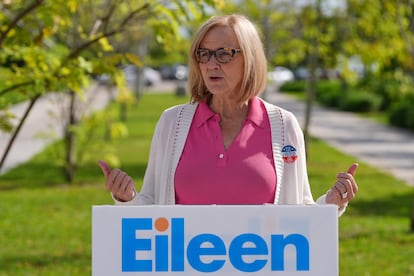

Eileen Higgins has taken the bull by the horns in the Miami mayoral race, launching a fierce attack against President Donald Trump’s immigration agenda, which she claims has caused “much pain” in this city of immigrants. The “regret” of those who supported the Republican president and now face the consequences of his policies, which directly affect their families, is emerging as her trump card.
Although the Miami mayoral race is not officially partisan, it has become a national battleground between Democrat Higgins and Republican former city manager and chief administrative officer of Miami, Emilio González. The 61-year-old Ohio native, who served as a Miami-Dade County commissioner for seven years, led the first round with 36% of the vote, followed by González with 19%. If she wins the election, in which she is the favorite, she would become Miami’s first female mayor, and it would also be the first time a Democrat — and someone who is not of Cuban or Cuban-American descent — has held that office in the last 30 years. The two candidates will face off again on December 9.
The dispute intensified after Democratic victories last month in key states like New York, Virginia, and New Jersey, interpreted as a boost for the party ahead of the 2026 midterm elections and a rejection of the Trump administration’s policies. The president has given his “full and complete” support to González, while the Democratic National Committee has said it is backing Higgins “with everything,” an unusual move at the municipal level.
The duel of endorsements has placed the municipal election under the national microscope, turning it into an electoral barometer that could determine the behavior of the Hispanic vote in the United States, especially after Miami-Dade — a Democratic stronghold for decades where 70% of the residents are Hispanic — turned toward the Republican Party in the last presidential election.
Miami, with half a million inhabitants, is just one of the 34 municipalities in Miami-Dade County. More than half of the residents are immigrants, and 70% are Hispanic.
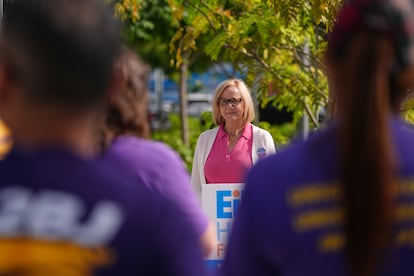
After Trump endorsed her opponent, Higgins has further distanced herself from the president and his agenda, presenting her candidacy as the antidote to a “cruel” immigration policy imposed by a government she describes as “a drip of hate” seeping from leaders into society.
“He [Trump] and I have very different points of view on how we should treat our residents, many of whom are immigrants,” Higgins points out in a telephone interview with EL PAÍS. “That is the strength of this community. We are an immigrant-based place. That’s our uniqueness. That’s what makes us special.”
The candidate says that during the campaign she has encountered people “with tears in their eyes because one of their relatives was sent to Alligator Alcatraz. Another one was sent away. They don’t know where the person is. This is cruel. It is no way to behave. In my opinion as a Catholic, it’s a sin,” she maintains. “Senior people and government officials are talking about our residents as if they are less than human. They are not criminals. They’re part of this community, and the community is scared,” she concludes.
Higgins insists the race is nonpartisan, but she knows there is a lot of regret among those who supported Trump and are now seeking change. “They did not realize that when they voted, they were going to be undermining their identity as Hispanics and the safety of the Hispanic community in Miami-Dade County. They’re hurt by the language that’s being used against them. They’re hurt that their family members are disappearing. That people who are trying to do the right thing by showing up to court are being escorted away without even being able to say goodbye to their families. I’m hurt by this too,” she says.
“I’ve served the residents of the City of Miami for eight years. They know I serve every single one of them. I do not ask their political party. And that reputation is what propelled me in the first round to win in every district. The City of Miami has five commission districts, and I came in first place in all five. And I need to let you know that some of those districts are not Democratic-leaning,” Higgins adds.
Facing off against DeSantis
Higgins’ criticism also targets Florida Governor Ron DeSantis, a Republican, who has also endorsed González. DeSantis, a Trump ally, has become one of the most aggressive promoters of the national crackdown on immigrants, building detention centers with ominous names and pushing through hundreds of 287(g) agreements between local and federal law enforcement agencies to carry out arrests.
“Just think about what this state has done. They built cages for human beings rather than affordable housing for them,” Higgins says, referring to the cells at Alligator Alcatraz.
Following the state agenda, Miami signed a 287(g) agreement last June, despite massive opposition from residents and civic groups. Higgins believes it was a mistake. “When I’m mayor, I will look to see if we can get out from under this agreement. Because having our police officers involved in anti-immigrant activities is bad for the city. We need a police force that when they’re in everybody’s neighborhoods, people feel safe,” she argues. The candidate points to Miami’s historically low crime rates and adds: “We cannot be perceived as an arm of the federal government which is out searching for our residents.”
Higgins also points out the danger to the city’s economic future posed by the Trump administration’s cancellation of temporary protection and humanitarian programs that allowed millions of people to live and work legally in the U.S., leaving hundreds of thousands of Venezuelans, Cubans, Haitians, Nicaraguans, and Hondurans, among other nationalities, in limbo.
Last month, the government ended Temporary Protected Status (TPS) for hundreds of thousands of Venezuelans, many of them residents of South Florida. The White House “told our Venezuelan neighbors, ‘It’s safe enough to go back to Venezuela. Get out of here. We’re getting rid of TPS.’ That same week, it was announced that Venezuela is a narco terrorist state that is so dangerous they need to close the airspace. So how can we be taking away protections and sending people back to a place so dangerous?” Higgins asks.
She cites the example of a local health clinic owner who received a notification from the federal government that he had to lay off 27 workers because they were Venezuelan and could no longer work legally. “So this is 27 families that don’t have a breadwinner. And then on the opposite side, this is a health clinic that might not be able to provide the care it should to its clients. This immigration policy — which is going after everyone, not going after criminals — is very, very dangerous for our economic future."
“We obviously need to get Congress to pass a legal path to citizenship for people that aren’t criminals,” she adds.
“Miami needs to be a city where people feel welcome to live here, welcome to work here, and succeed and thrive here. It is such a blessing to live in a diverse place where people come from different spots of the world. They think differently. The culture’s different. They explore new business opportunities differently. That’s what we need to be. That is the special sauce of Miami. It is our diversity,” she says. “And right now, at least from Tallahassee and Washington, that’s not what we’re hearing from people. We’re hearing that if you’re different, you’re bad.”
Sign up for our weekly newsletter to get more English-language news coverage from EL PAÍS USA Edition









































