
Eileen Higgins makes history as the first woman elected mayor of Miami, breaking the conservative hold on the city
Her victory ends 30 years of Republican control and makes her the first Democrat to lead a city historically dominated by Cuban Americans
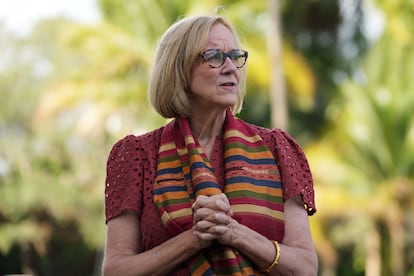

Eileen Higgins made history on Tuesday by becoming Miami’s first female mayor, defeating her opponent, former city manager Emilio Gonzalez, with nearly 60% of the vote. With her victory, the 61-year-old Higgins also becomes the first Democrat — and someone who is not of Cuban or Cuban-American descent — to hold that office in the last 30 years.
“Tonight, the people of Miami made history. Together, we turned the page on years of chaos and corruption, and opened the door to a new era for our city,” Higgins said in a statement.
The race for mayor of Miami, Florida’s second most populous city, is nonpartisan, but it was seen from the beginning as a political battle between Higgins, a Democrat, and Gonzalez, a Republican, after Miami-Dade County — a Democratic stronghold for decades — turned Republican in the last presidential election by supporting Donald Trump (although the city of Miami gave a narrow advantage to Kamala Harris).
That scenario opened the door to a race with an increasingly political overtones, and the fight intensified last month after Trump gave his “full” endorsement to González when Democrats secured important victories in key states such as the New York City mayoral race and the governorships of Virginia and New Jersey — results interpreted as a rejection of Trump’s policies and a boost for the Democratic Party heading into the 2026 midterm elections. For its part, the Democratic National Committee endorsed Higgins — an unusual move at the municipal level — placing the election in the national spotlight as a barometer of the Hispanic vote in the United States.
Miami has half a million inhabitants, of whom more than 70% are Hispanic and almost 60% are immigrants. The majority of residents are Cuban and Cuban-American (30%). The city is just one of the 34 municipalities in Miami-Dade County, which is over 70% Hispanic.
During the race, the Republican Party compared Higgins to Mamdani — whom Trump labeled a “communist” during the New York City Council campaign — in an apparent attempt to generate a negative perception among exile communities from totalitarian regimes such as Cuba, Venezuela, and Nicaragua living in South Florida.
González, for his part, entered the election bolstered by the support of high-profile Republican politicians, including Governor Ron DeSantis and Senators Rick Scott (Florida) and Ted Cruz (Texas). These endorsements earned him the nickname “MAGA mayor” among Democrats.
Donald Trump’s anti-immigrant agenda has hit South Florida communities hard. Miami-Dade residents have seen how hundreds of thousands of Cubans, Venezuelans, Haitians, and Nicaraguans — including their own relatives — were left in limbo after the government canceled humanitarian programs and protections that allowed them to live and work legally in the country. They have also witnessed the construction of immigrant detention centers in their backyard, with ominous names and accusations of human-rights violations, while workplace raids, arrests on highways, and detentions in immigration courts have intensified, creating an atmosphere of fear in the communities.
The political effect has been noticeable, and many who supported the Republican president have expressed regret. Discontent with immigration-enforcement tactics is reflected in polls, where a majority say they oppose arresting and deporting immigrants who have not committed any crime.
In that environment, Higgins was able to channel the discontent and capitalize on the backlash. During her campaign, she openly criticized the president’s “cruel” agenda and presented herself as a sensitive alternative to the Hispanic community’s struggles, promoting respect for immigrants. She has also said that the agreement between Miami police and federal agencies to arrest immigrants — known as 287(g), which the city signed in June — was “a mistake,” and she will try to overturn it.
The mayor-elect has indicated that ending Temporary Protected Status for Venezuelans and Haitians poses a danger to the city’s economy, leaving hundreds of thousands of people without work permits, with the corresponding impact on families and local businesses.
She has also expressed opposition to the controversial transfer of a valuable Miami Dade College property in downtown to the State of Florida for the construction of Trump’s presidential library.
For seven years, the mayor-elect represented District 5 of the Miami-Dade Commission, which includes Miami neighborhoods with a high density of Hispanics such as Little Havana, Shenandoah, and the river area near downtown. She graduated from the University of New Mexico and Cornell, and has worked as an engineer and marketing executive.
Local politics in Miami has been plagued by corruption scandals and is often described as a dynasty, because many people from the same families have held similar public positions for years. For example, the outgoing mayor, Francis Suarez, is the son of Xavier Suarez, who was mayor in the 1980s and 1990s and ran again this year.
Thirteen candidates took part in the race. In the first round, Higgins led with 36% of the vote, followed by González with 19%. Voter turnout was 21%.
Sign up for our weekly newsletter to get more English-language news coverage from EL PAÍS USA Edition









































