
Mexico seeks to shore up its defenses following US incursion in Venezuela
Sheinbaum insists on ‘collaboration’ and ‘shared responsibility.’ Trump’s main justification for attacking Caracas is the fight against drug trafficking. It’s the same argument he has used to pressure Mexico on various fronts
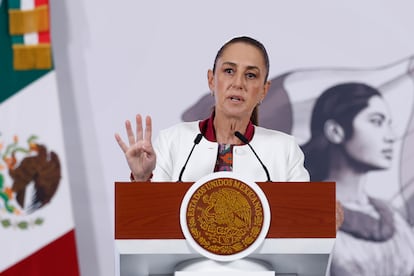

Mexico has been building defenses since the beginning of the U.S. military escalation against Venezuela. There have been months of diplomatic maneuvering: concessions, agreements, public pronouncements, and even appeals to the United Nations. But once the attack materialized and Nicolás Maduro was captured, the relationship entered a new phase. Donald Trump’s threats, which have been repeated with different targets—Colombia, Cuba, Mexico—since the Venezuelan president’s capture, sound more unsettling than ever. The possibility of an intervention against Mexico is now more plausible than it was three days ago. Anyone could be the next target for Washington, which has dusted off its view of Latin America as its own backyard. Since Sunday, not a day has gone by without President Claudia Sheinbaum trying to deflect the criticism and reduce tensions.
The White House’s main justification for attacking Venezuela, in violation of all international law conventions, is the fight against drug trafficking. This is the same argument Trump has used since his election campaign to pressure Mexico on various fronts: trade, migration and security. Sheinbaum is keen to reiterate that the relationship with the northern neighbor “is very good,” while reaffirming her condemnation of the military intervention in Caracas, which has resulted in the deaths of dozens of members of Maduro’s security detail, as well as targeted bombings of Venezuelan military bases. “Something is gonna have to be done with Mexico,” Trump said in one of his many interviews following Maduro’s arrest. Maduro appeared in a New York court on Monday, accused of several narcoterrorism charges.
Sheinbaum has emphasized concepts like “collaboration” and “communication” in her messages these past few days, while also advocating for “shared responsibility” by stating that “they must prevent weapons from reaching Mexico.” She also reiterated, through a statement from the Foreign Ministry, “respect for international law, as well as the principles and purposes of the UN Charter.” Since the beginning of the tension, Mexico has adopted a prudent stance, always adhering to the principle of “no to foreign interference and respect for the sovereignty of each country,” a long-standing Mexican diplomatic principle.
A couple of months ago, Sheinbaum announced that she had reached an agreement with the White House regarding the alleged drug-running boats that the Trump administration has been attacking since September, resulting in more than 100 deaths. The Mexican Navy would be responsible for intercepting these vessels in international waters near the Mexican coast. Despite the agreement with the Navy, the attacks have continued. The pact reached by Sheinbaum was largely a firewall to prevent the attacks from spreading to Mexico. The conflict with Caracas escalated rapidly with Washington’s explicit interest in Venezuelan oil in December, which materialized in the blocking of several tankers carrying the fuel. This has become much clearer after Maduro’s capture. Trump has openly stated that U.S. companies will regain control of the Venezuelan oil industry.
Mexico’s last move before the attack on Caracas was to request United Nations mediation to “prevent bloodshed.” The diplomatic triangle formed by the United States, Mexico and Venezuela has been very much present in recent months, but never so explicitly. Sheinbaum even offered Mexico as the venue for a meeting between Venezuela and the United States to foster diplomatic dialogue. None of that has come to pass.
The United States’ military escalation against Venezuela has shaken Latin American diplomacy. At the recent summit between the Community of Latin American and Caribbean States (CELAC) and the European Union, held in early November in Colombia, the final document defined the Caribbean waters as a “zone of peace.” The text deliberately avoided any mention of the United States. Among the regional presidents who most strongly advocated for a “maritime security zone” in the Caribbean was the host, Gustavo Petro, who had been the target of Trump’s threats even before the attack on Venezuela. The U.S. president has recently escalated his rhetoric against the Colombian president, whom he accuses, without evidence, of being involved in drug trafficking. “An operation in Colombia sounds good to me,” the Republican tycoon said recently.
The pressure campaign against Mexico does not, for now, include such serious accusations against the president of what is, after all, the United States’ largest trading partner. The two countries share one of the world’s longest borders, highly interconnected economies, and a tangle of overlapping interests, from geopolitical to cultural, which have led to a long list of clashes. All of these have been quite asymmetrical, with the powerful northern neighbor almost always holding the upper hand.
The designation months ago of Mexican cartels as terrorist organizations and the recent designation of fentanyl as a “weapon of mass destruction” are moves that open the door to a possible U.S. military incursion into Mexico. The Sheinbaum administration’s response has been to increase arrests and drug seizures, as well as transferring dozens of imprisoned drug cartel leaders to U.S. prisons. A couple of weeks ago, amid escalating tensions with Venezuela, U.S. Secretary of State Marco Rubio said that the Mexican government is doing more right now on the issue of security than ever before in its history. Since Trump’s inauguration, the carrot-and-stick approach has been a constant in the bilateral relationship, now marked by the very real threat of intervention on Mexican soil.
Sign up for our weekly newsletter to get more English-language news coverage from EL PAÍS USA Edition









































