
A Berlin Wall for the Latin American left?
Maduro’s disrepute is so great that it has paralyzed action everywhere against the most serious imperialist intervention in recent times
In August 2024, following the Venezuelan elections, an article in this newspaper concluded: “The images of repression in Venezuela—and of a government entrenched in power without even showing the tally sheets of its supposed victory—constitute an invaluable gift for reactionaries everywhere. A ‘socialism’ associated with repression, daily hardship and ideological cynicism does not seem to be the best foundation for ‘making progressivism great again.’” The article also noted that “while in the past Chavismo was an asset—both material and symbolic—for the regional left, since the mid-2010s it has become increasingly a burden.”
For a left wing that envisioned years of political abandonment, Chavismo fell from the sky like a miracle. That a Latin American president could speak of socialism after the fall of the Berlin Wall and amidst the so-called neoliberal “pensée unique,” was unexpected. Chávez could quote from the book Bolshevism: The Road to Revolution, by the British Marxist Alan Woods, on the importance of the “revolutionary party,” and read excerpts on television. And he would invite leftist thinkers to discuss their visions of social change in Caracas. In short: Chávez opened the debate on socialism when it seemed to be closed.
Various “people’s power” initiatives seemed to give substance to their revolution—Fidel Castro’s torch had finally been passed on. Latin America was, once again, the land of utopia, and a diverse revolutionary tourism flocked to Caracas and its most combative neighborhoods, such as the emblematic 23 de Enero.
But beneath this veneer of radicalism, an elite quickly formed that used the state as a source of wealth and a vehicle for plundering national resources—including oil. The public services that the Bolivarian Revolution supposedly guaranteed rapidly deteriorated or were failed experiments from the outset. “People’s power” masked a bureaucratic-authoritarian caste that controlled real power and a state that rendered everything it nationalized useless.
The famous Cuban-organized health “missions,” now worn out or defunct, were more like commando-style interventions in primary healthcare, running parallel to the destruction of the public health system. This illustrates the paradoxes of a “socialism” that dismantled what little but real welfare state existed in Venezuela and replaced it with erratic operations financed by oil revenues.
All of this worsened after Chávez’s death. A sector of the left—both inside and outside Venezuela—took refuge in attributing the ills to “Madurismo,” which had strayed from the path laid out by Chávez: “non-Madurista Chavismo.” With the series of successive crises following the oil boom, people’s energy became increasingly focused on solving day-to-day problems—on “killing small tigers.” This search for individual solutions to an impossible daily life found its most dramatic expression in one of the largest—if not the largest—migration movements in Latin America.
Meanwhile, the regime was distancing itself from electoral legitimacy, which had been one of the driving forces of Chavismo. A populism without the people was taking the place of “Chávez’s people.” The silhouette of “Chávez’s eyes”—as eternal commander—could be seen on the walls of Venezuelan cities. But those watchful eyes became increasingly invisible to ordinary Venezuelans—just as happened with “real socialism,” the words were emptied of meaning.
Once again, as had already happened with Cuba, the source of political legitimacy was no longer social gains, but resistance to the “imperialist” encirclement (which, in fact, had its moments of reality). Venezuela’s status as a hydrocarbon powerhouse further fueled the suspicion that the Empire was trying to steal its oil (a somewhat simplistic idea that Donald Trump is now trying to make a reality, although there seems to be some caution among companies).
The epic of resistance replaced the epic of building a politically democratic and economically viable model. As Wilder Pérez Varona wrote about the Cuban case, the vocabulary of the Revolution—sovereignty, people, equality, social justice—ceased to function as a shared grammar and as a horizon of meaning capable of organizing social experience. The flip side was increasing repression that included the active participation of the increasingly feared Bolivarian National Intelligence Service (SEBIN), with the power to imprison without the slightest respect for human rights.
Venezuela would then become a powerful weapon for the right wing. Even international media became obsessed with the Caribbean country in comparison to other authoritarian regimes. Venezuela was a “sell.” Later, emigration would make the discussion about Chavismo a national issue in various countries. The masses of Venezuelans around the world embodied a far more powerful activism than that of the likes of Corina Machado and her predecessors in the forums of the global right—and far right. Each migrant was a testament to the system’s failure.
In general—obviously with exceptions—the regional left failed to find a language, a theoretical framework, or a place in the public debate to question these trends, even though it distanced itself, often quietly, from Bolivarianism. The fact that criticizing Chavismo meant agreeing with the right—in a debate that had become largely confined to domestic circles—did not help in finding that “place of enunciation” (the same is true, in part, of the Russian invasion of Ukraine).
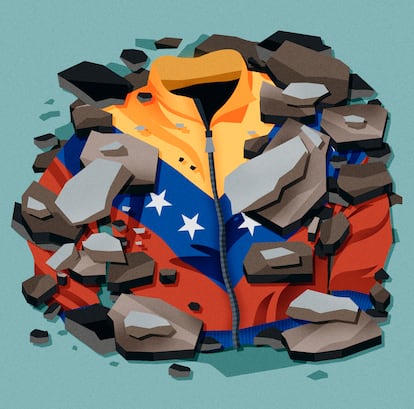
The result today is catastrophic. A kind of fall of the Berlin Wall for the Latin American left—and also for the left in several European countries. Maduro’s disrepute is so great that it has paralyzed action everywhere against the most serious, and unpunished, imperialist intervention of recent times.
The White House has made it explicit that it is implementing the “Trump corollary” of the Monroe Doctrine, which Secretary of State John Kerry declared concluded in 2013. This doctrine, conceived against the intervention of extra-continental powers at the end of the struggles for independence, would later justify, as Reginaldo Nasser wrote, outright interference in domestic affairs in the face of any threat or perceived threat to the security of the United States.
The “Trump corollary” now serves to blatantly defend U.S. interests and consolidate far-right forces in the region. Unlike the neoconservatives of the Bush era, Trump no longer speaks of democracy and human rights to justify his interventions. There is no hypocrisy in his speeches; it is naked imperialism that can go and kidnap Maduro, attempt to steal Greenland from Denmark, or declare that the United States will run Venezuela until there is a transition acceptable to him, and that U.S. oil companies will now be established there. Finally, why would a “lumpencapitalist” with autocratic tendencies in his own country, who despises and sabotages the multilateral order, try to impose democracy abroad? These policies have a chorus of support within the regional far right, which sees Trump, in many ways, as its “own” president. The most audible voice in that chorus is that of Argentina’s Javier Milei, who gets emotional almost to the point of tears, when he recounts his encounters with the New York tycoon.
The “poisonous stain” of Maduro now discredits anti-imperialist action, and, as with the fall of the Berlin Wall, the rubble falls on both those who supported Maduro and those who criticized him. Catastrophic crises pay no heed to “nuances”—they swing the pendulum to the opposite extreme. Today, that extreme is the reactionary wave sweeping the region, defining the new uphill political battleground on which the democratic left, weakened but not defeated, must operate.
Sign up for our weekly newsletter to get more English-language news coverage from EL PAÍS USA Edition









































