
From ‘Nazi’ to ‘moment for reflection’: Latin America’s left feels the blow of Kast’s victory in Chile
The leaders of Brazil, Mexico and Colombia have responded in very different ways to the return of the far right to the South American country, which held a runoff vote on Sunday
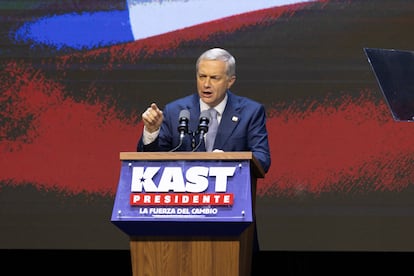
José Antonio Kast’s victory in Chile’s presidential election has come as a shock to Latin America’s left, but it has also revealed the different ways in which those in power are processing the blow. In Brazil, President Lula da Silva simply congratulated the representative of the Chilean far right, without offering any analysis or warnings. Mexican President Claudia Sheinbaum went a step further, calling on progressive movements to “reflect” on the reasons for this overwhelming victory. But it was Colombia’s Gustavo Petro who, once again, turned up the volume with an incendiary message: “It’s sad that Pinochet had to impose himself by force, but it’s even sadder now that the people are choosing their own Pinochet,” he wrote, alluding to the longtime dictator Augusto Pinochet (1973-1990).
The disparity in responses, to which Venezuela’s Nicolás Maduro added his voice on Monday night with references to Adolf Hitler and a warning —“Venezuelans must be respected, be careful”— stems not only from different styles but also from the strategic position each leader holds on the continent. Lula prioritizes dialogue over open confrontation, a strategy that has yielded very positive diplomatic results, even with his U.S. counterpart, Donald Trump. Last Friday, the White House removed Judge Alexandre de Moraes from the Magnitsky Act sanctions list, where he had been listed for months alongside a host of terrorists and drug traffickers. Days earlier, Trump had already eased tariffs on beef, coffee, and a large portion of Brazilian imports, which he had intended to impose to punish Lula for the coup trial against former president Jair Bolsonaro.
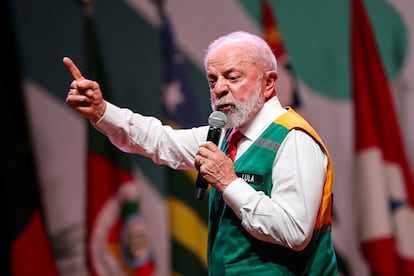
In the case of Chile, Lula shouldn’t have much to worry about, regardless of the government’s political affiliation. The strategy will be the same as with Argentina: distant, but with all communication channels open. Therefore, the Brazilian leader was quick to congratulate Kast, despite their ideological differences, emphasizing that the electoral process was “democratic, transparent, and orderly.”
Cumprimento @joseantoniokast por sua eleição à Presidência do Chile e o povo chileno pela sua participação em um processo eleitoral democrático, transparente e ordenado.
— Lula (@LulaOficial) December 15, 2025
Faço votos de pleno êxito ao presidente eleito no desempenho de seu futuro mandato.
Seguiremos…
Sheinbaum was also quick to post her congratulations on social media, though before mentioning Kast, she commended the Chilean people for conducting “a peaceful and democratic election.” The following day, at her morning press conference from the National Palace, she called for an analysis of the Chilean election results. “It was the people of Chile who chose who they want to govern them. I believe this is a moment for reflection for progressive movements in Latin America and why these circumstances arise,” she stated. She also dismissed the possibility of a shift to the far right spreading to Mexico, where Morena, her leftist party, enjoys strong popular support. “Here there is unity. Sometimes, when there is no unity within movements, this decrease in support occurs,” she concluded.
In any case, Lula and Sheinbaum chose to downplay an outcome that, while obviously uncomfortable for them, is no longer an anomaly on the regional stage. In recent months, Argentina, Bolivia, Paraguay, Ecuador, and now Chile have shifted toward the far right. Colombia’s Petro, on the other hand, is not afraid of ideological confrontation. Quite the contrary: he seeks it out, even if it provokes angry reactions, diplomatic tensions, and the indignation of his targets.
Chile’s response to Petro’s remarks about Pinochet was swift. Just hours after Petro’s tweet, Foreign Minister Alberto van Klaveren presented a note of protest to the Colombian ambassador in Chile. “His statements constitute a lack of respect and an improper interference in matters of internal politics,” which “not only denigrate the president-elect [José Antonio Kast] but also the sovereign decision of the Chilean people and the democratic strength of our institutions,” the foreign minister warned in a video.
In Kast’s case, Petro attacked the unabashed return of authoritarian rhetoric. “Fascism is advancing. I will never shake hands with a Nazi, nor with the son of a Nazi; they are death incarnate. It’s sad that Pinochet had to impose himself by force, but it’s even sadder now that people are choosing their own Pinochet: elected or not, they are children of Hitler, and Hitler kills people,” he posted on Monday morning on his X account, his main platform of communication for any domestic or international issue. The Colombian leader had publicly supported Chile’s left-wing candidate, the communist Jeannette Jara.
Sign up for our weekly newsletter to get more English-language news coverage from EL PAÍS USA Edition









































