
Delcy Rodríguez inherits a dying economy in Venezuela
The interim president faces the challenge of another inflationary storm in a country under sanctions and with limited access to credit
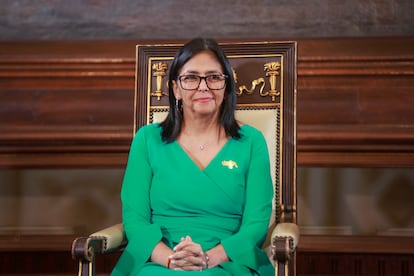
Delcy Rodríguez has assumed the reins of the Venezuelan state with an economy once again grappling with rampant inflation. The oil industry remains severely damaged by years of disastrous management. The country’s GDP has shrunk by 70% in the last decade, and the wage scale reflects the widespread impoverishment of the population.
Her rise to power, however, does not spell bad news for the local economic sectors. Before assuming the interim presidency, Rodríguez headed the Ministries of Economy and Finance, as well as Petroleum, all under the umbrella of the vice presidency. Without ever explicitly stating it, she was the first to acknowledge the failure of the interventionist model. To rectify the situation upon assuming her duties, she dispensed with the input of Venezuelan economists — almost all of whom were highly critical of Chavismo’s decisions in recent years — and turned to her friend and colleague Rafael Correa, the former president of Ecuador, who would ultimately recommend a team of advisors to implement a classic economic adjustment.
During Maduro’s years in power, there was virtually no economic spokesperson within the Cabinet. Rodríguez, with her advisors, managed the situation behind closed doors. The Central Bank of Venezuela stopped providing details about the alarming figures for the national economy.
From that moment on, the Maduro government began discreetly returning assets expropriated from business owners and industrialists during the Chávez era (almost all of whom were bankrupt and ruined). Excessive bureaucratic oversight of the economic apparatus was relaxed and eventually eliminated. Exchange controls were abolished, and the dollar entered the economy. Military takeovers of companies ceased. Hostility toward private property ended. The government and the business federation Fedecámaras — which Maduro had called “the parasitic bourgeoisie” in 2013 — made peace. Forced and unilateral wage increases were halted.
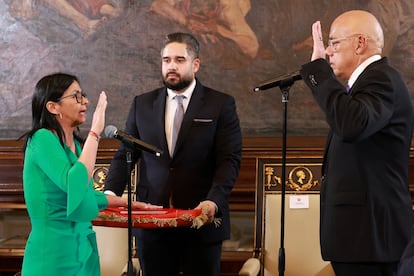
The modest recovery of the Venezuelan economy in recent years — let’s say, from 2022 onward — is related to Rodríguez’s influence. Within the revolutionary ranks, she has been one of those responsible for the opening to a market economy promoted by the Maduro government in 2019, after years of state intervention, a time when the national economic collapse had reached its nadir; all the nation’s assets, including Petróleos de Venezuela (PDVSA), had been bankrupted; and there was very little left to expropriate.
Rodríguez has been the Maduro government’s primary interlocutor with Venezuelan capital remaining in the country, with whom she has identified areas of collaboration, alliances, and shared interests over the years. She is also credited with the recovery of the country’s oil production, which technically reached zero — 300,000 barrels per day — in 2016, and now averages 1.1 million barrels (in its heyday, Venezuela produced more than three million barrels of oil per day).
In 2025, Venezuela experienced a five-point increase in GDP. Such a performance would be excellent anywhere in the world, but not in Venezuela, a country that would need double-digit growth figures for several consecutive years to recover its traditional economic size.
Economist José Guerra, a professor at the Central University of Venezuela and an opposition member of parliament, estimated a fiscal deficit of 8% of GDP and inflation exceeding 620% in 2024. “There is enormous exchange rate instability; the gap between the official and parallel exchange rates is over 100 percent. The currency is devaluing daily. If nothing is done, we are headed for another hyperinflation. The political crisis complicates the design of solutions,” he warns.
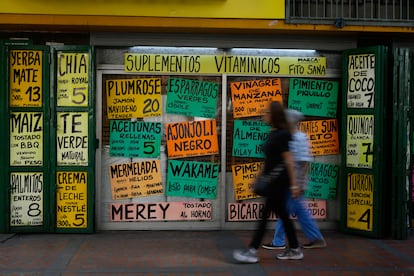
Venezuelan inflation is worsening due to fiscal problems and negative market expectations in the face of the political situation. International sanctions against the Chavista regime are hindering the day-to-day management of the economy and depriving authorities of the tools they need to address the economic emergency.
Experts on this subject agree: trapped in the labyrinth of Chavista hegemony, Venezuela faces a very clear ceiling on its economic recovery. Sanctioned and indebted to alarming levels due to past economic mismanagement, the Venezuelan state currently has no access to international credit or loans from multilateral organizations. Disinvestment levels are high. The Chinese government, once a very generous lender, has refused to renew loans, displeased with the Maduro government’s disastrous handling of those resources during the currency crisis.
It is highly likely that Rodríguez will do everything possible to appease Donald Trump, offering him advantages for oil exploitation and accepting some of his demands (always without relinquishing the Bolivarian Revolution’s control over power). There will also likely be a thorough search for new investments abroad, operating under market rules, and new projects with the local private sector. It remains to be seen whether the country will be able to reconnect with Russia and China (the former, its military advisor and protector; the latter its economic partner) as it has done in the past to secure new projects.
The fog is thick over Venezuela’s immediate future. Political uncertainty is total. Trump and Rodríguez, each in their own way, are speaking of two different realities when they refer to Venezuela’s immediate future. Rodríguez is forced to accept Trump’s presence and to adopt a conciliatory tone toward Washington after U.S. forces invaded the country and kidnapped Maduro in a commando operation. Amid this blind spot, a general feeling is emerging within Venezuela: things could get a little worse.
Sign up for our weekly newsletter to get more English-language news coverage from EL PAÍS USA Edition









































