
Chavismo factions divide presidency of the new Venezuela
The pragmatists negotiating with the United States after Maduro’s fall are now dealing with the most loyal and militaristic Chavistas
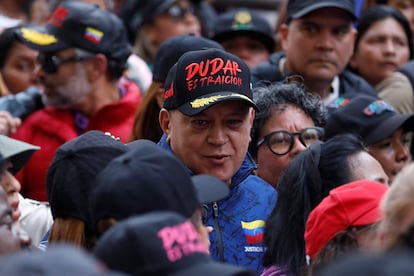
Chavismo is a movement of photos and icons, and on Monday it didn’t miss a fresh opportunity. On the day Delcy Rodríguez was sworn in as interim president of Venezuela and Jorge Rodríguez as president of the National Assembly — the day executive and legislative power fell into the hands of the siblings — the third wheel, Diosdado Cabello, appeared with a furrowed brow and a somber expression that did not go unnoticed by the photographers and television cameras covering the ceremony. Cabello, the visible head of what is considered the Chavista military wing, listened with a circumspect air to the heartfelt speeches from the podium during what seemed more like a austere ceremony than the inauguration of a new president.
Shortly beforehand, the Miraflores press team distributed a photograph of the Cabinet in which Delcy Rodríguez appeared presiding over a table, accompanied by the key figures in her government. To the right was the head of the army, Vladimir Padrino López, and to the left, Cabello, wearing a cap with the slogan “To doubt is treason” written on it.
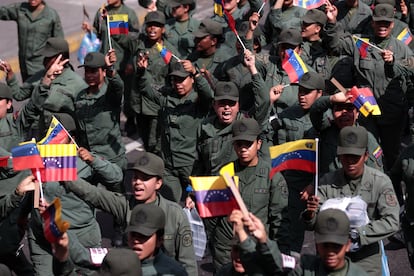
To the repertoire of classic Chavista icons — the images of Simón Bolívar and Hugo Chávez — was now added another: a photograph of Nicolás Maduro and Cilia Flores holding hands. Lest there be any doubt about the role each would play from now on, Cabello led a march through the streets that evening, accompanied by a small army of uniformed men who, rifles in hand, vowed to defend the homeland and guarantee the safety of its people. The message was clear: in the face of the technocratic backroom deals, the power of the guns remained in Cabello’s hands.
During the video, Cabello omitted any “joint cooperation” agreement and described any negotiation with Washington as “treason against the homeland,” assuring that the revolutionary forces and collectives would remain in the streets to defend territorial sovereignty against what he called the “invasion of the empire.”
Within hours, the two main branches of Chavismo — represented by the Rodríguez siblings and by Cabello and Padrino López — became so obvious that when gunfire occurred near the presidential palace at midnight against unidentified drones, the rumor quickly spread that this was not a new attack by the United States but the beginning of a coup d’état by Cabello against the new interim president.
Although both factions of Chavismo have staged rapprochements, the tensions on display are a reflection of a confrontation that began long before. Just as Hugo Chávez chose Nicolás Maduro — not Cabello — as his successor before his death, this time the United States has chosen Delcy Rodríguez, not him, to lead a strange transition in which everyone is keeping a close eye on each other. Some are seen as proponents of compromise, others as militarists; the two blocs have been defined, even if for the moment they are expressed only through images and gestures.
Following Maduro’s capture, the reconfiguration of territorial control in Caracas has been accompanied by the deployment of paramilitary groups, the infamous “motorcyclists,” who have assumed a central role in controlling the city. Armed and masked, they have been deployed in working-class neighborhoods of the capital such as Petare and Catia to prevent any movement in the streets.
Many Venezuelans who voted overwhelmingly against Maduro in 2024 haven’t even been able to celebrate the news they’ve been waiting for for years. Videos circulating show hundreds of men dressed in black, armed with pistols, shotguns, and rifles, stationed on street corners, patrolling the streets on motorcycles, and establishing informal controls over residents and businesses, even imposing closing times and restricting nighttime movement. They all operate under Cabello’s iron fist. They have at their disposal an article added at the 11th hour to the state of emergency decree, which orders “the immediate search and capture throughout the national territory of any person involved in promoting or supporting the armed attack by the United States.” This has provoked concern among human rights organizations and directly contradicts Delcy Rodríguez’s announcement of “working jointly with the United States.”
But the differences between the factions extend beyond what happens at home, to what occurs beyond their borders. After Maduro’s capture, when Venezuela and the world awoke to the news that he was on a U.S. Navy vessel en route to a New York court, Bolivarian diplomacy remained silent, awaiting instructions on what to say. Only one person — Glenna del Valle Cabello, Diosdado’s sister and consul in Bilbao — held a rally in the streets. “We do not accept what Trump has said, whom I don’t want to call president, but murderer. We govern ourselves. Venezuela belongs to Venezuelans, both its resources and its people,” she said.
The internal power struggle between those who accept Trump’s interventionism and the militaristic bloc was resolved in favor of the former during the ceremony at the National Assembly, where Delcy Rodríguez and her brother were sworn in on the Bible. Cabello wanted to return to the forefront of politics, but Washington would have interpreted it as a challenge by the Interior Minister — who has a $25 million reward on his head and has been linked to the Cartel of the Suns — to take the reins of the legislature. Adding to the consolidation of power for the Rodríguez siblings is Trump’s decision to give White House Deputy Chief of Staff Stephen Miller a prominent role in overseeing post-Maduro operations.
Miller, considered one of the most hardline figures in the U.S. administration, has spoken positively of the siblings, saying that so far the White House is receiving “full, complete, and total cooperation” from the government in Caracas led by Delcy Rodríguez. Cabello responded to these statements with personal attacks against the transition team appointed by Trump, specifically pointing to Miller and Marco Rubio as “21st-century pirates” whose sole interest is the plundering of the country’s oil and mineral resources.
In a defiant tone, he warned that U.S. military control over the coasts is a “criminal act of war” and called on the Bolivarian National Armed Forces (FANB) not to surrender, even though they have captured Maduro. This cooperation, which irritates Cabello, is part of another of Trump’s announcements concerning political prisoners. Trump said Tuesday that Delcy Rodríguez is proceeding with the closure of a punishment center in the heart of Caracas. During a party event, he asserted that Chavismo operated “a torture chamber in the middle of Caracas that they’re closing up,” referring to the facilities where political prisoners are detained, although he did not directly mention El Helicoide, a prison under Cabello’s control.
Adding further salt to the wound of distrust that has taken root within Chavismo and the factions that comprise it, where each side looks askance at the others, are the words of Nicolás Maduro Guerra. The son of Nicolás Maduro, sobbing, was the first to speak of betrayal after his father’s capture: “History will tell who the traitors were, history will reveal it. We shall see.”
Sign up for our weekly newsletter to get more English-language news coverage from EL PAÍS USA Edition









































