
Ricardo Hausmann: ‘If Trump does not facilitate the transition to democracy, we will have to oppose his strategy’
The Venezuelan economist and former minister rules out any possibility of recovery or revival of the oil sector without the restoration of citizens’ rights
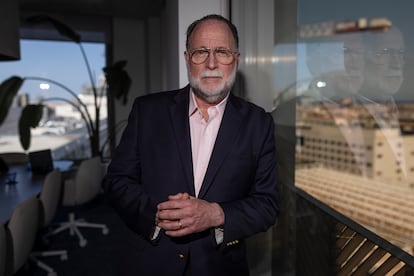

Like many Venezuelans, Ricardo Hausmann’s celebration over Nicolás Maduro’s fall was short‑lived. Hausmann, 69, one of the region’s most prominent economists and a leading voice of the Venezuelan exile community in the United States, has been watching events unfold with caution from Boston, where he has directed Harvard University’s Center for International Development for more than two decades and teaches at the Kennedy School of Government. Since the early hours of January 3, when the pieces on Venezuela’s political chessboard shifted in an unexpected way, he has cautiously followed the rapid chain of developments in his home country.
“These days began with immense joy and have gradually turned into days of great concern,” says Hausmann in a video call with EL PAÍS. “All of this has made me think about what the next steps will be for the diaspora and the democratic movement to confront this situation, because it would be a mistake to believe that we can remain passive in the face of Trump’s plans.”
The former minister does not consider Washington’s strategy toward Venezuela entirely misguided, but he does describe it as unpredictable. “Donald Trump told The New York Times that the only limit on his actions abroad would be his own moral compass, not any international law. The problem with that is that if he does whatever he wants, his behavior cannot be predicted. When this country liberated Europe, it had an ethic that guided it. Not anymore. This government has a predatory narrative. That means we all have to manage that risk. And I don’t think the way to do that is simply to pray for Trump’s goodwill or trust him blindly,” he says
Question. How did you view the first meeting between President Trump and María Corina Machado?
Answer. María Corina has had to skillfully manage Trump’s pathological narcissism. He’s obsessed with the Nobel Prize and believes he deserves it because he “stopped eight wars.” María Corina is noble enough to try to remove that issue from the discussion so it doesn’t become an obstacle to Venezuelan democracy. Trump loves flattery, but he doesn’t respect those who flatter him. He only understands transactions, and María Corina is the leader of a crucial political movement. In Trump’s attempt to steer the situation in Venezuela, it is in his interest to have her on his side rather than opposing him. Whether she gets a seat at the table in this transition process will depend on that.
Q. What if they don’t give it to her?
A. Inevitably, she will have to distance herself to defend the political interests of her movement. I think that at this moment, she has been very useful to Trump. I hope that Trump will also be useful to the democratic movement, although the scenario is still unclear.
Q. One of Machado’s points of negotiation with the White House is her return to Venezuela.
A. If María Corina can’t return, who can? If the United States doesn’t get Delcy Rodríguez to release the political prisoners and allow the return of the exiles, there will be no economic recovery. It’s very important that the Trump administration demonstrate that it can change things within the country. They haven’t been able to get out [Interior Minister] Diosdado Cabello, who was included in the same indictment as Nicolás Maduro. Nor have they been able to get out [Defense Minister] Vladimir Padrino López. There are hundreds of military personnel imprisoned on the orders of Cabello, who controls the armed wing of Chavismo. Delcy hasn’t been able to get him out either, but the day he feels like it, Diosdado can get her out. We’re in a very strange situation of governance within Venezuela, where the cash flow — which comes from oil — is administered by Trump. He says Delcy is doing everything they ask of her, and I find that interesting, because if political prisoners aren’t released in the next few days, those prisoners will effectively become Trump’s responsibility.
Q. Why does Washington still refuse to prioritize the democratic path?
A. Trump believes he has timelines that are not in the Constitution. The Constitution clearly states that when there is an absolute absence of the president, elections must be called within 30 days. And when the absence is not absolute, he can be given 90 days to see if he reappears, and up to another 90 days. But within 180 days, elections must be held, no matter what. Those are not Trump’s timelines. The White House is acting outside any constitutional framework — exactly what Maduro used to do. Serious companies will not want to invest in oil until there is legality. Perhaps it will be easier for them to concentrate production in [Venezuela’s state-owned oil company] PDVSA so the government can earn money from the cash flow, but that will significantly slow down the recovery of production.
Q. The demand for legality made by companies like ExxonMobil before reinvesting in Venezuela aligns with the national interest in a democratic transition.
A. Oil companies want to operate in a country with the rule of law. The current hydrocarbons law makes Venezuela uninvestable. Delcy has already announced that it will be amended, but who will do it — an illegitimate National Assembly that no one recognizes? That’s not credible. If the aircraft carrier and everything else the United States has deployed in the Caribbean aren’t enough to remove Diosdado, it seems to me that this is a sign the regime is simply waiting for Trump to get distracted and shift priorities so they can remain entrenched in power. I don’t see U.S. pressure to lead a negotiation toward a political pact in the country, though I acknowledge that very few days have passed.
Q. You were a minister in the 1990s, just as Panama was going through a transition after Noriega’s capture. What lesson can be drawn from that U.S. intervention?
A. Guillermo Endara had won the election and, after Noriega was removed, the Americans installed him in power. Something similar could have happened in Venezuela with Edmundo González Urrutia, but the Trump administration chose not to do it, and we still don’t know how far‑reaching that decision will be. If Trump does not facilitate the transition to democracy, Venezuelans will have no choice but to oppose this strategy sooner rather than later. Only through that pressure will we be able to steer events in the direction we want.
Q. In 2018, you told EL PAÍS that countries that collapse the way Venezuela did never recover in less than a decade. Do you still stand by that?
A. We need to distinguish between trend and level. Venezuela was four times richer the day Maduro came to power [in April 2013] than it is today. GDP fell by 75%, which means that to get back to where we were, the economy would have to quadruple in size. That will take more than a decade because of the massive emigration. The human capital the country once had is no longer there, and we’ve spent eight years depreciating our institutional physical capital without replacing it. There is a huge amount of work to do, but Venezuela’s recovery depends, without question, on the return of its diaspora. Yet if we remain a country where, for example, journalists cannot publish that María Corina Machado won the Nobel Peace Prize, everything suggests people cannot return. The return of the diaspora is conditioned on the restoration of rights; without those, there will be no strong recovery.
Q. So Venezuela’s future doesn’t depend solely on reviving the oil sector?
A. Let me put it this way. When I was born [in 1956], Venezuela produced three million barrels of oil a day. Now it produces less than one million, and back then we had seven million inhabitants. Today, counting the diaspora, we are around 35 million. That means the population is five times what it was when I was born, but with only a third of the oil production of that time — 21 fewer barrels per capita than in the 1950s. If you want to create prosperity, no matter how much you recover the oil sector, we are now far bigger than that.
Venezuela has about 12 million hectares of good farmland, and only 300,000 are currently being used. We have the best hydroelectric river in the world, and we’re not harnessing that power. Our tourism potential is absolutely phenomenal, and we’re doing nothing with it. We also have a highly connected diaspora capable of integrating the country into the worlds of software, artificial intelligence, and new industries. If we truly want to inspire Venezuelans, we need to draw a future much larger than oil. The country’s recovery will require billions, and that will come hand in hand with restructuring.
Q. Do you feel optimistic about what comes next?
A. This is not the time to let our guard down. That would be dangerous. We need to make the issue of our rights and freedoms a political priority in the United States. It also needs to be part of the debates and negotiations between the U.S. and Europe. Europeans are in a moment of great weakness; they have avoided clashing with the Americans over the war in Ukraine. Venezuela has $5 billion at the International Monetary Fund, and Europe could deny Delcy Rodríguez’s government access to those funds. To achieve that, we need to build an international pro‑democracy coalition for Venezuela. The Democratic Party should take up that cause, because if Trump loses the November midterm elections, there will be greater democratic oversight of his actions. We’re going to have to keep fighting. This match is far from won.
Sign up for our weekly newsletter to get more English-language news coverage from EL PAÍS USA Edition









































