
Juan Barreto: ‘Those in power in Venezuela must take the first steps toward a national agreement’
The Chavista politician, estranged from the government, asserts that the country is caught between redemocratization and the loss of its sovereignty
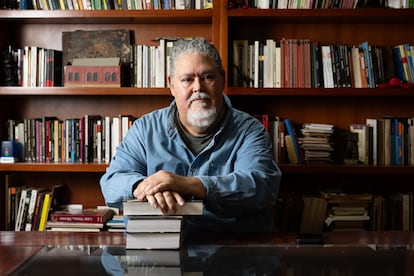

On January 3, former Chavista deputy Juan Barreto spent the day in darkness. After a powerful explosion, the neighborhood where he lives in Caracas was left without electricity, as frequently happens due to the deterioration of public services. Like many Caracas residents, he also heard the metallic drone of airplanes. “It was like a pressure cooker, with very high-pitched cicadas and crickets hitting your ears. There was a smell of smoke, on a very clear night, with a very clear sky and a full moon,” he recalls of that early morning that changed the political landscape in Venezuela.
After the initial anguish following the U.S. military attack, Barreto asserts that the country faces an enormous threat — the loss of its sovereignty — and, simultaneously, a significant opportunity: redemocratization. A leader within the Chavista movement, but estranged from the government for years due to his criticism of Nicolás Maduro, he considers the situation following the U.S. military intervention, which resulted in the capture and extraction of Maduro and his wife, Cilia Flores, to be deeply concerning.
Barreto had hidden away from public life for months, in forced seclusion after the crisis and repression unleashed after the 2024 presidential elections. Like other politicians critical of the regime, he suffered harassment from the security forces at his doorstep.
During the first prisoner releases following the forced change of leadership within Chavismo, Barreto reappeared in public. He was seen in a video released when security agents freed former presidential candidate Enrique Márquez in a Caracas neighborhood after a year in prison. Barreto gave him one of the first hugs he received upon his release. They have been friends for over 40 years, even during periods when they were politically opposed. Barreto supported Márquez’s 2024 presidential candidacy and today is demanding his full freedom.
“We are in a new situation, a new stage characterized by threats and challenges that can become opportunities,” the politician, journalist, and former mayor of Bogotá during Hugo Chávez’s presidency told EL PAÍS. He warned that the first move must come from those currently in power: “They are the ones who have to make the first decisions and take the first steps to build the conditions for a grand national agreement that will lead to a transition, to the reinstitutionalization of the country, and to a return to the Constitution.”
Barreto maintains that, beyond his differences with Maduro, his “kidnapping is unacceptable” because it violates international law. “This turns the planet into a lawless land, with a gunman on the loose,” he states. At the same time, he offers some nuance regarding the path that led to this predicament. “Nicolás Maduro could have taken action and didn’t; the opposition was excessively radical. That weakened the possibility of a national unity movement. It’s never too late, but now it’s urgent.”
Without Maduro, he asserts, those who remain in power have an opportunity to break the country’s deadlock. “Today we see that, thanks to Bolivarian diplomacy — as Delcy Rodríguez has stated — embassies are reopening. But let’s finish opening the prisons. Let’s open the media and the political parties that have been taken over. Let this be a true political opening for a country that has long desired change.”
He summarizes it with a popular saying: “Let this not be light on the outside and darkness on the inside. Let it not be a moment to buy time with cosmetic, superficial changes, where everything changes so that nothing really changes.” In his opinion, the first signs given by the interim president, Delcy Rodríguez, have been positive, although he warns that the process is only just beginning.
Barreto points out that it is Rodríguez who faces the challenge of preparing the conditions “so that at some point a general election can be called that will allow Venezuelans to come together again.” For the politician, a shift in the repressive policies that some sectors of the government have turned into a “comfort zone” is also essential. “We’ve been at this for 26 years, and I’ve been part of that confrontation. I’m coming back from that experience, and also from my own mistakes,” he says. “Pragmatism cannot be interpreted as ‘every man for himself’ or as an accommodating adaptation. It must be guided by principles enshrined in the Constitution.”
Sign up for our weekly newsletter to get more English-language news coverage from EL PAÍS USA Edition









































