
Maduro faces a legal ordeal while he waits in the prison known as ‘hell on earth’
The former president of Venezuela awaits trial in New York, where he is expected to argue that international law was violated and that diplomatic immunity must be respected
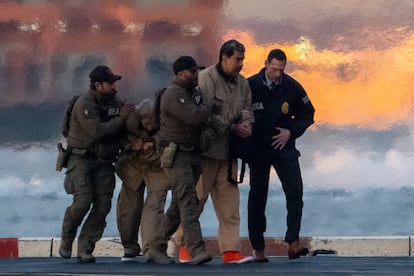

Nicolás Maduro has gone from sleeping in the Casa de Los Pinos, a fortified palace in Caracas, to sleeping on a metal cot, covered with a wool mattress, at the Metropolitan Detention Center (MDC) in Brooklyn. It is one of the worst prisons in New York, known as “hell on earth.” It is there that he awaits trial for narcoterrorism offenses. The ousted president of Venezuela was captured along with his wife, Cilia Flores, by a U.S. special forces unit that transferred them to New York. Attorney General Pam Bondi released the indictment that same day, charging him with four offenses related to narcoterrorism and possession of machine guns. He is accused of conspiring and devising a plan with high-ranking officials in his government to flood the United States with cocaine.
The leader of the Chavista regime faces a legal ordeal that could last for more than two years. The couple faces severe penalties, including life imprisonment. Their lawyers will attempt to overturn the arrest by invoking international law, defending their diplomatic immunity, challenging evidence, and contesting the proceedings. The case against Maduro is poised to be one of the trials of the century in the United States due to its complexity and media attention.
The first episode of the soap opera that the case threatens to become unfolded last Monday. The Latin American leader, heavily escorted by police officers and DEA agents, arrived at the Daniel Patrick Moynihan Courthouse, the building that houses the Southern District Court of New York, for his first court appearance.
There, amid great anticipation, he appeared before Judge Alvin Hellerstein, a 92-year-old magistrate with extensive experience in high-profile cases. Maduro, 63, pleaded not guilty. Seemingly relaxed and calm, even smiling, he proclaimed through a translator: “I am innocent. I am not guilty. I am a decent man. I am still the president of my country.” “I was captured at my home in Caracas, Venezuela,” he stated. “I am the president of Venezuela, and I am being held hostage here,” he insisted before being interrupted by the judge. His wife, visibly bruised and with some serious injuries after their abrupt capture as they tried to flee their shelter during the attack by the elite U.S. military unit, echoed this sentiment: “I am the First Lady of the Republic of Venezuela.”
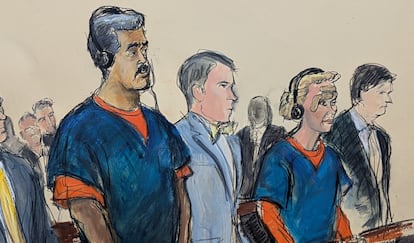
These brief testimonies constitute the first line of defense. His lawyer, a tenacious and tough Washington jurist nicknamed “The Pitbull,” is Barry Pollack, known for his skill in securing the release of Julian Assange, the co-founder of WikiLeaks, the platform responsible for the largest leak of classified files in recent history. Pollack, who has already begun to question the suitability of some members of the prosecution, plans to begin his work with two lines of defense: first, that Maduro’s arrest was illegal because it violates international law; and second, that he has immunity as president of Venezuela.
During the hearing, Pollack raised questions about the “legality of his military abduction,” a point Maduro emphasized as a line of defense. That same day, several countries protested the military action at the UN Security Council. “The U.S. operation in Venezuela is clearly illegal, and it will be crucial for the international community to recognize it as such and for the United States to be held accountable. Otherwise, the credibility of the international ecosystem will be seriously undermined,” stated Marc Weller, Professor of International Law at the University of Cambridge.
The Trump administration, however, maintains that it was a law enforcement operation that required military intervention in a foreign country. Secretary of State Marco Rubio argued: “Essentially, this was the arrest of two fugitives wanted by U.S. justice, and the Department of Defense supported the Department of Justice in that.”
Matthew C. Waxman, a senior fellow at the Council on Foreign Relations (CFR), a nonpartisan U.S. think tank, says: “Once he’s in U.S. custody, the international legality of his detention won’t matter much for prosecution. Maduro will keep raising this issue, but I doubt he’ll get anywhere.”
“It’s quite obvious that, to obtain immunity, you need to be a diplomatically recognized head of state,” Dick Gregorie, a federal prosecutor in Miami, explained to CNN. Maduro is considered an illegitimate president by U.S. authorities after failing to demonstrate his victory in the 2024 elections. The electoral records compiled by the opposition declared Edmundo González Urrutia the winner, backed by opposition leader María Corina Machado, who had been barred from holding office.
There is also a precedent that could support the White House’s position: the case of Panamanian dictator Manuel Antonio Noriega, arrested in 1990, also on January 3, like Maduro, and tried in a Miami court on drug trafficking charges. The two cases share many parallels. Noriega’s lawyers also unsuccessfully attempted to appeal to international law. The Panamanian dictator was sentenced to 40 years in prison, although he was extradited to France to serve the final years of his sentence there.
Gregorie worked on the formal prosecution in Noriega’s case. He recalls that one of the defense strategies, which he suspects will be replicated in Maduro’s case, is to demand the release of evidence and details of Maduro’s high-level relationship with Washington. Classified information threatens to delay the proceedings for months.
Judge Hellerstein has scheduled the next hearing for mid-March. It is expected that the validity of the evidence on which the Justice Department has based its case will be debated then. Some analysts suggest that the administration may have gathered potentially incriminating evidence and testimony from other legal proceedings. The nephews of Cilia Flores, Maduro’s wife, have been prosecuted for drug trafficking in the United States. This is the same crime for which the former head of the Chavista regime’s intelligence services, Hugo Armando “El Pollo” Carvajal, was convicted. He pleaded guilty after deciding to cooperate with U.S. authorities. He was tried in the same New York court where Maduro’s case is being heard.
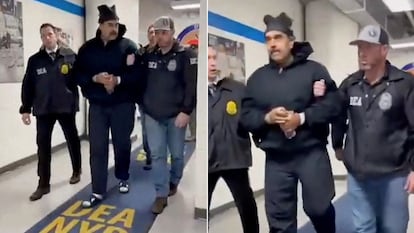
The politician who started out as a bus driver in Venezuela faces four charges: conspiracy to commit narcoterrorism, conspiracy to import cocaine into the U.S., and possession of machine guns and destructive devices, as well as conspiracy to acquire those weapons. Conspiracy cases are often more difficult to prosecute due to the complexity of presenting evidence, compared to other types of crimes that are more straightforward. It remains to be seen whether the case will ultimately go to trial or whether a plea bargain will be negotiated in exchange for a reduced sentence and extradition to another country, as happened with Noriega.
The Justice Department’s indictment includes precise details. It alleges that Maduro used the Venezuelan Embassy in Mexico to facilitate the return of cocaine proceeds. The more detailed indictment describes how, between 2006 and 2008, Maduro sold diplomatic passports to criminals so they could transfer drug trafficking proceeds from Mexico to Caracas. It asserts that the defendants conspired with “narcotics traffickers and narco-terrorist groups to ship processed cocaine from Venezuela to the United States via Honduras, Guatemala, and Mexico,” utilizing Mexicans because of their control of the routes and their expertise in smuggling the drug across the border.
The hearing in March is also expected to begin clarifying the lawyers’ lines of defense.
The prison where Maduro is being held is known as “hell on earth.” Drugs are rampant, fights between inmates are frequent, and complaints about the conditions, including frequent power outages and filth, are commonplace. He shares the prison with 1,300 other inmates in an overcrowded facility. Advocates often complain about the dangers faced by prisoners in this jail, which they describe as inhumane. For security reasons, Maduro is in a separate unit, isolated from the general prison population.
“Until U.S. courts determine the legality of the raid [on Maduro’s residence], criticism that it was illegal is opinion, not fact. An additional benefit of prosecuting Maduro is that these arguments will be heard in court. Given the gravity and constitutional nature of many of the legal issues at stake, the case will end up in the Supreme Court. That process could take years,” says Mark F. Cancian, an analyst at the Center for Strategic and International Studies (CSIS).
Sign up for our weekly newsletter to get more English-language news coverage from EL PAÍS USA Edition









































