
Former Venezuelan intelligence chief pleads guilty to four charges in the United States
Hugo ‘El Pollo’ Carvajal, who broke with Nicolás Maduro in 2019, is accused of drug trafficking and narco-terrorism, and could face a life sentence
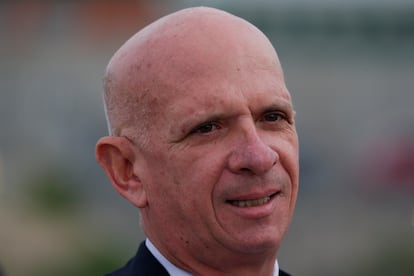
Hugo “El Pollo” Carvajal, retired military officer, former congressman, and former head of intelligence for the Chavista regime, has pleaded “guilty” to four charges related to drug trafficking and narco-terrorism in a U.S. federal court in New York City.
The former official, who has agreed to cooperate with authorities, faces a potential life sentence in the worst-case scenario. Sentencing is scheduled for October 29. “The deeply troubling reality is that there are powerful foreign government officials who conspire to flood the United States with drugs that kill and debilitate,” said Acting U.S. Attorney Jay Clayton in Manhattan.
Carvajal, 65, was head of the then Military Intelligence Directorate (DIM) from 2004 to 2011 under the Hugo Chávez government and wielded considerable power. He had been under U.S. indictment for years, facing charges of conspiring to import cocaine into the country, as well as offenses related to weapons possession and ties with Colombian guerrilla groups.
In 2014, Carvajal — who at the time had diplomatic immunity — was arrested in Aruba by U.S. security forces, causing a major stir and prompting a strong protest from the Venezuelan government, of which he was still a part. He was released shortly afterward.
Once a trusted insider at the presidential palace, Carvajal’s militant enthusiasm began to wane after Chávez’s death and Nicolás Maduro’s rise to power, just before Venezuela plunged into a severe economic and inflationary crisis. He was elected to the National Assembly on the United Socialist Party of Venezuela (PSUV) party list in 2015.
As a legislator, he maintained a low public profile, and his stance toward the opposition and anti-Chavista critics began to soften. During the large-scale anti-government protests in Venezuela between March and July 2017, Carvajal permanently broke with his former allies.
He blamed Maduro for the deaths of hundreds of student protesters that year, as well as for the widespread shortages of food and medicine. In 2019, Carvajal even recognized the interim government of Juan Guaidó as the legitimate representative of Venezuela’s democratic cause.
The Chavista leadership, which had previously stood by Carvajal, suddenly severed ties with him and labeled him a traitor. They distanced themselves entirely.
Diosdado Cabello, current Minister of Interior and Justice and the second-most powerful figure in the ruling party, condemned his former ally harshly when the political break occurred. “He was elected congressman with our votes, and he ended up betraying the homeland,” Cabello said in 2021. “He had a very expensive residence in Madrid. They don’t just become traitors — they become scoundrels. We’ve withstood all the attacks against us because we have values. Some forget their values, surrender to imperialism, and betray a cause, a movement.”
Carvajal, who has also been accused of conspiring with members of the now-defunct Revolutionary Armed Forces of Colombia (FARC) to traffic weapons and drugs, was arrested in Spain in 2021 at the request of the United States. He had been on the run and living underground for more than two years. He was finally extradited to the U.S. in 2023.
A statement from the U.S. Department of Justice said that Carvajal, along with other allied officials, “abused the Venezuelan people and corrupted the legitimate institutions of Venezuela [...] to facilitate the importation of tons of cocaine into the United States.”
Sign up for our weekly newsletter to get more English-language news coverage from EL PAÍS USA Edition









































