
Venezuela opens up to the world
After years of clashes and ruptures, Chavismo seeks to rebuild relations with dozens of countries
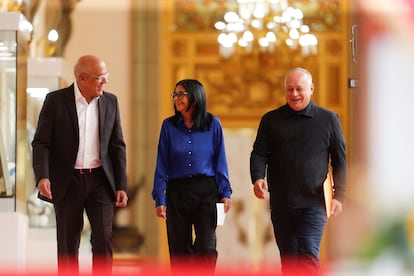
Just a few weeks ago, the scene would have been unthinkable. The German ambassador, Völker Pellet, shook hands with Interior Minister Diosdado Cabello at the Miraflores presidential palace. A month earlier, Cabello, one of Chavismo’s strongmen, had dedicated part of his television program, where he usually ridicules and threatens those he considers adversaries, to the German diplomat. He said he had seen him “taking it easy” in Caracas and showed photos from his social media accounts of him walking around Waraira Repano, the Ávila mountain that dominates the city, to mock Berlin’s warning about the risks of traveling to Venezuela in the midst of escalating tensions with Washington. Today, that same ambassador is being officially received in the heart of Chavista power.
Just a year ago, Venezuela was expelling diplomats. Today, it welcomes them into the presidential palace. Something has shifted since the attack on January 3 and the capture of Nicolás Maduro. After years of broken relations, accusations of interference, and clashes with much of the world, Chavismo is looking outward. “Venezuela is opening itself to a new political moment, one that allows for understanding despite political and ideological differences,” said the country’s interim president, Delcy Rodríguez.
The speed has been surprising. In just a few days, Rodríguez activated an agenda that no one expected so soon: calls to international leaders, promises of official trips, meetings with ambassadors, and messages of reopening. “There is a lot of hope that this new stage will change the paradigm and [Venezuela will] open up to the world,” says a high-ranking European diplomatic source. “That is why, despite everything, we continue talking.”
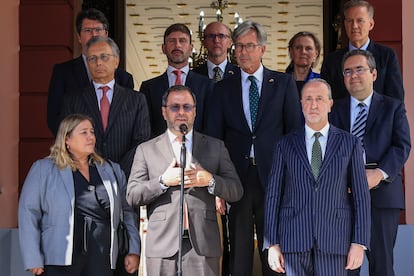
Just nine days after the U.S. operation that landed Maduro and his wife, Cilia Flores, in a New York jail, representatives from the European Union, the United Kingdom, and Switzerland traveled to Caracas for a meeting convened by Rodríguez. Following the meeting, the president wrote on Instagram that Venezuela had “the firm will to advance an agenda of international relations.” Meanwhile, the Venezuelan government began preparations to reopen its embassy in the United States and explore the return of the U.S. mission to Caracas, which has been closed since 2019. Envoys from both countries have been traveling back and forth in recent days, something that would have been scarcely possible until very recently.
For years, every internal political crisis ended up translating into a diplomatic clash. Europe, Latin America, and the United States were all, at different times, the adversary. There were expulsions, withdrawals of ambassadors, and even restrictions on the movements of diplomats. Isolation ceased to be exceptional. “We are coming out of a period of widespread cooling,” explains a diplomatic source from a European country that withdrew its ambassador from Caracas. “The EU did not recognize the last elections or Maduro’s victory, and there was anger over the political repression. And we have always been consistent: we do not sympathize with any dictatorship.”
The archives are full of references to diplomatic crises, some more serious than others. In 2019, when more than 50 countries recognized Juan Guaidó as interim president, several states cooled relations or closed their embassies. The United States shuttered its mission, leaving hundreds of thousands of exiled Venezuelans in limbo without consular representation in the countries to which they had emigrated. Diplomats stopped attending official events. Chavismo stopped attending state receptions. Direct channels of communication were severed. The world became inaccessible to Venezuela.
For many ambassadors, daily dealings with those in power became a barrier. Even mediating the release of detained foreign citizens or providing basic consular assistance became dependent on subtle diplomacy, conducted through unofficial channels. At the same time, several diplomatic missions played a part in the country’s recent history. Since 2017, some diplomatic buildings have served as refuge for opposition leaders. The Chilean ambassador’s residence sheltered as many as six, including Freddy Guevara, who spent three years there before leaving the country after negotiations with the government.
The most delicate episode unfolded at the Spanish embassy. In April 2019, opposition leader Leopoldo López escaped house arrest and sought refuge in the residence of the ambassador, Jesús Silva — who passed away last year — and who, during his mission, attempted to mediate between the Chavista regime and the opposition. López remained there for over a year and became the elephant in the room of bilateral relations. Intelligence services maintained constant surveillance of the residence in the Caracas Country Club. Even so, López managed to flee into exile in Spain with the direct assistance of the ambassador and his family.
Over time, and after several stability crises that tested Chavismo, European diplomacy began to seek ways to navigate Maduro’s entrenched position. The decision by the 27 EU member states to maintain only chargés d’affaires — a way of diminishing political recognition — began to lose its effectiveness around 2022, when the opposition was once again decapitated by repression. By then, Maduro had already expelled the European Union ambassador with a 72-hour ultimatum. Even so, Portugal took the first step and presented its credentials. There was a handshake after years of avoiding them. Then came Spain, France, and Germany. Just this week, Italy announced it would do the same after the release of several of its citizens from prison.
The ostracism came at a high price for dozens of detained foreigners. Without dialogue with the regime, many countries struggled to secure the release of their citizens from Venezuelan prisons. And there were many. Over the past year, the arbitrary detentions of foreign nationals became a tool of diplomatic pressure. The Venezuelan government saw international conspiracies, while human rights organizations denounced a pattern: arrests used as bargaining chips in bilateral negotiations.
Venezuela is now deploying its diplomacy, but the regime remains besieged by sanctions. Its relations with the world continue to be constrained by the web of restrictions the United States maintains on the financial and oil systems, designed to isolate the core of Chavista power and limit its access to foreign currency. The European Union also maintains targeted measures against 69 Chavista leaders, including Delcy Rodríguez herself, in addition to asset freezes, travel bans, and an arms embargo.
Spain has been one of the countries that has most strongly promoted this sanctions regime, although it is now opening the door to reviewing it. Foreign Minister José Manuel Albares argued in an interview with EL PAÍS that if Caracas takes steps toward a democratic solution, “the logical thing” would be for these measures to begin to disappear. Albares even indicated that Rodríguez’s situation warrants “almost automatic reflection,” given that the European Union avoids sanctioning the head of state in order to maintain dialogue. The idea of a new phase is beginning to take shape.
The current developments have attracted attention. “I was surprised to see Delcy Rodríguez meeting with the ambassadors,” says Isabel Santos, a former Portuguese MEP and head of the EU election observation mission in 2021, speaking from Lisbon. “The Chavista Venezuela I knew could be very volatile. Everything depended on which sectors held the most power. When the most radical elements gained ground, everything shut down.”
Others view the scene with more detachment. “I would remain cautious,” warns a former European ambassador who served several years in Caracas. In his opinion, meetings like the ones taking place are not unprecedented. “Delcy wants to send a message. She insists on the idea of normalcy, that there is no power vacuum, that Chavismo has closed ranks, and that she is demonstrating that control. She is telling the world that she wants good relations with everyone, but it remains to be seen what new stage is truly beginning.”
Sign up for our weekly newsletter to get more English-language news coverage from EL PAÍS USA Edition









































