
Spanish Foreign Minister José Manuel Albares: ‘If steps are taken in Venezuela, it is logical that EU sanctions will disappear’
‘Denmark has our full solidarity in the defense of its territorial integrity and sovereignty in Greenland,’ the politician told EL PAÍS

Washington’s military operation in Venezuela on January 3 has upended the international order. A U.S. invasion of Greenland, an autonomous territory of an allied country like Denmark, is no longer seen as mere bravado by President Donald Trump. The long-awaited ceasefire in Ukraine is slipping through the world’s fingers while Washington and Tel Aviv threaten a new attack against Iran.
Diplomacy has started the year at a frenetic pace, and on Tuesday, outside the Spanish Ministry of Foreign Affairs, the Iranian ambassador in Madrid — who was summoned to hear Spain’s opposition to the bloody repression of protests in his country — crossed paths with attendees of a convention on feminist foreign policy. In his office, Spanish Foreign Minister José Manuel Albares explained to EL PAÍS that if the new Venezuelan authorities continue to take steps toward a democratic transition, Spain will ask the European Union to reconsider the sanctions imposed on the Chavista regime.
Question. It seems that the United States, whose Secretary of State, Marco Rubio, you spoke with last week, is not in much of a hurry to establish democracy in Venezuela. It is prioritizing the reconstruction of the oil industry. Shouldn’t Spain be pressing to accelerate this process?
Answer. Spain does not want to impose any solution. Solutions cannot be imposed from the outside, much less by force. What we want is for the Venezuelan people themselves to decide. The solution must be genuinely Venezuelan, and that can only come from the broadest possible dialogue between the government and the opposition. If Spain can help with this, if Venezuela so desires, we are willing. We have ongoing dialogue with the government of the interim president [Delcy Rodríguez] and with the main opposition leaders, including, of course, Edmundo González, who reside here under a status granted to them by this government. Regarding natural resources, they are a very important attribute of the sovereignty of any country in the world, including Venezuela.
Q. Many criticize the slowness of the process and the fact that the release of prisoners is happening in dribs and drabs.
A. If Venezuela is moving towards a negotiated, peaceful, and democratic solution, Spain will be there to support it. What we want is not so much to set deadlines — it’s absurd to do so from the outside, because nothing that doesn’t come from Venezuelan society itself will take root — but rather to ensure that the objective is not lost. If we take the example of our own Transition, a year and a half passed between the death of the dictator [Francisco Franco] and the first democratic elections. Therefore, the release of a group of prisoners, including nine Spaniards, five of whom hold dual nationality, is a very good sign, a first step in this new stage that we have been calling for for some time and which must continue. In fact, the first communication we sent to the new interim president was along the lines of requesting the release of the prisoners.
Q. Is Washington’s objective a democratic Venezuela? Did your counterpart Marco Rubio tell you that?
A. We’ve said it from the very beginning: the solution has to be democratic, it can’t be any other way. But we also have to prevent chaos. We can’t allow a civil conflict to erupt in Venezuela, leaving the country without an effective government and destabilizing the entire region.
Q. How do you view former Spanish prime minister José Luis Rodríguez Zapatero’s mediation?
A. I want to remind everyone that this mediation began in 2015, at the request of the Venezuelan opposition, along with other former presidents, from Colombia and the Dominican Republic; and that from the first political prisoner released, Leopoldo López, to the most recent, Rocío San Miguel, all of them have expressed their gratitude for his work, as did then-prime minister Mariano Rajoy of the Popular Party [PP]. I believe that mediation must always be discreet and that former prime minister Zapatero deserves the same respect as other former prime ministers.
Q. The EU maintains sanctions on 69 leaders of the Chavista regime, including Delcy Rodríguez. Will Spain propose that the EU lift them as Venezuelan authorities take further steps?
A. The European Union sanctions, most of them proposed at Spain’s initiative, are not an end in themselves, but a means to an end. And that end is a negotiated, peaceful, and democratic solution. Therefore, they are there to promote it. If steps are taken toward what the European Union wants, the most logical outcome is that these sanctions will gradually disappear. In fact, what I would like is for one day no sanctions of any kind to be necessary because Venezuela has managed to put a solution on the table, which is what Spaniards and Europeans want. Steps are being taken that we welcome and that are moving in the direction we want, such as all the releases we are seeing. Therefore, if this continues, not only Spain, but all the EU countries, will consider it. I want to remind you, for example, that [Delcy] Rodríguez headed the Venezuelan delegation at the European Union-CELAC Summit during the Spanish presidency of the EU in [July] 2023 [in Brussels], and she was seated in the same room with all the presidents of the European Union.
Q. Is this something that can be considered now?
A. There is one thing we do need to consider, and that is that the European Union normally never sanctions the person holding the presidency [of a country], precisely to maintain dialogue with the person exercising international representation; and since this person [Delcy Rodríguez], even if only in an acting capacity, is currently serving as president [of Venezuela], this certainly warrants reflection, almost automatically, I would say, because that is how the EU usually operates. This, coupled with the fact that prisoners are being released... this is a new phase, that much is clear. Therefore, at the very least, we must reflect on how the European Union should position itself and adapt to this new phase. And Spain’s voice is decisive in this regard.
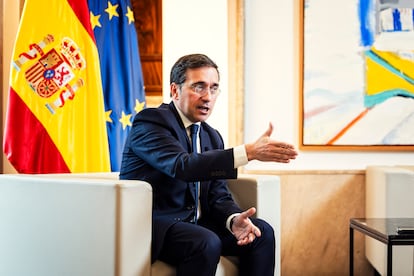
Q. Is this about lifting the veto on Delcy Rodríguez to facilitate dialogue…?
A. I’m not going to get into those speculations, not because I don’t have an idea about it, but because, logically, you have to allow me to discuss it first with the High Representative and the other 26 countries. But what is logical, and there’s no need to whisper it, is that we are indeed facing a new stage and therefore a new situation in Venezuela. We must consider the best way to continue supporting a process that, in its early steps, is heading in the right direction.
Q. We are seeing a revival of the so-called Monroe Doctrine — “America for Americans” — a version 2.0 in Trump’s style. How is Spain approaching this scenario ahead of the Ibero-American Summit it will host?
A. The summit, by unanimous decision of the Ibero-American countries, will take place in November in Madrid. A community is much more than an alliance or an international organization. It involves sharing values and objectives. Latin America is not just a foreign policy issue for Spain. I firmly believe that there is a genuinely Ibero-American way of being and existing in the world, and that its voice must be heard loud and clear. The times of spheres of influence, of limited sovereignties, of the law of the jungle where the strongest can dictate to the weakest whatever they see fit, are over.
Q. Staying in the Americas: Trump has made it clear that he wants Greenland — one way or another. He says he wants to buy it, but doesn’t rule out using force. It’s like negotiating with a gun on the table.
A. We have made our position clear: territorial integrity, like sovereignty, is part of international law. And that is not just an intellectual construct; it is the virtuous way in which states relate to one another, cooperate, and move forward together peacefully. If any ally believes that Arctic security is not sufficiently well protected, just as Spain raised the issue of the southern flank at the NATO summit in Madrid, there is no problem in discussing it and working together to address any security gaps that may exist. But the territorial integrity of any state, especially if it is an EU partner… Denmark has our full solidarity.
Q. Would the use of force by the U.S. mean the end of NATO?
A. A foreign minister, while they may consider all kinds of scenarios internally, does not suggest in an interview like this, even as a hypothesis, that this could happen.
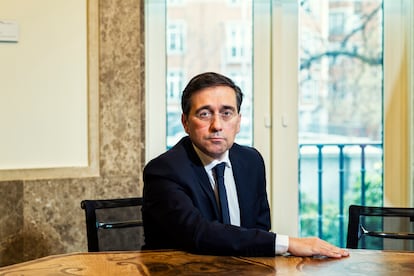
Q. Spain’s King Felipe, in this very building, warned that the link between Europe and the U.S. is at risk.
A. The transatlantic link is an alliance between Europeans and North Americans that has brought us decades of prosperity. We want it to remain so, but we must recognize that the new U.S. administration has new principles in its relationship with the Alliance and the European states, and both are needed to maintain it. That is why it is important for Europeans to take a leap forward, one that can no longer be merely about autonomy. It must clearly be about sovereignty, as we did with the single currency, when we discovered that our national currencies were no longer sufficient against the attacks of the financial markets and we created the euro.
This means ensuring that we will be free from any economic or commercial coercion. We must remove the last obstacles to the internal market so that the economy and trade within the EU can reach their full potential, and seek new trading partners who share our values and desire for free trade. The agreement with Mercosur, the world’s largest free trade area, is a good step in the right direction.
And we must guarantee that deterrence is in our own hands. We must tell the world that Europe is a land of peace and that no one can bring war to European soil because we have the means to prevent it. This means moving towards a European army; integrating our defense industries and, at the same time, using a coalition of volunteers, as we have done so many times throughout history.
Finally, but most importantly, we must focus on protecting our values. We must morally rearm ourselves because Europe is currently a beacon of hope for humanity and must remain a zone of prosperity, peace, and stability.
Q. Did Marco Rubio reproach you for Spain’s refusal to spend 5% of its GDP on defense, as Trump has publicly and repeatedly stated?
A. I have a good relationship with the secretary of state. The conversation took place in Spanish and in a cordial tone. We have a trade relationship with a surplus for the United States. We are one of the largest buyers of LNG [liquefied natural gas]. In terms of investment, it’s exactly the same in both directions. I believe that this relationship is mutually beneficial. And the United States is aware of what Spain contributes to Euro-Atlantic security. On the eastern flank alone, we have almost 3,000 troops, and our commitment to providing the capabilities requested by the Alliance is absolute.
Q. Was there no reproach whatsoever?
A. None.
Q. What role will Spanish troops play in Ukraine?
A. At this moment, the coalition of volunteers is in the process of drafting what could be the future peace plan. There is nothing tangible yet because those who started this completely unjust and illegal war don’t want to hear about peace, or even a ceasefire. It’s difficult to define something that is still in the realm of ideas. I insist, not because of Ukraine, not because of Europe, not because of the United States, but because Russia continues its war of aggression. But we are all aware that the peace framework that is eventually established in Ukraine will largely be the framework for peace and security for Europe, and, unlike what has happened in the last two centuries, Spain will be at the table with those who decide the future.
Sign up for our weekly newsletter to get more English-language news coverage from EL PAÍS USA Edition









































