
The invasion of Ukraine has already lasted longer than the Soviet fight against the Nazis in World War II
Vladimir Putin’s ‘special military operation’ marks 1,418 days on January 12
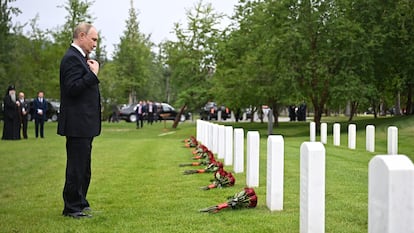

The Soviet front of World War II, the “Great Patriotic War” for Russians, lasted 1,418 days. The “special military operation” as Vladimir Putin dubbed Moscow’s invasion of Ukraine, reached its 1,418-day mark on January 12. Nearly four years of war that, in the Soviet theater, resulted in the retreat of the Third Reich from Moscow and the Volga to Berlin, while the Kremlin’s current campaign remains entrenched in Donbas.
The anniversary comes at the worst possible time for Putin. If the parallels with the Holy War were already causing concern within Russia, now the United States, the country it aspires to emulate as a superpower, has just carried out its own “special operation” in Venezuela with the kidnapping of President Nicolás Maduro, in a matter of minutes.
The Kremlin’s biggest success in 2025 has been expelling the Ukrainian army from the Russian region of Kursk, where Kyiv’s forces staged an incursion in 2024. Along the rest of the front, advances have ranged from a few dozen miles to a few hundred meters. Putin wanted to force the surrender of all of Ukraine in 2022, but today he barely controls 99% of the territory of the Luhansk region, 80% of Donetsk — both of which Moscow had partially controlled since 2014 — and another three-quarters of Kherson and Zaporizhzhia, where he doesn’t hold the provincial capitals, but has created a land corridor with the annexed Crimea.
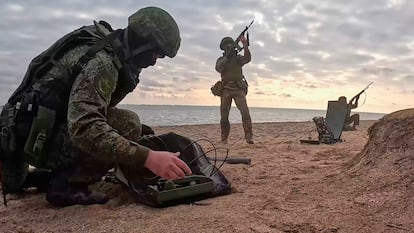
The front is more reminiscent of the trenches of the First World War than Operation Bagration or the Blitzkrieg of the 1940s. Russian advances in 2025 have been modest, at the cost of even greater losses than in previous years. Ukrainian forces remain on the defensive in a war of attrition, and the occupied villages have not resulted in a strategic breakthrough. In fact, the much-touted conquest of Pokrovsk remains unfinished, despite Moscow having deployed around 170,000 troops to the area. By comparison, the current German Armed Forces has 180,000 active troops.
A joint investigation by the BBC and the independent Russian newspaper Mediazona has confirmed the deaths of 160,000 Russian soldiers in this war through open sources, although their analysis of obituaries, graves, and news reports only accounts for between 40% and 65% of the total, according to these media outlets. Their estimate is that between 243,000 and 352,000 Russians have died, while the number of wounded is several times higher.
This conflict is very different from World War II, where at least 8.6 million Soviet soldiers, from various peoples (Ukrainians, Belarusians, Russians, Armenians, Georgians, and Kazakhs, among others), died, according to the Russian Ministry of Defense. The Great Patriotic War was the culmination of total war.
However, in his invasion of Ukraine, Putin has tried to avoid provoking a full-scale war in order to protect himself. Putinism seeks to maintain its long-standing social contract: if you don’t raise your voice and don’t speak about politics, the Kremlin will more or less leave you alone. Except for the forced mobilization of September 2022 to stabilize a disintegrating front, the regime has incentivized contract military service. Thus, the Kremlin has opened the civil service and universities to those who go to war, in addition to paying them a salary — 210,000 rubles a month (around $2,570) — that is three to four times the average Russian wage.
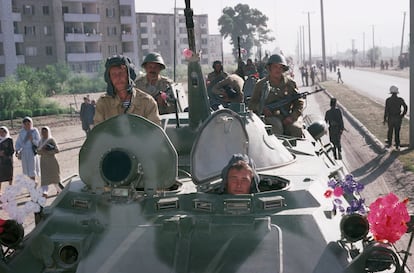
Russia is currently filling its ranks. Last year it recruited 417,000 soldiers, in line with previous years, according to Security Council Vice Chairman Dmitry Medvedev. The problem for the Kremlin is that this war is far bloodier than other traumatic conflicts of the recent past. Russians are weary, and the economy is hanging by a thread.
In the two Chechen wars (1994-1996 and 1999), some 11,000 Russian soldiers died, according to the State Duma Defense Committee. By comparison, in the conquest of Bakhmut alone (2022-2023), 19,500 Wagner Group soldiers died, most of them prisoners released from jail, plus thousands more casualties from other Russian units. This figure is even higher than the 15,000 Soviet deaths during the occupation of Afghanistan between 1979 and 1989.
The mothers and wives of military personnel played a crucial role in ending past conflicts. Their protests demanding the return of their husbands and sons were fundamental in pushing the Kremlin toward peace. However, the invasion of Ukraine is proving to be different. The systematic repression of these women and other peaceful demonstrations has stifled all dissenting voices in a spiral of silence saturated by war propaganda.
The longer the war drags on, the more questions arise among Russians. According to the Kremlin’s own polls, two-thirds of the population would end the conflict tomorrow, although an overwhelming majority believes that Putin alone should decide what is best for Russia.
The leadership of the high command, headed by the immovable Valery Gerasimov, chief of staff since 2012, is also in question. Moods in the face of a war of attrition against a Western-backed Ukraine are swinging between euphoria and pessimism, according to the shifting statements from Washington and Europe.
In any case, Russia has mortgaged its future with its invasion of Ukraine. Putin announced in the early hours of February 24, 2022, that he was launching a lightning offensive under the pretext of an operation to “demilitarise and denazify Ukraine, as well as bring to trial those who perpetrated numerous bloody crimes against civilians.” The objective was to capture Volodymyr Zelenskiy, the elected president of Ukraine, legitimized by Putin himself in 2019 and who appeared as a comedian on Russian state television’s New Year’s Eve broadcasts in 2013.
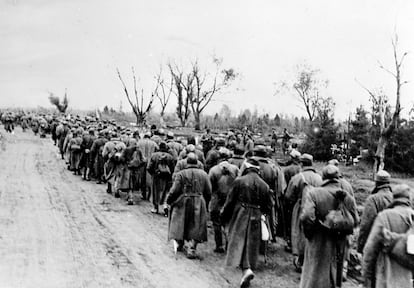
On February 24, Russian forces launched an offensive into the heart of Ukraine on three fronts. The objective of the advance from the north, supported from Belarusian territory, was to capture Kyiv and the Ukrainian government. Russian airborne forces were to seize Hostomel Airport while a massive column advanced toward the capital, where Chechen units had been infiltrated to eliminate Zelenskiy. But Ukrainian forces put up a strong fight, much to the Kremlin’s surprise. Putin would eventually withdraw his troops from that front in the face of the threat of a greater debacle.
The Kremlin launched an all-out offensive on Ukraine that, according to its own propaganda, was supposed to last “three days.” Its failed attempt to capture Zelenskiy in the first hours of the assault has recently returned to the memory of Russian nationalists like a nightmare.
Trump’s operation against Maduro, with U.S. helicopters flying over Caracas, and Washington’s blessing of Venezuelan interim President Delcy Rodríguez, has revived that unpleasant Russian memory. Almost four years earlier, Russian planes, tanks, and soldiers fell under intense enemy fire. Ukrainian civilians did not greet the troops with flowers either. The Kremlin soon afterward carried out a purge of its intelligence services for having misinformed Putin.
“The main mistake was that the intelligence services believed that Ukrainian state institutions were weak and corrupt, nor did they anticipate the reaction of Zelenskiy and Ukrainian society in general,” says Russian journalist Andrei Soldatov by telephone.
This reporter specializing in the Russian secret services revealed in 2022 the wave of arrests carried out for this failure within the Russian National Guard [Rosgvardia] and the Federal Security Service (FSB), including the arrest of the head of the Fifth Directorate and his deputy, the department responsible for foreign espionage.
“It’s much easier to believe that the Americans are naive and always buy everyone off. That’s rather than thinking that our level of planning, intelligence, and coordination is still far below par and something needs to be done about it,” denounced Yuri Kotenok, a well-known Russian war correspondent, this week. The reporter also cited Israeli and Ukrainian special operations as examples, from drones hidden in trucks to bombs concealed in Hezbollah pagers.
That purge of Russian intelligence would not be the only “clean-up” undertaken by Putin in an increasingly protracted war. The Kremlin dismissed Defense Minister Sergei Shoigu in 2024 and imprisoned his aides for alleged corruption. Two “heroes” of the special military operation, Generals Ivan Popov and Sergei Surovikin, had also fallen a few months earlier due to their close ties to rebel factions within the army. Both had been responsible for halting the Ukrainian counteroffensive.
“The failure in World War I — which for Russia lasted about 1,300 days — led to the Russian Revolution and the collapse of the Tsarist Empire. The Afghan War only weakened the country and damaged the government’s reputation, thus contributing to the collapse of the USSR. And if the current situation continues for another five years or more, what will happen? 1941, 1917, or 1991?” asks an influential Russian pro-war channel, Voyennoye Obozreniye.
Sign up for our weekly newsletter to get more English-language news coverage from EL PAÍS USA Edition









































