
Venezuela’s opposition reorganizes in a new political landscape
María Corina Machado and Henrique Capriles represent rival leaderships as voices emerge from hiding ahead of possible election
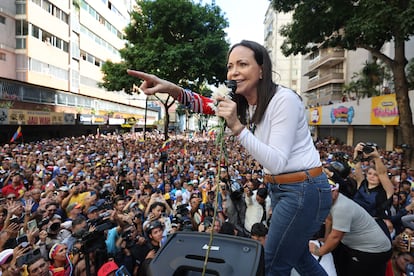
The history of the Venezuelan opposition is one of relentless resistance, periodically coming within a hair’s breadth of seizing power, only to be repeatedly crushed before achieving its goal. The violence unleashed after the 2024 elections cast a veil of silence over the country: thousands forced into hiding, exile, or prison, once again cutting short the latest attempt to attain power peacefully and democratically through elections. However, the ouster of president Nicolás Maduro and the possible call for new elections have triggered a realignment among the different sectors of the opposition. In this Maduro-era regime without Maduro, no one wants to miss out on the unfolding drama.
In recent weeks, former presidential candidate Henrique Capriles has been maneuvering to portray himself as a centrist fighting from within the country. From abroad, opposition leader María Corina Machado is intensifying her international agenda. On Monday, she met with the Pope, and this Thursday she will meet with U.S. President Donald Trump at the White House. Meanwhile, opposition figures living in hiding, such as Alfredo Ramos, former mayor of the city of Barquisimeto, have returned to the country after spending 17 months underground. Aware that exile often amounts to a politician’s social death, and trusting in greater openness from the regime, new voices hope to emerge from the shadows and rejoin the debate as soon as possible.
Facing all of them, the Maduro government and the Rodríguez siblings — Delcy, acting president, and Jorge in the National Assembly — had designed their own opposition to keep up appearances. In May of last year, a group of dissidents took their seats, including Capriles, Henry Falcón, Pablo Pérez, Stalin González, Timoteo Zambrano (a friend of former Spanish prime minister José Luis Rodríguez Zapatero), José Brito, Antonio Ecarri, and Bernabé Gutiérrez.
It is a comfortable opposition group for Chavismo, one that calls for the release of political prisoners and greater openness but wields no real power, since, as a minority in the National Assembly, it lacks enough votes to advance any legislative proposal. Among them, Henrique Capriles stands out, having returned to political life after a decade marginalized and overshadowed by his former partner María Corina Machado, with whom he is now bitterly at odds.
Capriles secured his seat after breaking with the Democratic Unitary Platform (PUD) led by Machado, which called for abstention in last year’s elections to choose governors and National Assembly lawmakers. The result was that Capriles returned to political life by gaining representation, but he was expelled from his party, Primero Justicia, branded a “traitor” to “anti-Chavista unity.”
With an energetic discourse and strong appeal among the working classes, Capriles has been the most formidable electoral rival Hugo Chávez and Maduro ever faced, losing twice by a handful of votes in elections riddled with fraud. After 12 years of erratic statements and senseless clashes with his former allies, he slipped back into the National Assembly in May, but since then, he has used every opportunity to define his new political space. Three days after the U.S. bombings over Caracas, Capriles appeared alongside Delcy Rodríguez, endorsing a government in shock as it formalized Maduro’s replacement.
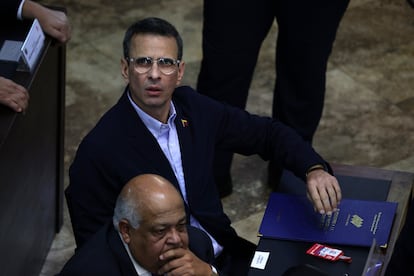
Unlike other opposition leaders, Capriles has managed to remain in Venezuela without being detained. His rhetoric remains anti-Chavista, but he has distanced himself from the opposition in exile by proposing overtures to the regime that are seen as unacceptable by those abroad. His aim is to position himself as a centrist candidate capable of winning over a popular electorate wary of Machado’s right-wing policies.
By contrast with this compliant opposition, Machado — who won this year’s Nobel Peace Prize — is the figure with the greatest popular pull in the country. Before attempting to return to hiding in Venezuela, as she has promised, she has stepped up her international appearances, which began in Oslo. On Monday she visited the Vatican, and on Thursday she is scheduled to meet with Donald Trump. At the top of her agenda is the release of political prisoners, the central plank of a platform she is promoting alongside Edmundo González, her stand-in to face Maduro after she was barred from running in the elections. Both insist there can be no transition while political prisoners remain behind bars, and they have denounced irregularities in the releases announced by Jorge Rodríguez. “The figure of 116 releases does not match reality,” they said in a statement on Tuesday, noting that “only 56 releases have been verified.”
Alongside the maneuvering taking place among opposition leaders, long-silenced voices are also re-emerging in small cities and neighborhoods. The former mayor of Barquisimeto, Alfredo Ramos, a national leader of the progressive party La Causa R, reappeared publicly on Friday after 17 months in hiding. Ramos is part of Machado’s PUD platform, which swept the July 2024 elections. Following the subsequent crackdown, he remained underground until last week, when he gave his first statements, urging new voices to step out of the shadows and come forward. For many, it remains the only viable electoral platform.
The history of Venezuela’s opposition is that of a movement marked equally by pain and frustration, one that has deployed every imaginable strategy in an attempt to defeat Chavismo. Now, the emergence of Trump has renewed the hopes of a political class that had all but given up.
From the moment an exultant Chávez arrived at Miraflores Palace in 1999, the opposition tried to economically strangle the regime by organizing a major oil strike, which was ultimately neutralized. In 2002, Pedro Carmona led a coup d’état that lasted less than 48 hours, and a decade later, in 2013, Chávez’s death once again shook up the political landscape. He died of cancer after winning his final election, a kind of Cid Campeador — victorious even as he was already fading.
It was not the charismatic Chávez, however, but Nicolás Maduro who then held on to power against Capriles, thanks to elections riddled with irregularities. Not even the massive demonstrations that for days took over every city in Venezuela could bring Chavismo to its knees. The price was extremely high: thousands of Venezuelans protesting against Maduro were tear-gassed, beaten, killed, imprisoned, and persecuted along with their families, spreading fear among anyone who dared to speak out.
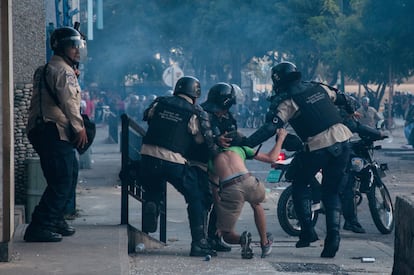
Universities such as the one in San Cristóbal have never been the same since the harsh crackdown on students who were trapped there for months in 2015. Hundreds of them were never able to finish their studies and ended up imprisoned or forced into exile. When the opposition finally won a majority in the National Assembly in 2015, it was still unable to prevail, as Chavismo created a parallel assembly that stripped the original body of both power and funding. The opposition then turned to Juan Guaidó, exploiting a loophole in the Constitution. By controlling the National Assembly, it appointed Guaidó “interim president” in 2019 — the same post now held by Delcy Rodríguez.
Guaidó’s appointment was recognized by 50 countries, and the United States and the European Union imposed sanctions on Venezuela. The hope that a new window had opened to bring an end to Chavismo once again mobilized thousands of people from the middle and working classes, inspired by a candidate who was their complete opposite. But repression once again proved brutal, and the opposition once more pinned its hopes on elections to test its strength. By then, eight million Venezuelans had left the country.
In the 2024 elections, the government ultimately barred Machado from running, but the stopgap solution — Edmundo González — swept the polls until a new and furious wave of persecution imposed silence. Since January 3, the opposition’s familiar figures have begun to glimpse yet another new opening.
Sign up for our weekly newsletter to get more English-language news coverage from EL PAÍS USA Edition









































