
Delcy Rodríguez, caught between regime survival and transition in Venezuela
The vice president assumes power in the face of Maduro’s ‘forced absence’ and is the figure tasked with managing Chavismo’s relationship with Trump
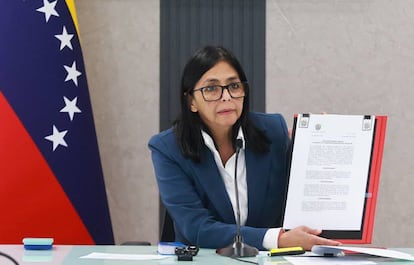

In the hours following Nicolás Maduro’s capture, one woman has captured all eyes and speculation, and it is not María Corina Machado. Delcy Rodríguez, Venezuela’s powerful vice president, has emerged more than ever as a central player in the reconfiguration of Chavista power during these critical hours in which U.S. President Donald Trump has succeeded in removing Maduro.
For now, Rodríguez, 56, has taken the reins of the country. Venezuela’s Supreme Court declared Maduro’s “temporary absence” on Friday afternoon and ordered that Delcy Rodríguez, as vice president, assume the presidency due to the president’s “forced absence.” The Venezuelan Constitution, according to Article 234, states that the vice president will fill the president’s temporary absence for up to 90 days, a period that can be extended for another 90 days by decision of the National Assembly. Brazil has already recognized Rodríguez as Venezuela’s leader in Maduro’s absence.
“Delcy is the key,” claims a source familiar with the internal situation in Venezuela. “She’s intelligent and will be prudent,” the source adds. Every hour is crucial in a landscape of conflicting information, propaganda, and fake news. No one dares to predict what will happen in the coming days — or even the coming hours — but no one doubts that it will involve Rodríguez in one way or another. The daughter of a Marxist leader assassinated in prison in 1976, Rodríguez grew up in a male-dominated system where she has tried to distinguish herself through her ability to engage in dialogue with economic elites and foreign actors.
Trump, who claimed that opposition leader María Corina Machado does not have the necessary “respect” and support to lead at this crucial moment, said that U.S. Secretary of State Marco Rubio had a “long conversation” with Rodríguez. According to Trump, Rodríguez offered her support to Washington. “She really doesn’t have a choice,” he said.
Rodríguez, however, appeared publicly a few hours after the attack to draw a red line: the country will not be a colony, and Nicolás Maduro remains the only president. Between public displays of firmness and behind-the-scenes negotiations, Rodríguez now finds herself in a pivotal role, halfway between the continuity of the regime and its end after nearly three decades in power.
Delcy Rodríguez has been described as a moderate within the government, but that’s perhaps not the most accurate description. Unlike some of her allies, she is a Chavista figure capable of surviving a U.S.-backed transition, according to analysts. “Trump’s primary objective was to eliminate Nicolás Maduro and avoid triggering a more serious conflict, with the risk of civil war,” adds the source familiar with the situation in Caracas. “They’re going to attempt stabilization under the supervision of Delcy, whom they consider very much a Chavista, but also intelligent and capable of dialogue. And from there, a transition that’s still undefined,” the source ventures.
What has happened in Venezuela is being interpreted in different — and sometimes contradictory — ways. “President Trump’s statements made it clear that removing Nicolás Maduro from power was not Washington’s ultimate goal,” says Renata Segura, program director for Latin America and the Caribbean at the International Crisis Group. “The announcement that the United States will now ‘govern Venezuela’ and take control of the oil industry indicates Washington’s intention to remain involved in the country long-term.”
Once again, uncertainty looms in the short, medium, and long term. According to Segura, “The next few hours will be crucial in determining whether Vice President Delcy Rodríguez or other members of the Chavista movement will remain in power in an agreement with Washington and whether there are fractures within the regime.”
Sign up for our weekly newsletter to get more English-language news coverage from EL PAÍS USA Edition









































