
Diosdado Cabello, the unpredictable go-between in Venezuela
All eyes are on the powerful minister of the interior, capable of destabilizing the new post-Maduro era
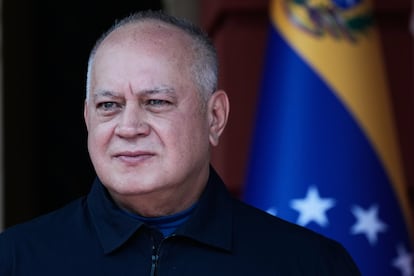
A shadow has been cast over the offices, barracks, embassies and cafés of Caracas and also of Washington since January 3. It is the shadow of a man many fear. The future of the new Venezuela is in his hands; whether or not the country descends into chaos rests on his shoulders.
Diosdado Cabello is a military man who represents Chavismo at its most radical. He is also at the center of this unprecedented period in which the regime dialogues with Washington. All eyes are on him, some more skeptical than others. For some, he is the greatest threat to the leadership of the new president, Delcy Rodríguez, the actor capable of blowing up the current fragile balance at any moment. For others, he is the silent guarantee that this unexpected turn of events would not have happened without his consent. Diosdado, nicknamed for a time “Diostodo” — the Almighty — could be both.
For two weeks, analysts, diplomats, intelligence services and Venezuelans themselves have been trying to work out what is going through Cabello’s head when he appears at public events with Delcy Rodríguez and her brother Jorge, the new leaders of a Maduro-free Venezuela. His control over the security apparatus and armed militias is fueling fears in Washington that he could become unpredictable and jeopardize transition plans, Reuters has reported. “It is very clear that he can’t survive without the consent of the Americans,” a source close to the Venezuelan government said. “He is already reforming the Armed Forces, laying off personnel and appointing new officers.”
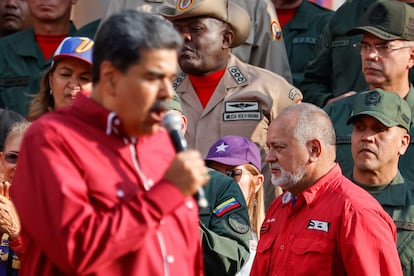
Cabello has demonstrated a strong survival instinct over the years and a cast-iron loyalty to the revolution, as long as that loyalty does not cost him power. Although he has never appeared to covet the presidency, he is considered the last guardian of Chavismo, the final line of defense of the Bolivarian revolution at its most radical. He is the most militaristic of Venezuelan politicians, with historical ties to military commanders, political police, and the feared groups of armed civilians that function as eyes for the regime.
Obsessed with the figure of Hugo Chávez and with the revolution, his discourse has been marked by contempt for democracy and the middle classes. According to several sources consulted, Cabello embodies the orthodoxy of Chavismo and if Delcy Rodríguez moves too quickly in the opposite direction, things could get ugly.
The intervention of the U.S. in Venezuela, with the declared goal of gaining access to the largest oil reserves in the world, has been a profound blow to Chavismo, both for its radical and more pragmatic wings. While Rodríguez is appearing to move quickly to open spaces for dialogue, Cabello’s shadow is a constant. “The two have very different sensibilities,” explain those who know them. Maduro balanced out the two, but Maduro is no longer there. Among observers of Chavismo, there is a shared conviction: if Cabello does not agree with something, it can’t be done. “Probably many of the things that are happening would not happen so quickly without Diosdado,” said opposition leader Iván Stalin González in an interview with EL PAÍS.
For more than a decade, Cabello has been one of the centerpieces of Chavista power. He was president of the National Assembly, number two in the United Socialist Party of Venezuela (PSUV) and the main organizer of its territorial machinery. Every week he hosts a TV program, broadcast on state television, which he has used to mark the regime’s hard line for years with denunciations and warnings aimed at both the opposition and dissidents within the party.
The program was used as a mechanism of political discipline and a Chavismo showcase, reinforcing the image of Cabello as the man guarding the ideological framework of the revolution. On TV, he has called Americans “sheep” and, recently, threatened María Corina Machado indirectly in the midst of escalating tensions with Washington. “At this point, everyone should be clear that, if they squeeze us, we squeeze them,” he warned.
Since Maduro’s capture, Cabello’s role has been interpreted as an uneasy fit. Sources in Venezuela maintain that the gestures of openness presented by the regime — such as the release of hundreds of political prisoners — would have been impossible without his approval. At the same time, those familiar with the negotiations suggest he poses the greatest resistance over who to release.
Cabello wants to set limits, they say. Rodríguez is moving quickly on an agenda of greater openness with nods to diplomacy, prisoner releases and reforms, and also appointments, according to loyalties. Among the new names emerging is Major General Gustavo Gonzalez, 65, who will head Venezuela’s feared DGCIM, Chavismo’s military counterintelligence agency. The appointment has been interpreted as a “tactic” by Rodríguez to counter Cabello’s power, according to Reuters.
Despite his ideology, Donald Trump has decided to rely on Cabello. According to Reuters, the interior minister was engaged in secret talks with U.S. officials in the months leading up to the operation that ended with Maduro and his wife, Cilia Flores, imprisoned in New York. Trump’s emissaries warned Cabello, 62, not to use the security services or ruling party militants under his supervision to repress the opposition. Accused by the U.S. of drug trafficking and with a reward of $25 million on his head, Cabello is nonetheless useful to Washington. For now, it seems he will continue to be one of the central figures in Venezuela.
Sign up for our weekly newsletter to get more English-language news coverage from EL PAÍS USA Edition









































