
A Nobel Peace Prize against authoritarianism
Jørgen Watne Frydnes’ message is clear: Maduro must accept the election results and lay the groundwork for a peaceful transition
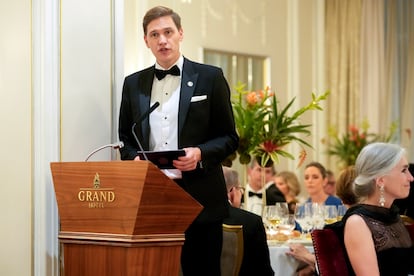
While the decision to award the Nobel Peace Prize to María Corina Machado was controversial, the speech by Jørgen Watne Frydnes, chair of the Nobel Committee, did nothing to quell the uproar. On the contrary, he forcefully defended the decision and, going even further, called on Nicolás Maduro to resign and lay the groundwork for a peaceful transition in the South American country.
This year, the award went beyond simply recognizing the winner’s accomplishments. The prize was explicitly linked to the defense of democracy, demonstrating a clear stance in the face of an urgent challenge: the rise of authoritarianism. “People living under dictatorship often have to choose between the difficult and the impossible. Yet many of us — from a safe distance — expect Venezuela’s democratic leaders to pursue their aims with a moral purity their opponents never display. This is unrealistic. It is unfair. And it shows ignorance of history,” said Frydnes.
Of the 142 recipients of the award since its inception in 1901, Fydnes mentioned Nelson Mandela twice and cited Lech Walesa, Carl von Ossietzky, and Andrei Sakharov once each. He brought up the South African and Polish leaders to highlight the dangers of empty dialogue, while he remembered Sakharov and Ossietzky as those who stood firm in the face of adversity: “Those who kept going, when others gave up.” “Mr. Maduro: You should accept the election results and step down. Lay the foundation for a peaceful transition to democracy. Because that is the will of the Venezuelan people,” the prize official said near the end of his remarks. This isn’t the first time the award has been controversial: Henry Kissinger also received it.
In Oslo City Hall hall, where the ceremony was held, there were dozens of Venezuelans. By 1:00 p.m., it had already been reported that Machado, although she had managed to leave Venezuela, would not be able to attend the official event. As the hours passed, the appointment with her was repeatedly postponed. She eventually reached Oslo at around midnight. Frydnes himself confirmed that she would not come out to greet her supporters, as had been speculated, because she first wanted to meet with her family. I asked Venezuelans who were celebrating at a gathering with the diaspora. They were all prepared to stay overnight.
The hall where the award was presented was filled with everything from exiled political leaders, including the election winner, Edmundo González Urrutia, to ordinary citizens who had managed to gain entry by filling out an application. All fell silent upon hearing Frydnes’s powerful words.
The Committee chairman also delivered a well-structured speech, remembering the victims of the Venezuelan dictatorship and dissecting the dismantling of democracy in the South American country. He addressed, one by one, the arguments of those who disagree with the decision to award the opposition leader the prize this year. “Ms. Machado has requested international attention, support, and pressure, not an invasion of Venezuela,” he asserted.
Oslo has a distinctly Venezuelan atmosphere after Machado’s arrival at the Grand Hotel, where she greeted supporters in the early hours. There were also protests. However, there were no reports of violence. Meanwhile, in Venezuela, there is no opportunity to celebrate the award.
Controversy has surrounded the award since its announcement. These criticisms are reflected in the traditional exhibition honoring the winners at the Nobel Peace Center, including one from the journalist Jon Lee Anderson. The Committee’s position, however, remains quite clear: Venezuela serves as a cautionary tale of what can happen when an authoritarian leader holds power.
While speculation swirls about whether Donald Trump will order an escalation of the crackdown against the Maduro dictatorship, in Norway, a country where no one asks permission to speak, the conversation in various sectors extends far beyond the Nobel Prize. It revolves around democracy, the dangers it faces, and even more so with the kind of president currently in office in the United States.
“Today, we honour you, María Corina Machado. We pay tribute as well to all who wait in the dark. All who have been arrested and tortured, or have disappeared. All who continue to hope. All those in Caracas and other cities of Venezuela who are forced to whisper the language of freedom,” Frydnes said.
Sign up for our weekly newsletter to get more English-language news coverage from EL PAÍS USA Edition









































