
The story of the Barcelona DJ who spent five years in a Panamanian prison
Professor Angel Dust was a key figure in the Catalan nightclub scene of the 1990s. He recounts how he became entangled in ‘a sinister plot,’ ending up in prison surrounded by drug traffickers and murderers

He walked down the prison corridor, guarded by police. His wrists and ankles were shackled.
He had shoulder-length blond hair, pale skin and light-colored eyes. On both sides of his body, there were dark, tattooed faces and half-smiles. The smell of sweat was pervasive.
The most dangerous prisoners peered through the bars of their cells to observe the new arrival. A voice cut through the darkness of bodies: “Welcome, Shakira. Here, we’ll find you a new boyfriend for sure.” Malicious laughter erupted from the other inmates. The new convict had never been more afraid in his life. He was going to spend the next five years living in that prison.
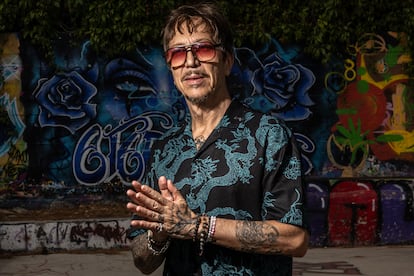
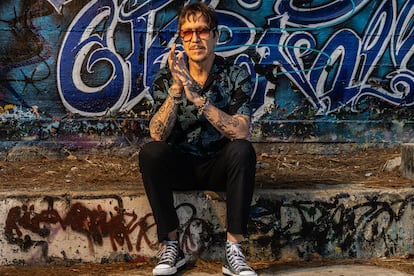
Today, Ángel Francisco López would no longer be recognized as “Shakira.” He has short hair, a neatly trimmed goatee and, above all, a relaxed expression — something unthinkable that day. And his body is covered in tattoos, something revealed by the book jacket of his recently published memoir, En el estómago de la bestia (In the Stomach of the Beast), where he recounts his intense and at times harrowing life.
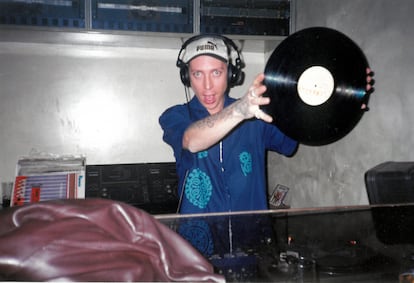
In the 1990s and early 2000s, López was one of the key DJs on the Barcelona nightclub scene. He spun records and organized parties at the most exclusive venues. His sets drew the city’s trendsetters, affluent crowds, indie kids, celebrities and adventurous music lovers alike, with sounds ranging from hard funk to cumbia. One night, even Leonardo DiCaprio and Tobey Maguire turned up at his venue.
Then, in 2008, a chasm opened up beneath him. He became embroiled in what he calls a “sinister plot” that led to a six-and-a-half-year sentence in a Panamanian prison on drug trafficking charges. He was eventually released after five years, the same amount of time his partner spent behind bars after being implicated alongside him. Their daughter — taken from her parents’ arms the day of their arrest — was only 18 months old when her parents lost their freedom.
López was born in Mexico City in 1963. From the ages of 17 to 26, he lived in Canada: he had moved there with his parents, in search of better job opportunities. He eventually settled in Barcelona, drawn there by the vibrant Catalan cultural scene of the late 1980s. He has lived in Barcelona for the last 37 years. “I consider myself a Barcelonian, more than a Catalan,” he says in a Madrid café, having travelled to the Spanish capital to meet with EL PAÍS.
Ángel Francisco López’s story, however, begins in the Mexican capital. From a young age, he had musical talent, as well as a natural artistic flair (he used to imitate the Spanish singer Raphael as a child). He soon became a fan of rock: at first, he was enamored with Kiss, Deep Purple and Black Sabbath. Later, with the Velvet Underground, Iggy Pop, David Bowie…
He saw The Clash in Canada and was blown away. In Toronto, he started a couple of bands, such as Bambi (which opened for Pink Floyd) and On (which opened for Neil Young). Malcolm McLaren, the visionary creator of the Sex Pistols, fell in love with On and was the band’s creative adviser for a time.
In the early 1990s, Lopez attended a Prodigy concert in Stockholm and — upon seeing the audience’s ecstatic reaction — he knew that electronic music was going to take hold on a massive scale. That’s where his DJ career began, under the name “Professor Angel Dust.” His specialty? Mixing funk with exotica, rock, electronica and Latin rhythms.
His breakthrough came with a remix of Santana’s version of the classic song Oye Cómo Va, which even made its way onto the Spanish charts. But his natural habitat was Barcelona’s club circuit, where his DJ sets became a major draw. He played at Apolo, Moog, Dot, Moviedisco, Razzmatazz, La Sal and Global Chillage, among other spots. At La Paloma, he launched the wildly popular Bongo Lounge nights. He also performed at festivals including Sónar, Primavera Sound, Doctor Music and Festimad.
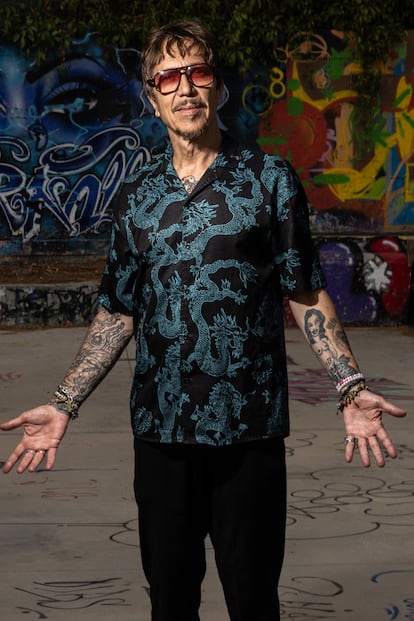
He claims that he tried a variety of drugs, but never had addiction problems. “I used them in moderation, and I never bought them. The longest-lasting thing was marijuana,” he explains. Today, he looks good: slim and stylish, wearing brown sunglasses. He speaks softly and smiles often, even when recounting episodes that are sometimes terrifying.
One night, back in 2008, after performing at the Barcelona club Omm, a man “dressed in an impeccable suit, wearing a gold Rolex” offered him a DJ gig at a party in Panama City, the capital of the Central American country. At first, he wasn’t convinced: the pay was standard (just over $1,000) and Professor Angel Dust — who was then at the peak of his career — had other commitments to fulfill around that time. But when he discussed the offer with his partner, Keni, they decided that a week in Panama — with all expenses paid — could be a nice vacation for them and their little girl, Sienna.
After arriving in Panama, the gig kept getting delayed. Six days passed. The family was due to return to Barcelona. Then, according to the DJ’s account, his contact arranged to meet them at an apartment. He arrived with his partner and daughter.
“I already knew the gig wasn’t going to happen, so all I wanted was to get paid at least part of the money and head to the airport, because our flight was leaving in a few hours,” he recalls.
Then, something completely unexpected happened. “They started telling me my parents’ names, where they lived, who my siblings were and what they did for a living. They knew everything about my life. They warned us that, if we didn’t follow their instructions, there would be consequences. The one who was talking the most unbuttoned his jacket, so that we could see the gun he had tucked into his side pocket. All of this happened with my daughter there. It was terrifying.”
And then came the demand: they had to transport cocaine from Panama to Barcelona. There, they would hand it over to someone who would contact them. “They ordered us to undress behind a screen: they strapped the drugs onto our waistbands with plastic wrap. Then, they called a car, which took us directly to the airport.”
He says they considered reporting the incident to the police, but that the threat against their families stopped them. “We didn’t trust the police there, either. They had a reputation for corruption. Our goal was to get through airport security and report the situation to our airline, KLM.”
In customs, their turn came. Keni went through first. A police officer became suspicious and pulled her aside for a search. The packages strapped to her body were discovered. López tried to intervene, but officers quickly restrained him and found the drugs he was carrying. Both were arrested, and their daughter was taken away.
They were given a six-and-a-half-year sentence. López maintains that he provided very little information to the authorities, because he simply didn’t have it: the names of the people who had hired him were fake. He only suspects that they came from “Nigeria.”
López’s parents and siblings immediately traveled to Panama. “They started making inquiries in the city’s shadier areas, but they were advised that it was best to do nothing, because they would endanger their lives and ours.”
Today, he accepts that some people may doubt his version of events. “But I’m not here to be believed or judged. If anyone finds out anything, let me know,” he says calmly.
His parents won custody of the girl and took her to live with them in Barcelona. López spent five years surrounded by “murderers, drug traffickers and thieves.” In the prisons where he served his sentence, he witnessed stabbings and fights. He also made friends.
He thought about escaping. “But then, you think, ‘How do I do it… and, if I manage it, then what? I hide out in Thailand?’” He fell ill almost immediately from the water in the prison and from various insect bites. It took two weeks for him to be taken to a clinic, all of them spent with a high fever.
“Those first weeks were terrible,” he remembers. “I thought to myself, ‘If I die, it would almost be better.’ But my daughter kept me alive. If I hadn’t had her… I don’t know, I could have ended up like many prisoners there, falling into drugs; cocaine was dirt cheap. But my survival instinct prevailed.”
He listened to the French pianist Erik Satie on his headphones and iPod, which the guards let him keep. “That music comforted me. I’d hunker down on my bunk. Next to me, other prisoners were watching porn, masturbating with sex toys, or doing drugs. I’d close my eyes and listen to Satie.”
He continued doing his own thing: avoiding conflicts, keeping a low profile. His Mexican heritage and his DJ status afforded him protection, since one of the high-ranking prisoners was also Mexican and a music enthusiast. “He took a liking to me, so everyone left me alone.”
It was his musical project that made it all bearable. First, he befriended the visiting priest, who gave him a guitar. Later, he became the choir director. When he was transferred to a different prison (one deep in the jungle), he took charge of a recording studio that another inmate had set up. There, he devised a program called Rehabilitation Through Music (R.A.M.), where he recorded music with convicts, organized festivals, composed a pacifist song (which became a hit on the Panamanian charts) and helped encourage the creativity of prisoners who came from the ghetto. He wrote up a detailed report of everything that had happened, and in return his sentence was reduced by 18 months. What had originally been a six-and-a-half-year term was cut to five years. His partner was released three months after him.
The return to Barcelona wasn’t easy. Three months later, his mother — the woman who had cared for their daughter during their years of captivity — died. And, a year later, his father died, too.
The world had changed a lot in five years: people now listened to music on their phones. His name no longer carried the same weight. He struggled to find work, partly due to the stigma of his time in prison. It was the Sónar music festival that came to his rescue: López gradually got his career back on track. He separated from Keni, but before that, they had another daughter — the result of one of the few conjugal visits they managed to secure in Panama. Keni also turned her life around and now lives with a new partner on the outskirts of Barcelona. The two remain on good terms.
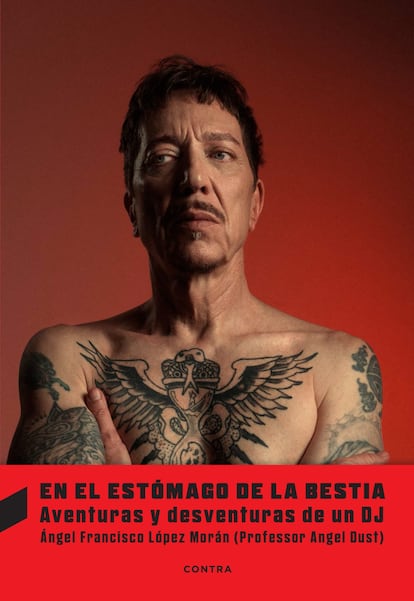
López — who has been with his current partner for the past nine years — continues to produce music. He DJs occasionally and will release some new songs in a couple of weeks. “But I’m more interested in producing other artists,” he says. He has managed to control his nightmares… although he does have a recurring dream. “It’s a desolate situation. I feel trapped. Nobody pays attention to me and I can’t get out. It’s a very powerful feeling of abandonment.”
“Now, I’m a much better person,” he reflects. “Despite everything bad that happened, it was an experience that tamed my ego. Life had put me in a position of importance: I was a famous DJ, a personality who thought I was better than everyone else. Now, everything has changed. I’ve stepped outside of myself. And I have a lot of empathy for others.” He is also a full-time father, as both of his daughters live with him.
Sienna, the eldest — who was practically a baby at that Panamanian airport where it all happened — will soon turn 20. A few days ago, her father left her a copy of his memoir in her room. She’s also part of the book.
“I don’t think she’s started it yet,” López sighs. “She’s finding it difficult, for a combination of reasons: kids her age are terrified of facing a long, printed book, and maybe she doesn’t want to know some of the stories. Maybe, someday, she’ll read it…”
Sign up for our weekly newsletter to get more English-language news coverage from EL PAÍS USA Edition









































