Don Omar, reggaeton pioneer: ‘What’s happening with Bad Bunny is the result of 30 years of urban music’
The Puerto Rican musician embraces the genre’s evolution, the new generation’s rejection of old masculine role models and many of his peers’ conversion to religion
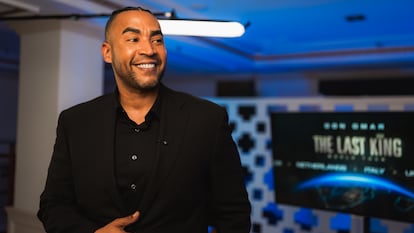

William Omar Landrón Rivera, known as Don Omar, has lived through it all. From childhood to adolescence. From adolescence to the streets, drug trafficking and gangs. Then he became a church pastor, a youth preacher. From there he rose to become a leading figure in what was then a new genre, reggaeton, debuting with Dile in 2003. He faced two gender violence complaints — in 2012 and 2014 — and a lengthy legal process after being accused of illegal firearms possession in 2004. He had kidney cancer in 2024, from which he has since recovered. And now, at 48 and with no intention of leaving the stage, the Puerto Rican is preparing the The Last King tour across the United States and Europe, which will begin next September, and a new album of previously unreleased songs.
He says the shows will last two hours and will include songs that span whole generations, from his beginnings to the present. These days he is also celebrating 15 years of Danza Kuduro, the song that was part of his appearance in Fast and Furious and which, for him, marked a turning point in his repertoire and propelled him onto the global stage. It remains to this day the most-played Latin song on Spotify, with nearly 2.7 billion streams.
But before that tour, Don Omar stopped in Spain to take part in several festivals. Impeccably dressed, showing a bright smile, the Puerto Rican welcomed this newspaper at a Madrid hotel, a stopover between his performances last week in Santa Cruz de Tenerife and Seville, and before scheduled shows in Barcelona and El Puerto de Santa María this Thursday and Friday, respectively.
Despite his career, Don Omar is modest about his achievements: “I don’t consider myself a musician. Music has to be studied, practiced every day. I neither studied music nor invested time in it enough to go into a music studio and try to conduct,” he explains.
—But you’re the founder of a genre…
—Yes, that’s true —he says with a laugh that recurs throughout the interview.
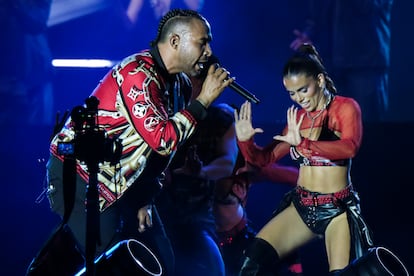
As the father of reggaeton, a title he shares with Daddy Yankee and Tego Calderón, he recalls his first steps and compares his experience with that of the new generation of singers. “Twenty-three years ago, when I first came to Spain, no one knew about reggaeton,” he recalls. “To find Don Omar’s music you had to find a pirated CD, which is how music was shared back then. I think younger colleagues have better tools now, an enviable world.”
While celebrating the genre he helped push forward, Don Omar sides with younger artists, speaking with an air of wisdom and experience. “The evolution of things should always be seen as something to celebrate.” And as a rule of life, younger artists look to him for encouragement: “Anuel, Jhay Cortez, Mike Towers, Karol G — they still look at me with a lot of respect, and whenever they need advice, I’m honored that they pick up the phone and write to me on Instagram: ‘Boss, how are you?’” And he’s there, ready to talk and share his knowledge.
His relationship with other reggaeton pioneers also remains alive. With Tego Calderón there is love; Don Omar calls him his brother. “I think he’s one of the most gifted songwriters in our music,” he acknowledges, and says fondly: “I love that he has found his peace, although many people want him to come back and make music again.” With Daddy Yankee it was different. “A brother too, with a thousand battles and a thousand wars. He’s the industry brother with whom I had the most disagreements, but today I respect Raymond’s work,” he says, with a hint of understanding after noting that Daddy Yankee had no youth because his career took off in 1995 at just 18: “He put on the Daddy Yankee mask and never stopped being Daddy Yankee until the last day of his career. You have to be tenacious for that.” The singers reconciled in 2023 after years of rivalry on and offstage.
They all belonged to a generation criticized for the objectification of women and glorifying street life. But things have begun to change: “My father is much stricter than I am, and my grandfather even more so. Over time and through generations, we have learned to discard what is unnecessary.” Reflecting on the type of man they represented, Don Omar says: “If there is one thing the urban genre enjoys, it’s that the new generation refuses to keep seeing that street-man model. I come from there; that’s who I am.” But he believes he has changed too, after legal troubles, the loss of friendships and more than 20 years of career: “The industry was hurt at one point because of that. And today I admire that the genre grew, evolved and left some things behind.”

It’s hard to imagine the experience of the first women who carved out a space in reggaeton, a hostile environment Don Omar himself has called “a war.” The prime example, and a close friend of the singer, was Ivy Queen, to whom he credits part of who he is: “My first performance outside Puerto Rico, in Colombia, was because Ivy spoke to the promoter about me. I am always grateful, and wherever I see her I tell her, ‘I love you, I care about you and you are the queen.’” He says Ivy Queen commanded unquestioned respect among peers. “We have always respected her. Ivy was that woman who wouldn’t allow any man to disrespect her because she knew she was breaking into a male-dominated genre.” That character and the career she built served as a model for those who came after: “I think those female pioneers planted the seed for Karol G, Natti Natasha, Elena Rose. What you’re seeing today are women who grew up with the example of a superwoman like Ivy Queen, who taught them it could be done and won her place.”
The artist who is now recognized —and sometimes criticized— for trying to change traditional masculinity within the urban genre and for musical innovation is Bad Bunny, the current occupant of the reggaeton throne. “What’s happening with Bad Bunny is the result of 30-plus years of urban music,” Don Omar says. “He found a way to align everything while loudly proclaiming the pride he feels for being Puerto Rican.” Bad Bunny’s success, he adds, is undeniable. “He has a great opportunity to keep changing music.” They collaborated in 2020 on Pa’ romperla, and it is Bad Bunny who is now closing in on dethroning him on Spotify’s Latin songs chart with La canción.
Religion, the reggaeton star’s written destiny
Before becoming Don Omar, William experienced another conversion. He was the first of the urban-genre legends to reconnect with God after his time in gangs and the drug trade. “My story is a little backwards. I was a youth pastor at a church, and when I entered the genre I realized this was a war.” One by one, reggaeton’s leading figures have taken a similar path: Farruko, Héctor el Father, Lary Over and Daddy Yankee. “I think my colleagues’ conversions come because at some point we all got hurt trying to keep being the character.” He sees it as an expected path to join faith after years of success, dancing, partying and work. “I think human beings at some point experience that spiritual fatigue, and my peers felt it and did the right thing. I think they are happier than ever.”
On many occasions Don Omar has said his happiest time was those years as a pastor. Would he return to that? He says he would love to, especially after the illness he had in 2024. “Two years ago I got cancer and I did one thing: remembering the time I was a pastor,” he recalls. “One time I spoke to God. I said: ‘I want to speak to you, to tell you, if I’m going to die, please do it quickly. I’m not going to ask you for explanations, I’m not going to blame you, I’m not going to ask for anything. If this is how my story ends, fine, but remember me.’ From that day on I try to follow God’s purpose, to see others’ spirits to detect when they’re sad or need something. I try to be an ‘agent of change.’ ‘Daddy God must be pretty happy with me,’” he smiles.
William Omar Landrón Rivera has been through a lot, and that has changed many things, but he retains his essence, the one you hear in Bandolero, his favorite song. “Bandolero is a very intimate moment in my life and a moment when I found God. And I said, ‘You know what? This is me.’ And I shouted it to people, and they told me, ‘You know what? Thank you for your sincerity. Thank you for opening your heart.’”
Sign up for our weekly newsletter to get more English-language news coverage from EL PAÍS USA Edition