How Trump’s Latin American allies helped Flávio Bolsonaro flee Brazil
The governments of Argentina and Ecuador collaborated to get the far-right candidate out of the country, bypassing Brazilian legislation. A conservative bloc has emerged in the region that is willing to act according to the US president’s logic
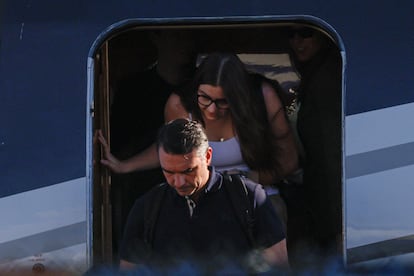
The flight of far-right Brazilian politician Flávio Bolsonaro has exposed covert support from the Donald Trump administration and a network of alliances among conservative governments on the continent, encouraged by Washington, that collaborated to enable his escape. Bolsonaro’s departure for Miami — just one day after insisting he would lead the opposition to the newly re-elected Luiz Inácio Lula da Silva — demonstrates the existence of a Latin American bloc not only ideologically aligned with Trump but willing to act according to his logic, disregarding international treaties, several analysts said.
“It’s a network behaving identically to Trump’s, where international law has no relevance. The U.S. administration feels no respect for it and the Bolsonaro case is further proof. This creates a contagion effect among his regional allies, who choose to ignore legality. Trump sets the pattern and his allies avoid any decision that might anger him: they are aligned and follow the policy he defines,” says Michael Shifter, former president of the Inter-American Dialogue and one of Washington’s most influential hemispheric policy analysts.
Shortly after returning to the White House for his second term, Trump infused the federal administration with his particular geopolitical vision — a view that seeks to restore U.S. preeminence in the Western Hemisphere, according to the National Security Strategy published by the Pentagon late last year. The Defense Department’s new plan aims to reinstate the Monroe Doctrine, named for U.S. President James Monroe, who in the early 19th century formulated the idea of “America for the Americans,” an ideology that consolidated U.S. hegemony across the Americas and encouraged interference and intervention in Latin American countries.
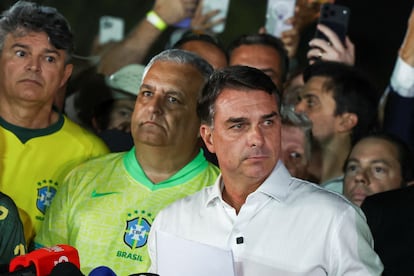
The strategy has found backing among his allies. A few months before Brazil’s election, the son of former president Jair Bolsonaro — who was sentenced to 27 years in prison for plotting a coup after the 2022 elections — visited Trump in the Oval Office, an unusual move for a candidate. There, according to U.S. media reports, they agreed that Trump would not publicly endorse Bolsonaro because it could be counterproductive, but in recent months the U.S. president has made things difficult for the Lula da Silva government. And now he has welcomed Flávio in his country.
The fact that the United States, under Trump’s leadership, allowed Flávio Bolsonaro to flee Brazil — where he is under investigation for corruption cases, including money laundering — sets a dangerous precedent in the region, Michael Shifter says. “Everything Trump does sets a precedent,” he notes. “There’s a long list of unprecedented acts, and this is a very worrying precedent because it shows there is no regard for any law, regulation or court order,” he explains.
The occupant of the White House has meddled in every presidential election held in the region over the past two years to favor the most conservative candidates. Trump openly backed Argentina’s Javier Milei in last year’s legislative elections. Washington facilitated a $20 billion financial rescue to sustain the Argentine currency during a period of financial turbulence. And without much hesitation it conditioned that aid on the populist Argentine’s electoral victory.
Imposing the Monroe Doctrine
It was the clearest example of interventionism, although Trump also meddled in other elections through explicit messages of support on his social network, Truth, designed to favor right-wing hopefuls aligned with his cause. He publicly backed Nasry Asfura in Honduras. He also staged his “full support” for Abelardo de la Espriella in Colombia’s presidential race. Over the last two years, Trump has kept the carousel of endorsements going with Keiko Fujimori in Peru, Rodrigo Paz in Bolivia, and Laura Fernández in Costa Rica. Last November he declared his support for far-right José Antonio Kast to become Chile’s next president.
All these new conservative allies signed an agreement to create the so-called Shield of the Americas, an association of American countries to fight drug trafficking and organized crime. Trump staged the founding of the new organization last March at Doral (Miami), in a summit attended by a large representation of leaders who bowed to the U.S. leader’s dictates. The Shield of the Americas, however, is also a Washington instrument to cement its new foreign policy toward Latin America: under a neocolonial vision dubbed the “Donroe doctrine,” a play on James Monroe’s strategy combined with Donald Trump’s name.

Since Trump returned to the Oval Office two years ago, this strategy has forged an alliance with Latin America’s conservative presidents, showing favoritism and at times disparaging their rivals.
The political shift in the region is evident. A total of 17 allied, right-leaning countries have joined the Shield of the Americas founded by the United States. In the region, practically only Brazil, Mexico, Uruguay, Guatemala, Nicaragua and Cuba are governed by leftist parties. Although Trump did not publicly back Flávio Bolsonaro in Brazil’s presidential race, he maneuvered to favor him.
That alignment enabled Bolsonaro’s unpunished exit from Brazil, evading Brazilian law. Katya Salazar, director of the Due Process of Law Foundation (DPLF), an organization that promotes human rights and the rule of law in Latin America, criticizes the support provided by the governments of Argentina’s Javier Milei and Ecuador’s Daniel Noboa in facilitating the senator’s escape; late Tuesday night he crossed the land border into Argentina by vehicle with his wife and two daughters. At 11.30 p.m. (local time), the family boarded a private flight operated by Baires Fly S.A. bound for Guayaquil that departed after midnight.
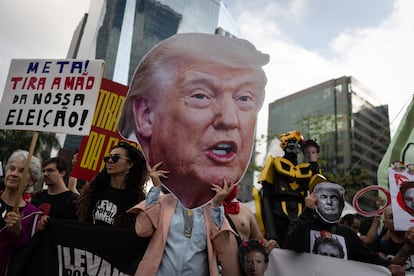
“Argentina and Ecuador’s support for Bolsonaro’s departure is especially troubling because there were explicit judicial restrictions preventing him from leaving the country. Ideological affinity weighed more than respect for justice,” Salazar says. “This kind of solidarity between governments is not exclusive to one political sector; we have seen it across the ideological spectrum. But precisely for that reason, we must insist on a basic principle: political affinity cannot justify evading the law or disregarding court rulings,” she adds. “The precedent is awful for the Americas, especially in a context where the United States plays an increasingly active role in backing like-minded leaders. Accepting these behaviors means normalizing a logic where alliances prevail over institutions. The region cannot afford that,” she warns.
Internal fractures
Both Ecuador and Argentina are part of the Shield of the Americas. For Michael Shifter, the bloc shows severe fissures despite the firmness of its rhetoric and joint maneuvers such as Bolsonaro’s flight. “The electoral result in Brazil was a very heavy blow to Trump’s policy toward Latin America and to his ambitions of showing a fully aligned region,” he says. “The two largest economies in the area, which account for more than half the population and the largest GDP, are now on the other side. That trend toward automatic alignment is going through a very complicated moment,” he argues.
Added to that is the fact that governments such as those of Chile, Argentina and Ecuador face serious internal problems that suffocate their leaders: from the uncontrolled wave of violence besieging Noboa, to the low popularity levels of Chile’s José Antonio Kast or Peru’s Keiko Fujimori, who has just assumed the presidency with severe political wear.
“You can see the consolidation of a bloc sympathetic to Trump, willing to operate outside traditional legal parameters, but at the same time it is a bloc weakened by each country’s internal circumstances, which raises doubts about the sustainability of that alignment,” Shifter explains. At the social level, polls also reflect a deterioration in the image of the United States compared with a more favorable perception of China.
“The relationship with Washington is complex. It is true that these leaders maintain loyalty to Republican leadership, but they also know the political map in Washington could be reconfigured after the midterm elections, which would alter their calculations,” Shifter warns. A possible weakening of Trump at the ballot box would directly affect dynamics with his Latin American partners. “Trump will keep a lot of power, but not the same. And that matters for the historic tutelary relationship the United States has with the region,” he concludes.
Sign up for our weekly newsletter to get more English-language news coverage from EL PAÍS USA Edition