
Fujimori’s school discipline in Peru: ‘Boys must have short haircuts. No dyed hair or makeup for girls’
The president announces new rules banning mobile phones during class: ‘Order must return not only to the streets. It must also come back to our classrooms’
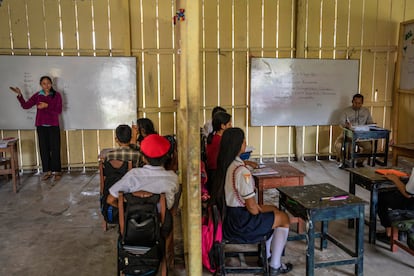
In Peru’s public schools, law and order starts with one’s hair. Male students will be required to keep their hair short and female students will have to forget about hair dye and makeup. There will also be rules about skirt length and the use of cellphones during class. President Keiko Fujimori on Monday announced new school discipline regulations that restore expulsions for serious offenses and reintroduce grades for conduct. The government says the goal is to combat violence and harassment in the classrooms.
“Order must return not only to the streets. It must also come back to our schools, to our classrooms,” Fujimori said during a ceremony in Chaclacayo, east of Lima.
The president governs a country that is battered by extortion and killings linked to organized crime, and she has made the restoration of law and order her main political banner. Her campaign policy plan was called, in fact, ‘Peru with Order.’ For now, that goal seems easier to apply to pupils’ hairstyles than to criminal gangs. “The most ill-mannered students will not be in the classrooms,” she warned.
“Boys must come with short hair. It is totally forbidden to dye your hair or wear makeup,” said Fujimori. Education Minister José Antonio Chang spelled out the limits of the new discipline. No makeup, no painted nails and no dyed hair. Boys must wear short hair and girls’ skirts must fall below the knee. Miniskirts are out of the question. Cellphones will also be banned unless the teacher authorizes them.
The strict rules on personal appearance will apply only to public schools. Private schools, which wealthier families typically attend, will be able to keep their own rules.
“I think these are absolutely mistaken measures and they will set our society back more than three decades,” said former deputy minister for pedagogical management Ana Andrade Pacora. “These measures amount to a declared renunciation by the school of educating young generations in a comprehensive way and in citizenship. I don’t think they will work,” she said.
The specialist also considers the restrictions on female students’ clothing to be sexist. “The girl is the one who has to take care of herself, instead of changing society so that men stop harassing women. That is the message that’s being conveyed,” she warns.
The new rules will affect a public education system that serves more than six million students. But behind the government’s crusade against hairstyles lies a far less picturesque problem. Between January and August of this year, the Peruvian Ministry of Education recorded 11,805 cases of school violence. In September, a 16-year-old teen reported being sexually assaulted by classmates during a trip on a school bus. The courts ordered the preventive detention of six students from a school run by the Navy. The scandal prompted the government to intervene in the school and reopened the debate over violence in classrooms.
“It’s not about how you look, it’s about how you treat people,” Andrade says. For the former deputy minister, confusing students’ appearance with their capacity to respect classmates is a mistake. “It’s a total absurdity,” she concludes.
Fujimori defended the new measures as a way to teach responsibility. “I know it can be quite strict, but believe me this will be important throughout life,” she said. The regulations also include awarding grades for conduct and allowing school managers to kick out students who commit serious offences. “All these criteria will establish dis-ci-pli-ne,” the president said, emphasizing each syllable.
Sign up for our weekly newsletter to get more English-language news coverage from EL PAÍS USA Edition









































