
Mexico joins Latin American crackdown on cellphones in schools
The Sheinbaum administration will restrict phones from November, while Brazil, Chile, Argentina, and Colombia move ahead with different approaches to limit devices in classrooms and playgrounds
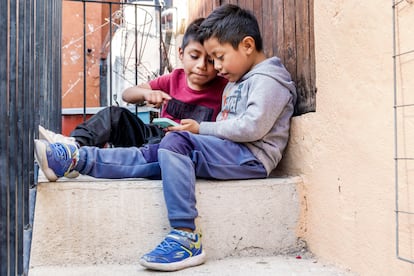

Children in Mexico spend up to seven hours a day in front of a screen. In light of this reality, the government has decided to completely restrict the use of cellphones in elementary and middle schools. President Claudia Sheinbaum, who has avoided calling the initiative a “ban,” says she wants to fight phone addiction among young people to “protect their development and creativity.” The country thus joins Brazil and Chile among regional states with stricter rules on cellphone use in classrooms and moves ahead of others, such as Argentina and Colombia, where regulation is still underway.

As of November 3, elementary and middle school classrooms and playgrounds in Mexico will be screen-free. Sheinbaum and Education Secretary Mario Delgado have spent weeks presenting data, backed by experts, that outline the problem: more than 83% of parents are worried about their children’s device time and more than 70% of household heads support regulating use. It is not only an adult perception: four in 10 Mexican students say their classmates are distracted by digital devices in most or all classes. In addition, a survey of over 565,000 teachers found that 81% support the measure. Delgado also highlighted the impact of social networks on children and adolescents, noting that U.S. courts have ruled that these platforms are designed to be addictive and cause harm to mental health.

The PISA 2025 report, in which Mexico slipped in mathematics, revealed that almost half of the time students spend on screens at school (2.7 hours) is for leisure. Devices have shortened the attention span readers use to comprehend a text. Following the government forums and the release of the results of the international study, Mexico has joined more than half of the world’s countries that already have restrictions on the use of devices in schools. Depending on the region, the measures range from banning cellphones during the school day to total restrictions on certain social media platforms.
In Latin America, Brazil removed cellphones from schools at the start of the last school year in January 2025. The Lula government decided to ban them both in classrooms and during recess, in public and private schools, to protect students’ mental and physical health and to improve academic performance. The debate was intense, but the overall assessment is positive. On the first anniversary of phone-free schools, eight in 10 Brazilian students reported “paying more attention” in class and 65% of teachers said incidents of online bullying had fallen, according to an evaluation of the law commissioned by the parliamentary education bloc. Even students unhappy with the new rule acknowledged the benefits. Lívia de Souza Xavier, 14, said she concentrates more and her grades have improved significantly, according to testimony collected by the NGO Alana, which focuses on children. Another student said she now talks more with classmates and, if she cannot find them, she goes to look for them, as reported by Naiara Galarraga Gortázar.
Chile has moved in the same direction since February, when Law 21.801 came into force, restricting the use of phones and any other internet-enabled device in preschool, elementary, and high school education. The prohibition, however, is not absolute: the law exempts pedagogical use, meaning cases in which a teaching activity requires a device. The legislation also allows other exceptions that must be justified by parents or guardians and generally require authorization from the school administration. These include special educational needs, emergencies or disasters, the student’s health conditions, and personal safety. So far, enforcement and monitoring of the regulation have been left to Chilean educational institutions. With reporting from Ana María Sanhueza.
In Argentina, regulation is advancing at the provincial level. Most provinces have passed laws banning cellphone use at all levels and allowing it only exceptionally, generally in high schools, and always for pedagogical purposes and at the express request of educational authorities. That group includes, among others, three of the country’s four most populous districts: the City of Buenos Aires and the provinces of Buenos Aires and Santa Fe. Other important jurisdictions, such as Córdoba and Tucumán, have left each school to set its own phone-use rules. Finally, provinces like Mendoza have authorized cellphone use “to improve the teaching-learning process” but have faced growing resistance within schools. With reporting from Javier Lorca.
The Lula government, which welcomed the PISA results optimistically, noted that 81% of Brazilian students examined attended schools that restrict cellphone use.
The debate has recently begun in Colombia, where the decision is left to each institution. The exception is Bogotá: on September 7 it launched the policy “(Re)connect to learn,” which requires public and private schools at all levels to implement a ban on cellphone use throughout the school day, including breaks, for both students and teachers. It only relaxes the restriction for health, inclusion, or emergency reasons, and allows pedagogical use from eighth grade. Schools now have six months to adjust their rules and define how the restriction will be applied, while the Health Secretariat will assess results after one year. Reported by Juan Esteban Lewin.
Mexico’s PISA 2025 results, even with phones present in schools, show indicators below the OECD average in all areas, although the country outperforms almost all the mentioned Latin American countries in mathematics. For example, it scores higher than Colombia, Brazil and Argentina, though it is surpassed by Chile, as in science and reading.
Mexico is thus undertaking the experiment of removing phones from schools to try to restore space for concentration, coexistence, and learning. From November 3, the country will be able to measure whether limiting screens also translates into better learning outcomes.

Créditos:
Sign up for our weekly newsletter to get more English-language news coverage from EL PAÍS USA Edition









































