
Neither US intervention nor Communist stagnation: Harvard’s proposed plan for Cuba
A 14-member working group has published a document calling for an end to sanctions, a robust economic reform, and a negotiated transition
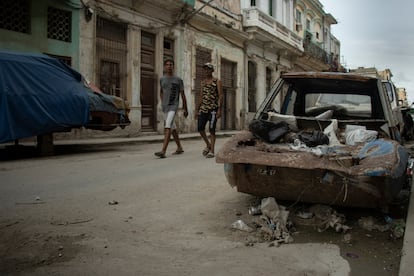

Saying that Cuba is in crisis is hardly news. It has been for decades. Nor is it news that Washington’s sanctions have worsened the health of an economy that is now on life support. Both statements are axioms. But talking about Havana is a high-risk sport.
In that ring, the two truths rarely meet. They exclude one another and push people into the trenches of ideology. Either Cuba is as it is because of the Communist Party — the only legal party in the country — or because of Washington’s sanctions. One is accepted. Never both. But for a group of 14 experts convened by Harvard University, this shouting match must stop. All agree: maintaining the status quo while the country collapses is unsustainable.
This appeal to common sense is based on a dialogue that began in January, when the White House imposed a de facto fuel blockade on Havana. The measure came after another dramatic move that rocked the island: the capture of Venezuelan President Nicolás Maduro. That is how Alejandro de la Fuente, coordinator of Harvard’s Working Group on the Future of Cuba, explains it to EL PAÍS. “President Donald Trump did not create the Cuban crisis, but he certainly made it much worse,” he says over the phone. The result is a 20-page document that examines causes and consequences and suggests a democratic roadmap for the country, without bombast.
The diagnostic data are stark. They come from an unusual mix: official figures combined with those from independent bodies. GDP fell 11% between 2019 and 2024. A third of the population has emigrated over the past decade, an outflow the report compares to that of nations in civil war. The government’s voracious pursuit of hard currency has emptied doctors’ offices and hospitals to export medical personnel. Schools lack teachers. Agriculture collapsed by 60% in that period. Eating congrís — the typical dish of rice and beans — has become a luxury.
Meanwhile, state investment has concentrated on building empty hotels — investment in tourism has been 11 times higher than in health, education, and social care combined; 20-hour daily blackouts are the norm; And those who dare to protest end up behind bars: there are 1,300 political prisoners. In fact, the island ranks second worldwide in incarcerated population per capita, behind only Nayib Bukele’s El Salvador.
Participants in the report include Jeffrey DeLaurentis, the U.S. chargé d’affaires in Havana during the Obama-era thaw; former Mexican ambassador to the island (2002–2005) Roberta Lajous; Cuban opposition figure Manuel Cuesta Morúa; exiled artist Tania Bruguera; and economist Omar Everleny Pérez. “This is a working group with participants who come from very diverse positions. We circulated many documents among everyone; we made calls… This summary we circulated was not going to reflect 100% the individual views of each person,” De la Fuente says. He adds: “We do not want to antagonize the White House, but we do want to steal its initiative.”
Dialogue with the authorities
In the text, published on September 10, the Group — an alliance between the Program on Cuban Studies, the Afro-Latin American Research Institute and Harvard’s David Rockefeller Center for Latin American Studies — calls for a negotiated exit from the crisis. An unforgivable heresy among the most radical circles of the Florida exile community. “Cuban authorities must take the initiative in this process and become facilitators. This is not a premise shared by all political actors in Cuba and in the diaspora. Our conviction, however, is that resolving the current crisis requires the participation of everyone,” the document reads.
The experts move away from maximalist positions that call for military intervention or a sudden regime change. As an alternative, they lay out a roadmap that includes amnesty for political prisoners, the dismantling of laws that have enabled repression, the lifting of U.S. sanctions, further economic reforms to empower the nascent private sector, and the country’s reentry into international financial institutions such as the IMF and the World Bank. The publication also advocates establishing a constituent assembly over the long term.
For former Mexican ambassador to the island Roberta Lajous, a hypothetical transition must consider both truths at once — something neither Washington nor Havana has openly admitted in six decades of hostility and propaganda. “The embargo and U.S. sanctions have only served to justify the continued existence of a single political party that, to date, still considers any kind of opposition illegal,” she tells EL PAÍS by phone.
The diplomat argues that U.S. measures have bolstered the Cuban system’s victim narrative — the David anti-imperialist against the U.S. Goliath — and have failed to achieve the White House’s objective: toppling the regime. As a result, ordinary citizens have borne the consequences. “It is not possible to continue with this situation of suffering for the population,” she concludes.
The working group’s document is final but not definitive. In other words, it will serve to “create dialogue” in the coming months, De la Fuente explains. The idea is to listen to everyone, from the hardest-line opposition to the ruling party. “Many maximalist positions are not unreasonable. Those who argue [that it is naïve to expect Cuban authorities to sit down and talk] are not without reason. But it must be tried [...] it is the Cuban state’s responsibility to find solutions to this problem. That is not a duty of the White House or the State Department,” the academic stresses.
The Cuban government was quick to respond in its customary tone. Foreign Minister Bruno Rodríguez said last week that the publication is “propaganda designed by the State Department” to “confuse and manipulate the U.S. and international public.”
The question the report leaves is not whether Cuba needs a transition. It is whether anyone, in Havana or in Washington, is willing to stop shouting.
Sign up for our weekly newsletter to get more English-language news coverage from EL PAÍS USA Edition









































