
Trump corners Cuba’s political leadership in a bid to force regime change
Washington’s sanctions against President Díaz‑Canel and his inner circle add to the energy blockade and the indictment of Raúl Castro. This Friday marks the deadline for foreign companies to stop collaborating with the island
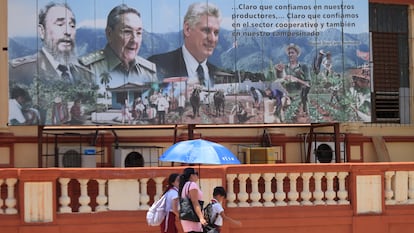

The grill‑strategy is starting to work. With every degree the heat rises, the situation in Cuba — both on the streets and in the regime’s top offices — becomes more and more unbearable. The fall earlier this year of Venezuela’s Nicolás Maduro, Havana’s key ally, and the subsequent energy embargo on the island marked the beginning of a decline that now seems unstoppable.
The indictment of Raúl Castro, former president and brother of the Cuban Revolution’s historic leader, turned the temperature up several more notches. Now, the U.S. Treasury Department’s decision to impose sanctions on the current president, Miguel Díaz‑Canel, on members of the Castro family, and on key regime institutions raises the heat even further.
Late Thursday night, while U.S. President Donald Trump was busy dealing with a mini‑revolt within the Republican Party over the war in Iran and his idea of handing public money to his allies — $1.776 billion, no less — the news broke. The U.S. Treasury Department announced a new round of sanctions against the island’s political leadership.
The sanctions target Díaz‑Canel, Alejandro Castro Espín, son of former president Raúl Castro, and prominent entities such as the Ministry of the Revolutionary Armed Forces and the Committees for the Defense of the Revolution. Washington thus takes another step toward its goal: regime change after 67 years of communist rule.
Havana responded immediately. The “vile inclusion” of Díaz‑Canel, members of his family, and other individuals and institutions on the sanctions list is “the latest example of the U.S. interventionist plan” to portray Cuba “as a threat to the national security of the United States,” said Foreign Minister Bruno Rodríguez.
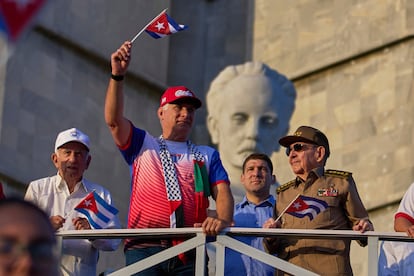
But the complaint goes no further than that — just a bit of foot‑stomping. The Cuban government knows perfectly well it has no weapons with which to fight its old nemesis, to whom it is now offering timid signs of détente. Such as the unprecedented meeting in Havana between CIA director John Ratcliffe and representatives of the island’s Interior Ministry on May 14.
No sooner had the sanctions been announced than the U.S. secretary of state, Marco Rubio, issued a warning to anyone considering cooperating with the regime. He said that anyone providing services to the sanctioned entities risks being punished as well.
“Foreign banks and other companies that provide services to these entities should freeze those activities,” he said in a message on X. “The Trump Administration will no longer tolerate radical Marxist regimes in our hemisphere seeking to threaten U.S. national security and engage in influence operations to export their poisonous and evil ‘revolution.’”
End of the ultimatum
This Friday also marks an ultimatum — yet another step in the strategy of turning up the heat. The Treasury sanctions were announced one day before the deadline for the White House executive order issued on May 1 to take effect. The order threatened to freeze the U.S.-based assets of foreign companies or individuals doing business with the regime — especially with Cuba’s opaque military conglomerate GAESA, which controls 40% of the country’s economy and owns many of the establishments operated by multinational tourism companies.
Executive Order 14404 gives Washington wide room to maneuver. On one hand, it puts multinational corporations in the crosshairs. But it also challenges any person or entity that provides material or financial support to the island’s government. Energy, defense, finance, mining, security… every sector could be affected. The text is ambiguous, leaving unclear exactly whom Washington will target.
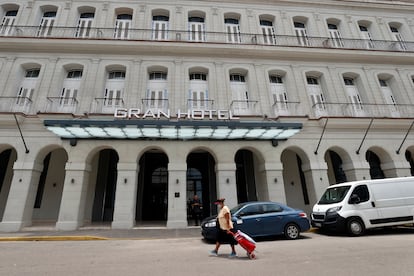
The threat has already had an impact. Hotel groups such as Iberostar and Meliá have announced they are stepping back from the island. The first was Iberostar, the second‑largest chain in Cuba (18 hotels), which has been in Cuba since 1993. In the early hours of Monday, the Balearic company announced it would stop managing the 12 hotels owned by Gaviota, GAESA’s hotel subsidiary. And one announcement triggered another. Meliá, the chain with the largest footprint in Cuba (34 hotels), said on Wednesday that it would “immediately” cease operating 15 hotels.
The announcement of the sanctions comes two weeks after yet another measure to step up pressure on the regime. On May 20, the U.S. Department of Justice filed charges against Raúl Castro — the true strongman of the regime at 94 — and five other military officers for murder, conspiracy to kill U.S. citizens, and destruction of an aircraft.
The charges, filed in Miami in the Southern District of Florida, referred to events from 30 years ago: the downing of two small planes belonging to the anti‑Castro organization Brothers to the Rescue. But that hardly matters. Everything is fair game in the strategy of maximum pressure on the regime.
“My message today is clear. The United States and President Trump does not and will not forget its citizens,” said acting Attorney General Todd Blanche, whom the president is expected to repay by making him the permanent attorney general.
All of this is unfolding amid a brutal economic crisis, in which most of the population is struggling to obtain even the most basic goods. The ironclad energy blockade imposed by Washington on the island is triggering a humanitarian crisis. There are frequent blackouts and barely any fuel to power the country’s electrical grid or fill the tanks of a nation desperately seeking a way out of an impossible situation.
Sign up for our weekly newsletter to get more English-language news coverage from EL PAÍS USA Edition









































