
Raúl Castro indictment corners Castroism and shows how far Trump is willing to go in Cuba
US justice accuses the 94-year-old former president of the deaths of four people in the shootdown of two planes in 1996 and takes a decisive step in plans to force regime change on the island

Almost at the same time on Wednesday morning, U.S. Secretary of State Marco Rubio spoke from Washington while Cuba’s president, Miguel Díaz-Canel, spoke from Havana. Both were addressing the people of Cuba. The former highlighted the date, May 20, as the day “the Cuban flag flew for the first time over an independent country” in 1902, an image preserved in a period photograph that forever enshrined the birth of the republic. The latter, however, said that date should be credited for only one thing: “Having planted in Cubans of that era an anti-imperialist sentiment.” Rubio invoked 1902 as an epic moment, but Díaz-Canel asked the people not to forget that May 20 marks the day of U.S. “intervention” and “interference” in Cuba. That has been the narrative between Washington and Havana to this day: two governments wrestling over the meaning of history.
At the same hour that Rubio’s Spanish-language speech and Díaz-Canel’s “in the Cuban way” message were made public, Cuba’s state power company announced that the National Electric System’s available capacity was 1,300 MW against a demand of 2,780 MW. In other words, a long day of blackouts stretched across the island’s sleeping hours, where any republican epic seems to have been swallowed by the chaos of the Revolution. There is no longer a throng of students descending the steps of the imposing University of Havana; the Hotel Nacional does not escape the blackouts; the storied Vedado neighborhood lacks water; and there are not even enough tourists left to take photos outside the Capitolio.
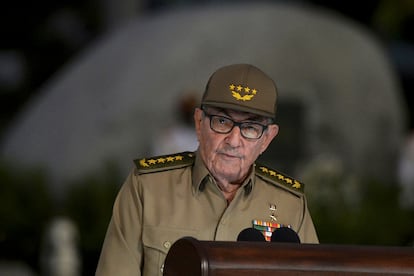
That same Wednesday, another symbol came to rest on the date of May 20. It was the day chosen by the U.S. government for the Department of Justice to file federal criminal charges against Raúl Castro for his responsibility in the deaths of four people after ordering the shooting down of two planes operated by the humanitarian organization Brothers to the Rescue on February 24, 1996.
The date drew attention: the same day Castro was charged with conspiracy to kill Americans, destruction of an aircraft, and murder, Rubio was telling Cubans that his government wanted to help to “not only alleviate the current crisis, but also to build a better future.”
Since the oil blockade decreed at the end of January, there have been almost-weekly threats: sanctions on intelligence services, pressure on the military-economic conglomerate GAESA, financial restrictions, and even a visit by the CIA director to Havana to make clear that Cuba does not represent a threat to U.S. national security. Added to this is what has become the most symbolic blow to Castroism: prosecuting Castro near the end of his life, as if history were now placing him in front of a kind of political firing squad.
In Fidel Castro’s absence, it is his brother Raúl, at 94, who seems to be assuming his government’s debts with the exile community. Rubio insisted that if Cubans today live without electricity, without fuel or food, it is “because those who control your country have plundered billions of dollars.” And Rubio named that swindler: GAESA, the military conglomerate that controls between 40% and 70% of the country’s economy.
Some have begun to long for those early 20th-century times, including people who do not really know what they were like, but who in any case do not believe they were worse than the present day. Sergio Ángel, director of the Cuba Program at Colombia’s Sergio Arboleda University, says that, just as the Platt Amendment — which guaranteed U.S. domination in Cuba — opened the doors to anti-imperialism and to the 1959 Revolution, there is now a return to rethinking the Republic. “It has been almost three quarters of a century since Cubans have known democracy. That has led to a revaluation of the Republican period. A revolution that ended up subverting its own ideals causes those times to begin to be idolized,” he says.
Nevertheless, Rubio’s proposal, the historic timing of the charges against Castro, and Washington’s still-unclear intentions about the island’s future also raise other doubts. “One thing would be to use the date to found a new narrative that builds a new nation, but this is a context in which the Trump administration has spoken of the importance of reasserting its dominance over Latin America, of the need to control what happens in its backyard,” says Michael Bustamante, a University of Miami professor and author of the book Cuban Memory Wars. “It may be that the message is different — that what is being proposed is not simply a refounding of the Cuban nation, but a return to a time when Cuba suffered from a tremendous dependence on the United States. Part of the White House’s current strategy seems to be to turn Cuba into a dependent state, so that the authorities realize that the only way out must pass through Washington.”
GAESA, the cog in a system
People in Cuba are overheated, caught between temperatures of nearly 30 degrees Celsius and the tension of not really knowing what Trump means when he talks about “liberating Cuba” or guaranteeing “a new dawn” for the island. That said, the public has been witnessing, for five months, the greatest pressure exerted among the 12 administrations that have occupied the White House since the triumph of the Revolution.
“Never has a U.S. government put so much pressure on Cuba,” says Andy Gómez, former director of the Cuban and Cuban-American Studies Institute at the University of Miami, who helped shape a policy proposal on U.S.-Cuba relations during the Obama era. “They have put a noose around the Cuban government, a noose that the people are also suffering in a way not seen even during the Special Period.”
Rubio’s targeting of GAESA has put the conglomerate on the radar; it has under its umbrella hotels, hard-currency stores, and export companies. For years it was run by Raúl Castro’s former son-in-law, the late Luis Alberto Rodríguez López-Calleja, father of Raúl Guillermo Rodríguez Castro, alias “El Cangrejo,” the grandson who sits at the table in each meeting about the country’s fate with U.S. officials.
But economist Miguel Alejandro Hayes, who has researched the economic empire of Castroism, makes an important distinction: “GAESA is an instrument of Raúl Castro, not of the system.”
“Cuba has always been controlled, first by Fidel, then by Raúl Castro. That attempt to explain the Cuban state as an appendage of a great economic power is completely wrong,” Hayes argues. “GAESA hasn’t always been around; it’s been around for no more than 20 years. GAESA has always been specifically Raúl’s tool, part of his authoritarian scheme to dominate the Cuban economy. It isn’t GAESA that’s in charge in Cuba; it’s a military elite, of which GAESA is, formally speaking, the largest and most powerful instrument, but it isn’t the only one.”
The unfathomable future
In his long Spanish-language message, Rubio told Cubans that Trump had an offer: a “new relationship between the U.S. and Cuba,” without GAESA as intermediary — in other words, without the government. He added: “In the U.S. we are ready to open a new chapter in the relationship between our people and our countries. And, currently, the only thing standing in the way of a better future are those who control your country.”
“What Rubio seems to propose is a model of relations that seeks to bypass the Cuban state and strengthen the private sector and other independent actors on the island directly,” says María José Espinosa, an expert in foreign policy and executive director of the Center for Engagement and Advocacy in the Americas (CEDA). “The Trump administration has made repeatedly clear that it does not want U.S. capital, tourism, or trade to flow through institutions linked to the Cuban armed forces. In that sense, this ‘new relationship’ is not only economic; it also seeks to alter power dynamics on the island.”
Therein lies, for some, the great question of this chapter of tension that opened after the capture of Nicolás Maduro in Caracas and that positioned Cuba as the potential target of a new U.S. offensive: on what terms would a relationship be conducted with a president who in his first term dismantled the steps the Obama administration had taken to rebuild diplomatic ties between the two countries? “U.S. law, the Helms-Burton Act, says that to lift the economic embargo there has to be regime change, so that complicates matters,” Gómez says. “Trump cannot suspend the economic embargo; at most he can do what Obama did and a bit more. So the responsibility lies on Cuba’s side. The question is: what moves can Cuba make that would facilitate Rubio and Trump establishing relations with the island?”
The Cuban government, however, shifts from intransigence to cooperation and back to intransigence again, depending on the tone of threats from Washington. Díaz-Canel, who responds in rhythm with tweets to each announcement, challenged the United States on Wednesday. “Lift the blockade and we’ll see how we play,” he said, referring to Rubio’s remarks about GAESA’s economic power and Cuba’s fate. Castro himself has not uttered a single public word about the indictment against him.
“If the [Trump] administration continues intensifying pressure without obtaining the concessions it seeks, I do not think one can assume that Washington would rule out military action,” Espinosa says. “The current trajectory risks triggering a prolonged period of humanitarian deterioration and slow suffering, without real change for the people. What remains unclear is how Washington expects that transformation to occur: through an economic deal, coercive pressure, conditioned aid, or even higher levels of confrontation.” She adds that the underlying question is “whether a change driven from Washington would truly empower Cubans inside the island or simply replace one form of concentrated power with another more tied to U.S. economic and geopolitical interests.”
Sign up for our weekly newsletter to get more English-language news coverage from EL PAÍS USA Edition









































