
Steven Soderbergh brings us John Lennon’s Last Interview
In a documentary using family album photos and AI, the filmmaker has illustrated a radio interview with the ex-Beatle and Yoko Ono that took place on the morning of his murder
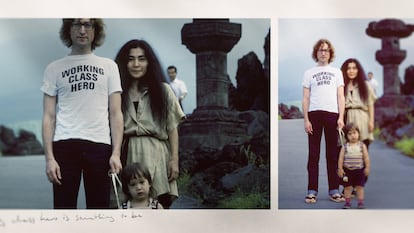

On December 8, 1980, John Lennon and Yoko Ono sat down to talk to a small crew from San Francisco’s KFRC radio station in their Dakota Building apartment in New York. It was the only radio interview they gave to promote their album Double Fantasy, released three weeks earlier. For two hours and 45 minutes they spoke calmly, optimistically and, in Lennon’s case, in an almost messianic voice, about life. That night, returning home, Lennon would be shot dead by Mark David Chapman. Given the circumstances, the interview could be viewed as prophetic, which is Steven Soderbergh’s angle in his documentary John Lennon: The Last Interview, presented at Cannes in a special session.
Soderbergh does not mince words. The title says it all. And at the beginning of the documentary, what Lennon says about the song (Just Like) Starting Over sets the stage. The theme is the couple’s reconciliation, after a turbulent few years, and celebrates the rebirth of their love story. It weaves between melancholy and optimism — one verse says “No one’s to blame, I know time flies so quickly” — although Lennon insists that the lyrics go deeper and are actually about the gulf between men and women triggered by the feminist boom of the early 1970s. The message of reconciliation is meant to apply to men and women in general, he explains. Soderbergh, who edits all his films, intends that the documentary serve as a tribute to Lennon.
Lennon’s last interview had previously never been accessed in its entirety. After the ex-Beatle’s death, only excerpts were broadcast. Now Soderbergh has the Lennon family on side, and has based the visual part on archive material, having compiled more than 1,000 images. His approach did, however, have its limitations. Lennon and Ono talk about their relationship, fatherhood, the future and sometimes get mired in the abstract. Those moments account for 10% of the film and had to be illustrated in an unconventional way. Soderbergh sought the support of his financial partner Meta, the tech giant that is also co-sponsoring the Cannes festival, drawing on MetaAI so that the viewer experiences what Soderbergh calls “thematic surrealism” in an interview with Deadline.
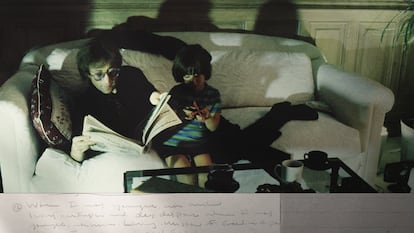
With that interview, Soderbergh notes that, after checking to make sure the audio from the conversation was in good condition (and it was, because it was recorded using the best equipment available at the time), “I wanted to respect the chronology of the conversation because there was a structure and a rhythm.” First, he edited the audio. Then he incorporated interviews with journalists, who talked about their experience. Among them were the radio station’s musical director Dave Sholin, broadcaster Laurie Kaye and engineer and producer Ron Hummel. The fourth participant, Warner Bros. Records executive Bert Keane, died during the production of the documentary. Finally, he added the archive images, illustrating the philosophical interludes with AI surrealism. “We met with Sean Lennon and he trusted us,” Soderbergh says.
Keane was the connection between the label and the journalists. That morning of December 1980, the conversation touches on the couple’s determination to return to the music scene. The album was selling well and there was plenty of laughter to punctuate the more serious moments. Lennon, who had just turned 40, reflects on himself and his generation — “the ’60s group that has survived” — and claims to contribute his ideas “not to tell people how to feel. Not as a preacher, not as a leader, but as a reflection of us all.”
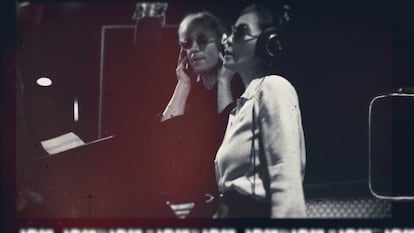
The interview takes place right after a mythical photo shoot by Annie Leibovitz for Rolling Stone. That’s why, at one point, only Ono appears, while Lennon finishes working with Leibovitz. The documentary helps us understand the artistic and sentimental chemistry between the two, particularly when the ex-Beatle describes their encounter at an exhibition of Yoko Ono’s conceptual artwork in London, and how he subsequently began to court her. “I was surprised at how open and excited they were to talk,” Soderbergh says. “You would think they had never been interviewed before.”
The film has no big reveals. The radio interview is, after all, the first in a series of promotional slots flagging up Lennon’s return to music. Double Fantasy was Lennon’s first album in five years, marking the end of his sabbatical that started in 1975 when his son Sean was born. At that point, he became what he called a “housewife.” This was a revolutionary idea at the time; when Sean turns five, he gives him breakfast “without sugar,” lets him watch Sesame Street on TV and then he and Yoko Ono disappear until the next day when the nanny arrives... something that was quite common among a certain demographic in those days. In the interview, he talks about his experience as a stay-at-home dad with excessive joviality, and you end up suspecting that he’s promoting his happiness to sell the album. He even says that he likes disco music.
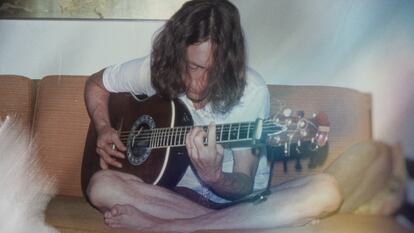
Prior to the interview, questions about the Beatles were said to be off limits. However, Lennon brings up the subject and talks quite naturally about them. Soderbergh is impressed by how deep the pair go on a variety of subjects and how love is at the heart of their conversation. “Everything that they said 45 years ago is not just relevant today. It’s even more relevant in terms of relationships, politics, how we treat each other. How systems work on the individual and above all on the importance of love in our daily life and our world.”
Lennon says in the interview “Let’s try and make the ‘80s good. ‘Cause it’s still up to us to make what we can of it.” After the interview, Ono and Lennon went to the recording studio to work on their next album. That night, at the door of the Dakota building, Chapman was waiting.
Sign up for our weekly newsletter to get more English-language news coverage from EL PAÍS USA Edition









































