
The photo that was never taken of John Lennon’s death
The painter Robert Morgan, a neighbor of the Beatle in 1980, looked out the window when he heard the shots and grabbed his camera, but when he focused on him in his final moments, he decided he couldn’t take the picture. So he made a painting
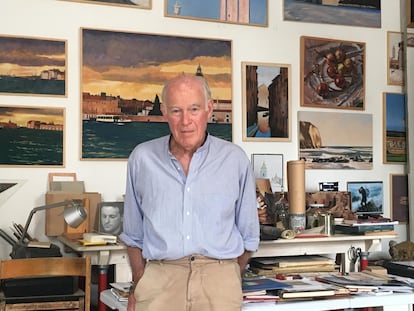

Robert Morgan, an 82-year-old American painter who has been living in Venice for half a century, says he is not famous and downplays his importance, though he has crossed paths with others who were. For example, his friend, the Russian poet Joseph Brodsky, winner of the Nobel Prize in 1987, who dedicated his beautiful and celebrated book on Venice, Watermark, to him. He also knew Peggy Guggenheim when he arrived in the city in 1973.
But his lesser-known story — and perhaps the most curious — is his fleeting contact with John Lennon, whom he lived next to for two years in New York, and what happened the day Lennon was murdered at the entrance of his home, on December 8, 1980.
It is the story of a renunciation, of the responsibility of bearing witness, and of a photograph that could have been historic but was never taken. Morgan chose not to take it: he leaned out the window when he heard the gunshots and saw the whole scene. He grabbed his camera but couldn’t bring himself to press the shutter.
“I saw John, still alive, moving on the ground, but I realized I couldn’t take that photo of someone who was dying — it didn’t feel right,” he recalls. So he didn’t. He set the camera aside and decided that instead of taking a photo, he would paint a picture.
“I’ve never regretted it,” he insists. And in fact, he never sold the painting. It still sits in his studio in Venice, in the Dorsoduro district. Twenty years ago, he offered to show it to Yoko Ono, but she wasn’t interested.
Morgan, who gave his testimony in the latest documentary about the musician, Borrowed Time: Lennon’s Last Decade, released in April in the U.K., is aware that in today’s world, where everything is recorded, photographed, and documented, his decision is particularly odd. Yet he says that whenever he has told this story, everyone believes he did the right thing.
“It was the decent thing to do, they tell me,” although he admits that others then add he would have made a fortune. “I’m neither rich nor famous, but that’s fine with me,” he concludes.
Looking back, Morgan recalls the lost normality of famous personalities. He lived with his first wife at the Majestic, 115 Central Park West, apartment 12G. Their windows faced 72nd Street, with views of Central Park and, directly opposite, the south façade of the Dakota building, where John Lennon and Yoko Ono lived. The building was famous for being the setting of Roman Polanski’s Rosemary’s Baby, and other celebrities lived there as well.
For instance, it was normal to run into Leonard Bernstein, Lauren Bacall, Mia Farrow, and Zero Mostel, who, like Morgan, lived at the Majestic. “John was kind and cordial with people who approached him to say hello when he walked through the neighborhood,” he recalls.
Even his killer, Mark David Chapman, was sometimes at the entrance of the building with other fans. “That day changed everything,” Morgan remembers. After the murder, fear spread — celebrities began going out with bodyguards, and fans weren’t allowed near them.
On the night of the attack, Morgan and his wife sat down to watch the evening news around 11 p.m. New York is noisy, but even so they clearly heard a series of loud bangs. “I’m a hunter, and I knew they were gunshots,” he says.
Looking out the window of his studio, he saw a black limousine stopped in front of the Dakota and a man lying on the ground next to the open rear door. “I recognized John, with his round glasses. He was wearing cowboy boots.”
The car door closed, the vehicle backed up, and drove toward Columbus Avenue, where there was always a police patrol, which arrived within five minutes. Morgan says the officers got out with their guns drawn.
By then he had already grabbed the camera on his desk, a Nikkormat EL with a telephoto lens that he often used to take photos from the window. “Through it, I could see John’s face — it was the face of a dying man. And then I told myself: this isn’t my job. Whoever is down there deserves one last moment of privacy.”
On the night of the attack, Morgan and his wife sat watching the news on TV around 11 p.m. New York City is noisy, but they still clearly heard a series of loud gunshots. “I’m a hunter, and I realized they were gunshots,” he says. When he looked out his studio window, he saw a black limousine stopped in front of the Dakota Building, and a man lying on the ground by the open back door. “I recognized John, with his round glasses; he was wearing cowboy boots.”
The car door closed, the vehicle reversed, and drove toward Columbus Avenue, where there was always a police patrol car, which arrived within five minutes. Morgan says officers got out, guns drawn. He had already grabbed the camera he kept on his studio table, a Nikkormat EL with a long-lens lens, which he used to take photos from the window. “I could see John’s face through it; it was that of a dying man. Then I said to myself: this isn’t my job. Whoever’s there deserves one last moment of privacy.”
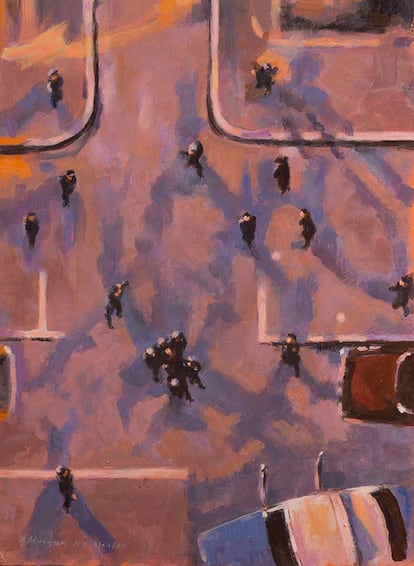
His job was to paint, and he set to it immediately. He began sketching, fixing in place the image of what he was seeing from the window. Meanwhile, no ambulance arrived, and five officers carefully lifted Lennon and carried him to a police car. Morgan remembers they placed him in the back seat, shut the doors, and sped off toward Roosevelt Hospital.
That was the scene he painted at the time, keeping his distance, to leave a record of a historic moment — like a painter from a previous century depicting a battle or a coronation before the invention of photography. Morgan recalls that the killer, Mark David Chapman, had turned himself in at the building’s front desk, but until they found him, police officers searched the walls of the entrance with their guns drawn — and in the meantime, they could not help Lennon. They did so later.
This painting is a rarity in Morgan’s body of work, which is primarily focused on landscapes, though he also creates portraits and still lifes. For half a century, he has been painting corners of Venice, and he says he never tires of it —there’s always a new angle that surprises him.
“I love the light, which is constantly changing; the light in Venice falls on very beautiful things,” he says.
His favorite area is where he has lived the longest, in Zattere, along the Giudecca Canal, where he would wander with Brodsky. “I never get tired of anything; I’m always happy to see the sun. Life for me is a delight, every moment.”
He continues to go to his studio every day to paint what he sees and what he encounters. “Just look out the window,” he says. Just like that sad day in 1980.
Sign up for our weekly newsletter to get more English-language news coverage from EL PAÍS USA Edition









































