
Miguel Díaz-Canel: ‘Stepping down is not part of our vocabulary’
The Cuban president tells NBC that he has no intention of resigning, but that he is open to dialogue with Washington
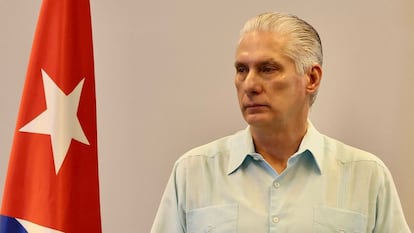

Miguel Díaz-Canel has issued a clear warning to the United States in response to threats of regime change. “Stepping down is not part of our vocabulary,” the Cuban president said in an interview with the U.S. network NBC. “In Cuba, the people who are in leadership positions are not elected by the U.S. government, and they don’t have a mandate from the U.S. government,” he said when asked if he has considered leaving his role in exchange for lenience from Washington, which has imposed an economic blockade in a bid to strangle the communist leadership. “We have a free sovereign state, a free state. We have self-determination and independence, and we are not subjected to the designs of the United States,” Díaz-Canel said.
The Trump administration has been blocking oil reaching Cuba since January as a measure to bring down the communist regime that has ruled the island since the 1959 revolution. The blockade has intensified the energy crisis that the country was already suffering. Deterioration of its electrical infrastructure had been causing blackouts for some time but that situation has been made far worse by the blockade, which has stifled the local economy and plunged Cubans into permanent survival mode. Díaz-Canel painted a picture of the current crisis in a recorded message sent to the UN on April 9, stressing that the prolonged power cuts have generated water shortages as well as shortages of liquefied gas, with a heartbreaking impact on hospitals. More than 96,000 citizens, including 11,000 children, have been left in limbo, waiting for surgeries that are never undertaken because the operating rooms have no guaranteed power.
When NBC asked Díaz-Canel if he would be willing to leave his post to appease Washington, the Cuban president responded with obvious anger. “Do you ask that question to Trump?” he said, querying whether NBC had come up with the question or if it was “coming from the State Department of the U.S.” He went on to say that there could be dialogue with Washington without pressure or attempts at U.S. intervention. “The concept of revolutionaries giving up and stepping down — it’s not part of our vocabulary,” he said.
Díaz-Canal’s statements come after months of tension with the White House. In mid-March, Trump dialed up the ante by telling reporters in the Oval Office, “I do believe I’ll be … having the honor of taking Cuba. Whether I free it, take it — I think I could do anything I want with it. You want to know the truth. They’re a very weakened nation right now.” At the end of March, Secretary of State Marco Rubio, who is of Cuban heritage, raised the possibility of imminent regime change stemming from the pressure applied by the Trump administration. “We’ve said it for many years, and perhaps now there is an opportunity to do it,” he said in Paris after a G7 conference.
The pressure has yielded certain results, such as the announcement of the release of 2,010 political prisoners, the largest number in a decade. The Cuban government also reported economic reforms and greater openness for private investment, although Rubio has said it has not gone far enough. Cuba “has an economy that doesn’t work in a political and governmental system. They can’t fix it. So they have to change dramatically. What they announced yesterday is not dramatic enough. It’s not going to fix it,” he said on March 17.
After making it clear that he does not intend to abandon his post, Díaz-Canel blamed U.S. policies for the current state of the relationship between the American people and Cuba. “I think the most important thing would be for them to understand and take this critical position, a sincere position, and recognize how much it has cost the Cuban people — and how much they have deprived the American people from a normal relationship with the Cuban people.”
Sign up for our weekly newsletter to get more English-language news coverage from EL PAÍS USA Edition









































