
Public pressure, secret contacts: Trump’s two-pronged strategy on Cuba
The US president is sticking to his plan as the war in Iran becomes more complicated
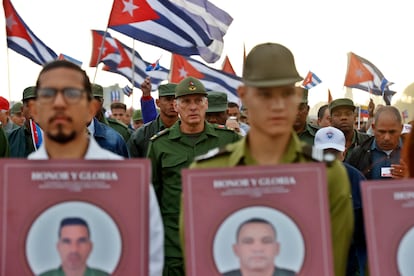

On the one hand, Washington is pressuring Cuba: from its energy embargo to its threats of some kind of military intervention. On the other hand, it is carrying out behind-the-scenes negotiations — acknowledged by both parties — and has made moves to ease the blockade, such as allowing a Russian oil tanker to reach the island last week, and indicating that future arrivals will be decided “on a case-by-case basis.” This is Donald Trump’s two-pronged strategy toward Cuba, the country he said he will target “next” once he has resolved the offensive against Iran.
The White House strategy seeks, at the very least, an economic agreement that could open the door to a thaw between the two long‑standing adversaries. Yet it also concedes, in the words of U.S. Secretary of State Marco Rubio, that there may be an “opportunity” for regime change. Such an outcome would represent a major political victory for the administration at a moment when its other major foreign‑policy gamble — the war in Iran, following the intervention in Venezuela — is becoming increasingly complicated.
The strategy has produced some results. Last Thursday, the Castro government announced the release of 2,010 prisoners — the largest in a decade and the second since the Trump administration began tightening its grip on the island.
The White House repeatedly reiterates its conviction that Cuba’s leaders “need to reach an agreement.” “Cuba is a failed nation whose rulers have suffered a major setback with the loss of support from Venezuela and the interruption of oil shipments from Mexico,” a White House official said.
Trump alternates between a hardline tone with a more paternalistic one, sometimes within the same speech. Last week, at a Saudi investment forum in Miami, he boasted about the strength of the U.S. military. “Sometimes you have to use it,” he said, immediately adding, “And Cuba’s next, by the way, but pretend I didn’t say that please.” In a separate speech on March 16, Trump predicted that he would have “the honor of taking Cuba.”
Just last week, however, he seemed to pivot toward softening his measures in light of the severity of the humanitarian crisis, saying he had “no problem” allowing a Russian tanker carrying 730,000 barrels of oil to dock at the Cuban port of Matanzas. His spokesperson, Karoline Leavitt, noted last week that the administration will review the possibility of future arrivals “on a case‑by‑case basis.”
When Trump returned to the White House for a second term, he warned that he had Havana in his sights. The mere choice of his secretary of state was itself a statement of intent: Marco Rubio, the son of Cuban immigrants and raised in Miami’s hard‑line anti‑Castro circles, has made the fight against the Cuban regime the central ambition of his political career. Immediately after both men took office, the U.S. administration resumed a campaign of maximum pressure, expanding travel and economic sanctions and once again designating the island as a state sponsor of terrorism.
The clearest hint of his roadmap came on January 3, when Operation Absolute Resolution captured Venezuelan president Nicolás Maduro in Caracas. That same day, at a press conference, Trump warned: “Cuba is going to be something we’ll end up talking about, because Cuba is a failing nation right now.”
Since then, Trump has referred regularly to the neighboring country, separated from Florida’s coast by barely 90 miles of sea. Always with a similar message: the regime was running out of lifelines. Without the oil supplied by Venezuela — which had served as a lifeline during the worst economic crisis in decades — its economy lacked the resources to function. And therefore, the government would eventually fall unless it negotiated some kind of exit with Washington and implemented “dramatic changes, very soon.” In February, he summed it up in a single line: “Maybe we’ll have a friendly takeover of Cuba.”
Trump has been so confident that the Castro regime was about to fall like an overripe fruit that he repeatedly insisted no military intervention of the kind ordered in Venezuela would be necessary. Cuba, his administration acknowledged, is a different model from the Caracas regime. Its internal cohesion is much stronger — the vast majority of dissidents have left the island — and its military is better prepared. And through its state‑owned companies, especially the large conglomerate GAESA, it benefits economically from the regime’s operations.
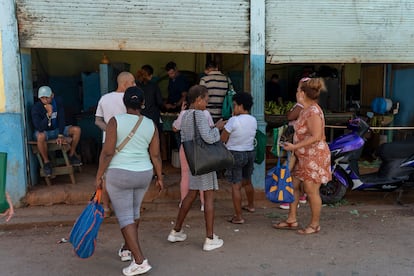
His strategy has operated on two levels. On the one hand, he has increased economic pressure on the regime, most notably through the imposition of an energy blockade. On January 29, he declared an emergency over Cuba, arguing that it posed a threat to U.S. national security, and consequently authorized the possibility of secondary sanctions against any country attempting to supply fuel to the island.
The flow of energy was almost entirely cut off. Almost. A few weeks later, Washington approved certain exceptions for Cuba’s private sector. Marco Rubio explained the reasoning: the pressure should not be so intense that it triggers a new wave of refugees fleeing to Florida, as happened in the 1990s during the Cuban rafter crisis.
On the other hand — just as the Obama administration did in 2013 and 2014 to open a brief period of normalization between the two countries — the Trump administration has opened secret talks with Havana. Or not so secret, in this case. Trump himself has revealed them in various remarks to the press. According to him, they were high‑level conversations, led by Rubio himself.
“The Cuban government is talking with us. They have no money. They have no anything right now. But they’re talking to us, and maybe we’ll have a friendly takeover of Cuba. We could very well end up having a friendly takeover of Cuba,” he said the day before launching the Israeli-U.S. offensive against Iran on February 28.
Exactly whom they have been talking to is something Washington has never wanted to disclose openly. But Trump — who has at times suggested that he personally took part in the contacts — has always indicated that they involved people in high-ranking positions in the Cuban government.
U.S. media initially suggested Washington might be speaking with Alejandro Castro Espín, the son of the nonagenarian Raúl Castro and a key figure in the secret talks with the Obama administration that led to the restoration of diplomatic relations and opened a brief period of détente between the two neighboring, long‑hostile countries.
Later reporting pointed instead to Raúl Guillermo Rodríguez Castro — known as El Cangrejo (The Crab) — the former president’s bodyguard and favored grandson. According to the Miami Herald, Rubio spoke with him while he was in Saint Kitts and Nevis to attend the annual Caribbean Community (Caricom) summit in late February.
At the Shield of the Americas summit with a dozen right‑wing Latin American leaders in early March, Trump returned to the subject of Cuba for the third time in as many days. “As we achieve a historic transformation in Venezuela, we’re also looking to the great change that will soon be coming to Cuba,” he promised, drawing applause from the assembled leaders. Four of them, he said, had brought up the situation on the island to ask him to bring about change.
Rubio, who is leading the negotiations, summed up the objectives as follows: “Cuba’s economy needs to change, and their economy can’t change unless their system of government changes. It’s that simple,” he said in Paris last week after participating in a G7 foreign ministers’ summit.
He added: “Their system of government has to change because they will never be able to develop economically without those changes. Economic change is important. Giving people economic and political freedom is important, but they come hand in hand.”
Sign up for our weekly newsletter to get more English-language news coverage from EL PAÍS USA Edition









































