
Cuba announces release of over 2,000 prisoners as a ‘humanitarian and sovereign gesture’
The mass pardon comes amid ongoing negotiations between Havana and Washington and just a week after Donald Trump gave an initial sign of easing the oil embargo
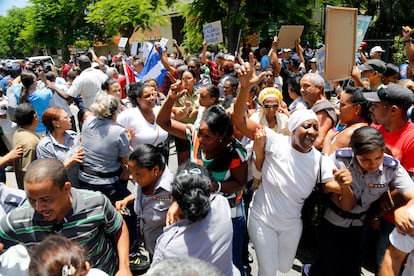

The Cuban government announced on Thursday the release of more than 2,010 prisoners. In a statement published in the official newspaper, Granma, the regime defended the decision as a “humanitarian and sovereign” gesture. This is the second prisoner release since the United States increased pressure on the island with an energy embargo that is causing the country’s economic collapse. The government did not provide details about the prisoners’ identities. It only stated that the individuals released included “young people, women, adults over 60 years of age,” as well as foreigners and Cuban citizens residing abroad who were nearing the end of their sentences.
The mass pardon comes amid ongoing negotiations between Havana and Washington and just a week after Donald Trump gave an initial sign of easing the oil embargo. Last Sunday, a Russian oil tanker arrived at Cuban ports with 100,000 tons of crude oil. This provides some relief from the supply crisis that has left the island with constant and increasingly prolonged power outages, as well as serious problems with basic services such as hospitals and transportation.
Despite showing a slight willingness to compromise and some ambiguous statements from Trump suggesting greater flexibility, the White House made it clear the following day that the gesture did not represent a formal change in sanctions policy and that the Russian ship had been allowed in due to the “humanitarian needs of the Cuban people.”
Thursday’s historic release of prisoners also comes one day after the Cuban ambassador to Washington, Lianys Torres Rivera, challenged the United States to “participate in Cuba’s economic transformation.” Since the military attack on Caracas, which led to the kidnapping of Venezuelan President Nicolás Maduro, the island has been in Trump’s crosshairs as his next target.
While negotiations—shrouded in secrecy and led by Secretary of State Marco Rubio, the son of Cuban immigrants—are underway, the president has been oscillating between a willingness to engage in dialogue and issuing threats. Just two weeks ago, Trump stated that it would be “a great honor” for him to “take over Cuba” and that he could do whatever he wants with it.
The Castro regime’s response has been to make a few gestures, but none on the scale of the step taken this Thursday. Last month, it announced the release of 51 prisoners, a move facilitated by the Vatican, which has historically been a key player in securing concessions from the Castro regime. The regime has also shown flexibility on economic issues, such as allowing Cubans in exile to do business on the island, or permitting private companies to import small quantities of gasoline. Meanwhile, Castroism continues to play on the classic rhetoric of “resistance against imperialism” and accusations against the United States of causing “genocide.”
None of these moves has been confirmed, at least publicly, by the U.S. side. Rubio insists that this is not enough, that more is needed, and, above all, that the changes must also be political. Some media outlets close to Washington have reported in recent weeks that the ongoing negotiations involve broad economic reform, but without President Miguel Díaz-Canel at the helm. The Cuban response to that information, which was denied by the White House, has also been firm: “The Cuban political system is not up for negotiation, nor, of course, is the president or any government official.”
The operation announced on Thursday surpasses even the historic releases of a decade ago, when Cuba and the United States signed an agreement to resume diplomatic relations after five decades of isolation. In September 2015, the Cuban government pardoned 3,522 prisoners to coincide with Pope Francis’ upcoming visit to the island. In January of that same year, the Cuban government had already pardoned another 53 inmates whom Washington considered “political prisoners.”
The United Nations has condemned the repression in Cuba, which it describes as the country with “the most convictions for arbitrary detention in the world.” The Cuban government claims to have pardoned 9,905 prisoners since 2010. According to estimates by the NGO Prisoners Defenders, there are currently 1,214 political prisoners in Cuba. The harsh crackdown on the massive protests of 2021—with hundreds of young people still in prison—has been one of the latest developments. The Cuban government has not clarified whether any of the prisoners from those protests are among those granted amnesty.
Sign up for our weekly newsletter to get more English-language news coverage from EL PAÍS USA Edition









































