
A bittersweet year for Afrikaners, the only refugees admitted by Trump
For some, white South Africans are considered to be unjustifiably favored by the Republican administration, while others see them as victims of genocide. They recount mixed experiences upon their arrival in the United States
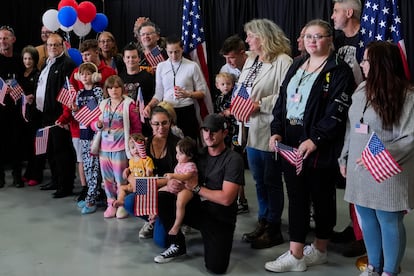

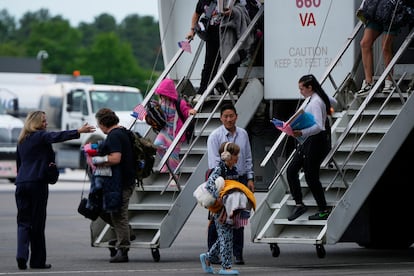
Charl Kleinhaus’s life took a dramatic turn on May 12, 2025, when his plane landed at Dulles International Airport, in a suburb of Washington, D.C. He arrived with his two children and grandson. Waving an American flag and brimming with excitement, he had finally achieved his long-held dream: leaving South Africa.
Kleinhaus was one of the first 59 Afrikaners to enter the United States through the refugee program that President Donald Trump created. He welcomed white South Africans, while closing the doors to all other foreigners fleeing persecution or torture in their home countries. According to the State Department, from October 1, 2025, to April 30, 2026, a total of 6,069 refugees arrived in the United States. Three of them are Afghan. The rest are South African.
Kleinhaus, 47, is employed on a farm in South Dakota. He grew up on a farm and later worked as a granite stonemason. Still, despite the difficulties of such a large-scale move, he’s confident that he’ll soon be able to start his own business as a stonemason in the country that has welcomed him. He never wants to leave.
“The people are much better than what I ever expected,” he gushes over the phone to EL PAÍS. What he values most is that the U.S. is a “Christian country, where you have rights — where it’s [fair] — no matter the color of your skin. You’ve got the same right[s] as everybody else,” he explains.
In the first few months after arriving, he couldn’t sleep. This was because there were no security bars on his windows… something he wasn’t used to. Kleinhaus says that, in South Africa, he feared for his life, which led him to apply for the refugee program as soon as he saw Trump announce it. He recounts how his neighbor was hacked to death with machetes: he cites this as an example of the persecution that, he claims, whites face in a country marked by the legacy of apartheid. The system of racial segregation and institutionalized discrimination against Black people was in effect in South Africa from 1948 until the 1990s, largely driven by the Afrikaner population.
The situation following the fall of that regime — with a majority-Black party in power and affirmative action laws instituted to compensate for the inequalities created by decades of discrimination, coupled with attacks suffered by white people — has led to talk of genocide. Trump, for his part, has used the term, referring to the brutal murders of white farmers in recent years as an example. But the reality is that violence in South Africa is widespread: analysts point out that most violent crimes occur in poor, predominantly Black areas, thus refuting the notion of a white genocide. The homicide rate per capita in 2022 was 43.7 per 100,000 inhabitants. In the United States, that same year, the rate was 6.5 per 100,000 inhabitants.
Preferential treatment
Trump froze the entire Refugee Admissions Program as soon as he returned to the White House. And, the following month, on February 7, 2025, the administration reinstated it… but only to accept Afrikaners, who are white South Africans descended from Dutch, French, and German settlers (although Indians and other mixed-race South Africans were later also admitted). Other foreigners — such as Afghans who had worked with the U.S. Army — were notified that their flights had been canceled. They were left in limbo, despite the fact that they had waited for years to be granted asylum and even had tickets to the United States.
At the time, Bishop Sean Rowe, head of the Episcopal Church, declared: “It has been painful to watch one group of refugees, selected in a highly unusual manner, receive preferential treatment over many others who have been waiting in refugee camps or dangerous conditions for years.”
During Joe Biden’s administration, approximately 125,000 refugees were admitted annually to the United States. But last September, the Trump administration announced that the quota for fiscal year 2026 (from October 1, 2025, to September 30, 2026) would be 7,500, with the spots “primarily allocated to Afrikaners from South Africa.”
Recently, Reuters and The New York Times reported that the Trump administration intends to double the number of white South Africans in the refugee program. According to The New York Times, the administration plans to declare an “unforeseen emergency” to attract more Afrikaners. This would represent a radical shift away from a program that was originally created to welcome people fleeing wars, famines, and natural disasters worldwide, transforming it instead into a channel primarily for white people seeking to live in the United States.
“It is ironic that the executive order makes provision for refugee status in the U.S. for a group in South Africa that remains amongst the most economically privileged, while vulnerable people in the U.S. from other parts of the world are being deported and denied asylum despite real hardship,” the South African government noted in a statement.
The killings of white farmers in South Africa represent less than 1% of the more than 27,000 annual murders that occurred between 2023 and 2024 across the country, according to Afriforum, a non-profit organization. Experts say that these deaths don’t constitute genocide. There are approximately 2.7 million white Afrikaners in South Africa, while roughly 80% of the population is Black.
An unexpected welcome
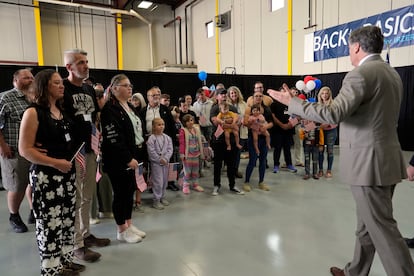
Some of the Afrikaners who have entered the program report suffering the consequences of having been chosen over other nationalities. Johanna (a pseudonym, because she fears reprisals) arrived in the United States this past March with her three children and her mother. Her experience has not been what she expected.
“I’m experiencing persecution by my supervisor, my agency… this is more because they’re Muslims and I’m a woman, so I’m experiencing this on a daily basis. And my caseworker for the [Matching Grant Program] is a Black man from the Ivory Coast. And it’s difficult. These people, they’re furious with the administration, because all other immigrants are blocked [from coming] in, so all their family and friends are outside the country. So now, [they] take this out on us,” she explains by phone from Florida, where she now resides.
Johanna applied to enter the U.S. through the program as soon as it was announced because “if we had stayed in our country, sooner or later, they would have ended up killing us all,” she says. Her experience in the United States, however, hasn’t been as positive as Kleinhaus’s. She lashes out at the resettlement agencies contracted by the government to help refugees during their first few weeks in the country. “Everybody back home thinks this is just the best thing ever. They [think that they’re] going to get here, they’re going to get [a] nice place to stay, they’re going to get furniture, they’ll get all the food [they need]... but that’s not the case,” she sighs.
Johanna recounts that, upon arrival, the agency housed her in a dangerous neighborhood, where one of her compatriots was stabbed. “Since I arrived, we’ve been placed in a Black motel. They wanted to place us in a Black neighborhood. They wanted to put my kids in a Black school. And I just said, ‘Listen, this is what I fled from. How can you do this to us again?’ We couldn’t sleep at night, as the people in the motel [were] fighting and [there were] drugs and prostitution… the police [were] in and out of there,” she recounts.
While she acknowledges that other Afrikaners have had better experiences, she complains of corruption in many of the agencies tasked with helping them. In her case, an agency managed the allocation of $2,450 (per person) provided by the government for a period of 90 days. After 28 days, however, the agency informed her that the money had run out, between payments to the motel and the security deposit for the house where they were going to put her family (without her consent). She was also unhappy with the food and furniture that was purchased for them with the allocated funds, which was done without her input.
Through a Facebook group of fellow South Africans, she managed to rent a house elsewhere, but she’s still worried about her financial situation and finding employment. “You must go and pack shelves, or you must work in a garden, or whatever. Then, you work for their friends (referring to employers who are connected to the agency) and then they pay you like minimum wage, so you cannot survive,” she says.
Johanna says that she’s in a difficult situation. On the one hand, she wants to warn people about the problems they’ll face upon arriving in the United States… but, on the other, she doesn’t want to discourage her compatriots, since her goal “is to get all my people here as soon as possible and in as many numbers as possible.”
Shelly Hepburn is intimately familiar with the hardships faced by those who have felt disillusioned upon arrival. Years ago, after watching a documentary about the violence in South Africa, she decided to help Afrikaners seeking asylum in the United States. Divorced and with two grown sons and a daughter, she took in several families. Over four years, she housed about 15 people. She offered each family free housing for seven months and provided them with support to get by. Although she paused the program for a few years, she maintained a Facebook page to help them. When Trump announced the refugee program, she shifted the focus of her page to assist those admitted under it. In Connecticut, where she lives, there are a dozen South African families whom she stays in touch with. She supports them by delivering food and relocating them to safe areas.
“We’ve had good experiences. People are doing great. Their feeling of safety and freedom… they haven’t felt [it] ever. And they’re getting in touch with their American community, they’re becoming one with their community. And then, you have the bad stories, where the [resettlement] agency is pressuring them, lying to them, putting them in housing that’s filthy, [rundown], dangerous,” she explains.
In recent weeks, it has come to light that at least four beneficiaries of the refugee program have returned to their countries of origin for various reasons. Most, however, will not return. “My son and my grandson will enlist in the army; they will go to war to defend this country,” says Charl Kleinhaus proudly.
Sign up for our weekly newsletter to get more English-language news coverage from EL PAÍS USA Edition









































