
The United States demands Cuba make ‘dramatic changes very soon’
Secretary of State Marco Rubio is in contact with Raúl Castro’s grandson, according to the outlet Axios
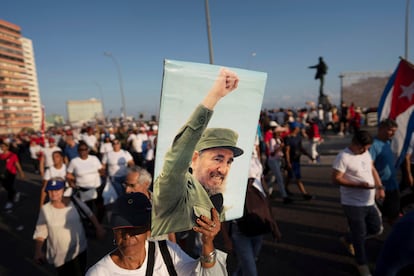

The United States demanded on Wednesday that Cuba undertake “very dramatic changes very soon,” while increasing pressure on an island facing its worst economic crisis in decades. At the same time, U.S. Secretary of State Marco Rubio is holding conversations with Raúl Guillermo Rodríguez Castro, grandson of Raúl Castro, the regime’s strongman, according to the U.S. outlet Axios, which claims these talks are taking place outside the Cuban government’s official channels in Havana.
“They are a regime that is falling. Their country is collapsing and that’s why we believe it’s in their best interest to make very dramatic changes very soon,” declared White House spokesperson Karoline Leavitt at a press conference on Wednesday.
The spokesperson for U.S. President Donald Trump did not confirm reports of conversations between Rubio and Cuban figures. Nor did she confirm whether the goal of U.S. pressure on the island is to provoke a regime change. Leavitt indicated that the United States wants to see prosperous democracies around the world, especially in the Americas, but declined to discuss what specific steps the U.S. administration is considering to achieve that.
Since the U.S. attack on Venezuela on January 3, in which president Nicolás Maduro and his wife, Cilia Flores, were captured, Trump has insisted that Cuba cannot survive without the help of its major ally and has called on the Castro regime to negotiate. Havana, he maintained, should “reach an agreement” with Washington.
On several occasions, Trump has stated that talks between the two sides are already underway; he made this comment again last weekend and added a detail: Rubio — the son of Cuban immigrants, for whom the fall of Castroism would be the fulfillment of a dream — is the one taking part in those contacts on the U.S. side.
So far, Havana has limited itself to saying that there are some technical-level contacts, but it has denied that any talks are taking place between the two long‑time adversaries. U.S. media had reported in previous weeks that Washington was engaging with Alejandro Castro Espín, Raúl Castro’s 41-year-old son, in secret talks in Mexico, which have never been officially confirmed.
Mexican President Claudia Sheinbaum has stated that her administration is continuing talks with the Trump administration to have Mexico serve as a mediator in resolving the Cuban conflict. “There are ongoing discussions to see if it’s feasible, but it depends on both governments, not only on the will of the Mexican government, but also on the will of the Cuban government and the will of the United States government,” she said at a press conference on Wednesday.
For now, Sheinbuam has promised to continue sending humanitarian aid to the island. “A collection was organized in Mexico City’s Zócalo, and we are helping so that it can be taken to the ships that are already returning so they can reload,” she said, referring to the Navy ships that have begun their journey back to Veracruz after unloading the first shipment of supplies in Havana. At the same time, the Mexican president noted that the Ministry of Foreign Affairs continues to seek a diplomatic solution to ease the fuel blockade against Cuba and to restore the contracts Pemex had with Miguel Díaz‑Canel’s government to supply oil — contracts that were in place until mid‑January, when shipments were halted due to U.S. tariff threats.
According to Axios, the Trump administration views Raúl Guillermo Rodríguez Castro — the son of Raúl Castro’s eldest daughter, Débora, and Luis Alberto Rodríguez López-Callejas — and his circle as representatives of a new generation of Cubans who are focused on business, less ideological and believe that engaging with the United States could bring benefits.

“I wouldn’t call these ‘negotiations’ as much as ‘discussions’ about the future,” a senior Trump administration official told Axios. “Our position — the U.S. government’s position — is the regime has to go,” the senior official said. “But what exactly that looks like is up to [President Trump] and he has yet to decide. Rubio is still in talks with the grandson.”
Trump’s advisers have also spoken with other influential Cubans aside from Raúl Rodríguez Castro — who is nicknamed “El Cangrejo” (The Crab) by Cubans because of a deformed finger — but the retired president’s grandson is considered the highest-level figure with whom to cultivate ties on the island.
“He’s the apple of his grandfather’s eye,” a source told Axios, describing the contacts between the Castro representative and Rubio as “surprisingly” friendly, aided by their shared Cuban accent and culture. “There’s no political diatribes about the past. It’s about the future,” the source added. “This could be a conversation between regular guys on the streets of Miami.” Rubio, Axios notes, has not spoken with Cuban President Miguel Díaz-Canel or other high-ranking officials of the Castro regime.
Although Trump has not yet decided exactly what outcome he wants to see in Cuba — limiting himself to asserting that the regime will inevitably fall due to its lack of support — analysts believe he may try to replicate the same roadmap used in Venezuela. There, after Maduro’s capture, he kept most of the regime in place, starting with the current acting president, Delcy Rodríguez, the former vice president under the Chavista government. Trump justified that decision by citing the need to avoid repeating the mistake of the 2003 invasion of Iraq, when everyone who had held a position in Saddam Hussein’s administration was removed, with disastrous consequences.
In any case, Havana’s options are as limited as they are unappealing. Either it yields to Washington with measures that could endanger the regime’s survival, or it faces a severe humanitarian crisis. Díaz‑Canel’s government has already announced rationing measures reminiscent of the worst days of the Special Period in the 1990s, following the cutoff of oil supplies it had been receiving from Venezuela.
Sign up for our weekly newsletter to get more English-language news coverage from EL PAÍS USA Edition









































