
Cuban opposition leaders on dialogue with the US: ‘The solution to the suffering of the people must be at the center of the debate’
Some of the most influential voices inside and outside the island believe that the regime is at a critical juncture that threatens its survival
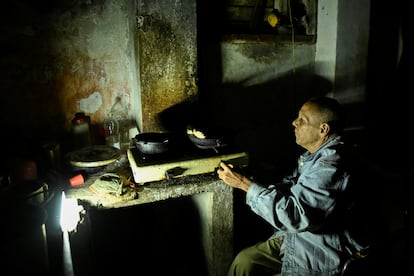

A statement from the Cuban Presidency announced that at 10:00 a.m. on Thursday, February 5, its YouTube channel would broadcast an address by President Miguel Díaz-Canel, the first time he would be stepping away from X posts and take up a microphone to address the Cuban people since the escalation of tensions with Washington began. José Daniel Ferrer, the renowned leader of the Cuban opposition, tuned in to the address, carefully analyzing and weighing each of the president’s words. “He didn’t say anything new, just what they’ve always said,” he asserted afterwards. He was alluding to the Castro regime’s willingness to establish a dialogue with the United States, at a time of economic crisis that has cornered the Havana power elite.
What Ferrer saw on YouTube was not just a politician who is the last vestige of Castroism, but also a “very worried man.” “He knows that the situation the regime is facing is more difficult, more complex,” he says from Miami, where he arrived after being released from prison in mid-October, following the Cuban government’s agreement to his release in exchange for his departure into exile. “The Cuban people are demonstrating more and more each day that they don’t want them, and the pressure from the U.S. administration is precise.”
Four months after his expulsion, Ferrer has once again considered the possibility of returning. “If I see the Cuban people in the streets tomorrow, courageous and resolute, determined not to return home until the true transition to democracy begins, I’ll go back to Cuba, even if it’s in a raft. I’ll take the risk and go back,” he says.
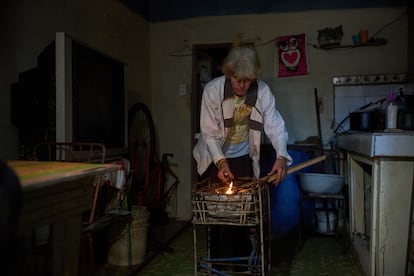
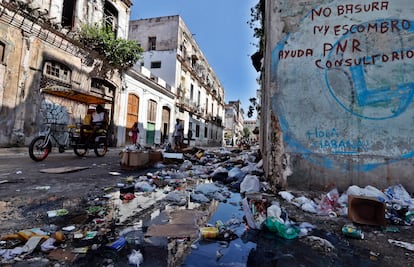
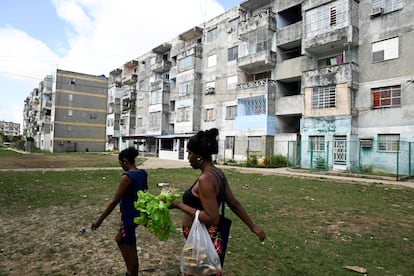
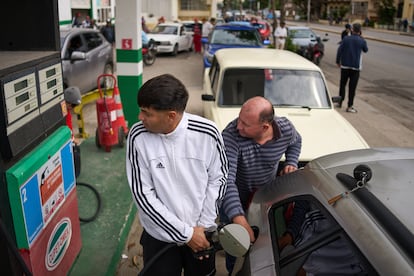
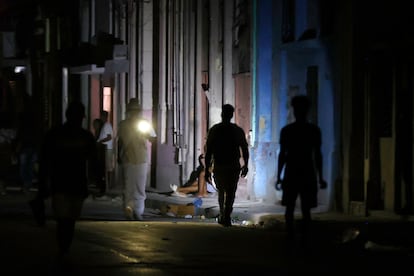
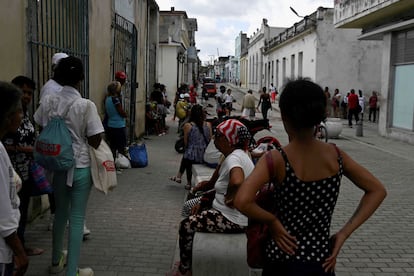
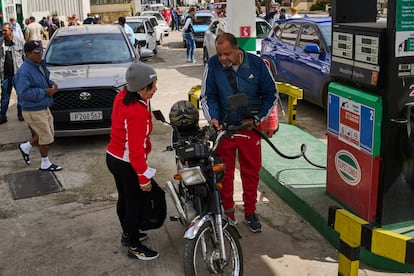
What will happen on the island remains a mystery after losing Venezuela as its main oil supplier, and given the pressure the Trump administration is exerting on another supplier like Mexico. The strategy, according to statements coming from Washington, is not a military attack on Havana like the one orchestrated in Caracas, but rather economic strangulation. “THERE WILL BE NO MORE OIL OR MONEY GOING TO CUBA — ZERO!,” the Republican president posted on his Truth Social platform a few days ago. He also warned that Cuba will fall very soon, some speculate before the end of the year.
Even so, no one knows exactly what the U.S. government might be planning. Ferrer, who met personally with Secretary of State Marco Rubio in November, explained his position to the Cuban-American. “The U.S. government should not take half measures with the Castro-communist regime,” he stated. “For the U.S. administration, there will be no negotiations without an end to the repression and the beginning of a transition to democracy in Cuba.”
Nor can there be dialogue, he says, without a general amnesty for all Cuban political prisoners, guaranteeing that the government cannot return them to their prisons. In January of last year, more than 500 people were released through the Vatican’s mediation and negotiations with the Joe Biden administration, after Washington removed Cuba from the list of state sponsors of terrorism, to which Trump reinstated it on his first day in the White House. Ferrer was “a bargaining chip,” one of the prisoners released at that time. Three months later, the Cuban authorities could no longer tolerate his activism. They imprisoned him again.
Dialogue as a strategy
In Havana, Manuel Cuesta Morúa, president of the Council for the Transition in Cuba, says that people on the island are living with a mixture of “powerlessness, uncertainty, anguish, and tension.” “Everyone wants change,” Morúa asserts, adding that he also took note of the Cuban president’s words, despite a speech lasting more than two hours that many consider rambling.
What he observed, he says, is that the government is trying to appease its inner circle “so as not to lose the legitimacy it has already lost with society,” and is attempting to get the international community to begin an informal mediation in favor of the regime. He also noted throughout the speech that Díaz-Canel was “strongly imploring the reestablishment of a formal line of dialogue.”
Despite Trump’s statement a few days ago that they were holding high-level negotiations with Havana, Cuba’s Deputy Foreign Minister, Carlos Fernández de Cossío, asserted in an interview with the EFE news agency that “this dialogue has not yet begun.”
However, Cuban activist Carolina Barrero, director of the organization Citizenship and Freedom, believes that the concept of “dialogue” to which the Cuban government alludes is “a survival strategy from which the regime obtains oxygen.” “In moments of suffocation, it feigns openness to allow the injection of capital essential for its survival. Once stabilized, it closes down. Thus, the power structure remains intact. We saw it with Carter, we saw it with Obama, and now it is being tried out with Trump. While the regime negotiates, it demands more sacrifice and more endurance from its population. The question Washington should be asking itself is not whether Cuba is willing to engage in dialogue or negotiation. The question is whether the United States, and also Europe, are willing to be, once again, the life support of a dictatorship.”
At four o’clock in the afternoon in Spain, the lawyer and activist Roberto Veiga, a member of the Cuban Democratic Coalition (DFrente), listened attentively to what the Cuban president had to say from Havana. He is certain that “dialogue between the two governments will be impossible without addressing Cuba’s internal politics,” as has happened in the past. “For there to be an internal process in Cuba that truly leads to a solution, there would have to be a parallel process with the U.S., dismantling the mechanisms of confrontation.”
He also insisted that there can be no dialogue without the participation of “Cuban society, with all its civil and political actors,” both on and off the island. “The solution to the suffering of the people must be at the center of the debate, as the primary objective of any negotiation with the United States and among Cubans. It is not possible to sacrifice the people for political interests,” he insisted.
Some are far more forceful regarding any agreement or dialogue that Havana and Washington might establish. “The crisis has no solution within socialism. We will not accept any more sacrifices or any more ‘special periods,’” said Rosa María Payá, a member of the Inter-American Commission on Human Rights (IACHR). Together with the Pasos de Cambio (Steps for Change) platform, comprised of opposition groups and Cuban civic organizations, she is promoting a transition plan that addresses “the humanitarian catastrophe while proposing an irreversible institutional change toward the rule of law and free elections.”
“While the people are being told to use animal traction and coal, the military elite has $18 billion in offshore accounts,” Payá argues. “The regime is a failed state with territorial control, but incapable of providing basic services due to the ineptitude and corruption of the military in power. The only way to recover electricity, water, freedom, and rights is through systemic change.”
Sign up for our weekly newsletter to get more English-language news coverage from EL PAÍS USA Edition









































