
Trump’s oil tariff push deepens Cuba’s agony: ‘I’m just doing my best to survive’
By targeting the island’s access to crucial imports, the US has exacerbated its economic and social strain. The Castro regime says it is trying to provoke a ‘genocide’
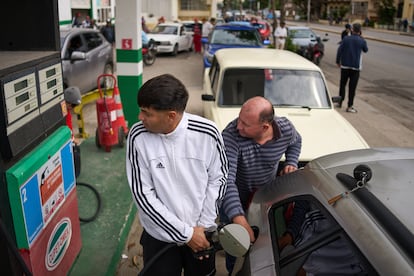
Lines to buy fuel in Havana have been longer than usual in recent weeks. It’s not that Cubans have more money, that there’s greater supply, or that prices have gone down. The gasoline currently available at service stations is sold mostly in dollars and, despite being more expensive, it runs out quickly. Lines of cars pile up at gas stations.
Dianelys is a young entrepreneur — a product of the slight opening to the private sector — who owns an old Soviet‑made car. She jokes that the fuel shortage may force her at any moment to sell the car and buy a bicycle instead. “The last time I went to get fuel [last week], I had to wait in line for 12 hours.”
The island’s oil squeeze worsened at the start of the year after the United States carried out a military attack on Venezuela, its main supplier for decades. U.S. President Donald Trump has tightened the screws further by announcing that he will impose tariffs on anyone who sells or supplies oil to Cuba. The noose around Cubans’ necks grows tighter as they remain trapped in a deep structural crisis in which mere survival is often the only possible goal. Each new blow from Trump is met with astonishment, while in Miami — the heart of the Cuban exile community — people wait, torn between suspicion and caution, for the possible fall of Castroism.
As she waits in line, Dianelys adds that she isn’t afraid of what Trump’s recent announcements might mean. For her, expectations are “the same as always.” She wants change — “for everything to improve so we can finally have a dignified life.” Still, she prefers not to place any hope in the U.S. strategy. “I don’t even think about that anymore; I’m just doing my best to survive here.”
The island’s economic collapse is a reality acknowledged even by the regime itself, which responded to the latest blow by calling it “blackmail and coercion,” extending more than six decades of the U.S. economic blockade. But officials have now escalated their rhetoric, accusing Trump of seeking to “provoke a genocide.” The Cuban government has admitted that “if the tariff threat were to materialize, the effect would be to paralyze electricity generation, transportation, industrial and agricultural production, health services, the water supply — in short, every sphere of life.”
The endless succession of crises hitting Cuba includes constant blackouts due to the lack of oil, shortages of medicine, a severe public‑health crisis, the collapse of tourism, mass migration, and deepening inequality and poverty. In an attempt to bring some order to the chaos and fuel scarcity, the government launched a digital app that tells people when it’s their turn to go to a gas station and buy fuel in the national currency. A taxi driver says he has been stuck at turn number 2,900 for more than a month and estimates he still has at least twice as long to wait before his turn comes up. Faced with the shortages, the government has slightly increased the supply of fuel at dollar‑only gas stations in recent days.
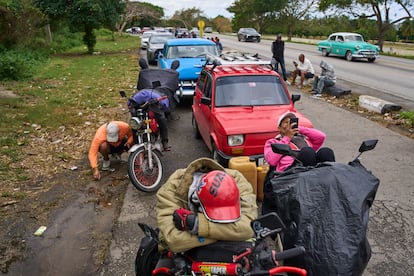
Drivers — whether they work in public or private transportation — talk about nothing else, and some, after spending the entire night waiting in line, head out into the city to start their taxi shifts. “This is going to get worse. Not even paying in dollars guarantees you’ll get fuel anymore,” the same taxi driver complains, as he considers spending $100 on his next purchase to stock up and build up reserves.
A direct attack on Cuba seems, for now, to have been ruled out by the Republican administration. U.S. Secretary of State Marco Rubio said on Wednesday that Washington is not seeking to directly force a regime change in Havana. The strategy appears to be more about exerting overwhelming pressure on the island. Trump himself suggested on Saturday — using his usual tone — the same idea of waiting for a collapse brought on by exhaustion after so much pressure: “I think we’re going to make a deal with Cuba,” he said. “We’ll be kind [...] They have no money. They have no oil.”
The threat of tariffs is also a message aimed at the few partners the island has left — specifically Mexico, which is facing its own pressures from its northern neighbor. Trump has long flirted with the possibility of an intervention on Mexican soil to strike at organized‑crime cartels, another dramatic move meant to appeal to voters amid falling approval ratings.
The Mexican government’s strategy with Trump involves, on one hand, showing results in its security policy while maintaining a firm public stance. After Maduro’s fall, Mexico became Cuba’s main supplier of crude oil, but shipments were temporarily halted. Trump said on Saturday that he personally requested the suspension of Mexican oil deliveries to the island during a conversation with Mexican President Claudia Sheinbaum.
On Sunday, however, Sheinbaum promised to provide assistance. “This week we are planning humanitarian aid for Cuba — assistance that will be delivered by the Navy, consisting of food and other goods — while we work to resolve, through diplomatic channels, everything related to sending oil for humanitarian reasons,” she said.
According to a calculation by the Financial Times, Cuba has enough oil to last for the next 15 to 20 days. Venezuela supplied an average of 46,500 barrels per day to the island before the U.S. intervention. Mexico delivered an average of 17,200 barrels per day, which stopped arriving in early January, just days after the U.S. incursion into Caracas. Other crude oil suppliers include Russia, which sent its last ship in October, and Algeria, which has not sent a tanker since last February, according to the same source.
Unease in Miami
Miami woke up on Friday to an unseasonably cool 20ºC (68ºF), almost the same temperature reported in Havana — two cities just 90 miles apart, a distance that politics has magnified for decades. Michel Cruz knows this well: as an undocumented immigrant in the United States, he cannot simply board a plane and land in Cuba in under 30 minutes to protect his twin children “in case something happens.”
When news broke on Thursday night that Donald Trump had declared a “national emergency” over Cuba, he couldn’t sleep. “I’m outraged, I’m shattered inside,” he says. “I feel fear and uncertainty, because my whole family is there, and they’re what I love most in my life. In the end, it’s not the government that will be left without electricity or food — it’s the people.”
From Florida, the Trump administration’s statements on Cuba since the capture of Maduro in early January have been met with a degree of mistrust. For nearly seven decades, Washington’s rhetoric has centered on exerting economic pressure on Castroism, which has endured even as other authoritarian regimes in the region have fallen. Although many in the exile community express fatigue in the face of an uncertain outlook, Cuban American politicians in Congress have urged the community to help bring about the final economic chokehold they have been promising for years. Congressman Mario Díaz‑Balart is convinced this time that “Donald Trump will be the liberator of the Western Hemisphere.”
Indira Romero, a 41-year-old Cuban-American actress who also works at a Miami Beach restaurant, is skeptical of the new announcement, which, according to predictions, would lead to the island’s collapse within weeks. “Trump doesn’t talk about democracy and freedom, and we’re seeing how he’s handling the situation in Venezuela,” she says. “At the moment, I don’t see a serious plan. It seems they’re just forcing the regime to flee, or appealing to the people to take to the streets like they did on July 11,” she adds, referring to the 2021 protests, the largest the Castro regime has faced to date. The protest took place amid the Covid-19 pandemic, which overwhelmed hospital and devastated tourism, and the blows from Trump’s first term, which tightened the embargo. The country hit bottom and Cubans poured into the streets in protest — more than 1,000 of whom were turned into political prisoners.
Maikel Bencomo, a 44‑year‑old Cuban American, works at a noodle company founded in Miami after the owners’ business in Cuba was confiscated. On Friday morning, as he headed to work, Bencomo felt puzzled but also somewhat pleased by the news delivered by President Trump. “He’s made the dictators feel fear. Cuba deserves to be free, and every freedom comes with great sacrifice.”
Shock in Havana
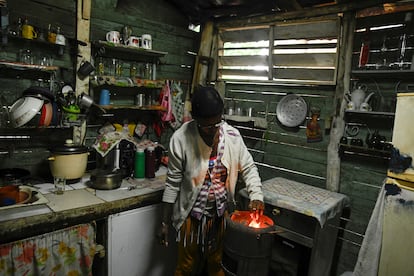
Cubans survive somewhere between shock and indifference. In recent years — and especially in the first weeks of 2026 — they have grown used to letting the dead hours pass, whether in a line, at work, or at home, because the blackouts never stop and having 24 consecutive hours of electricity has become a rarity on the island. “Is there power?” is a common question for anyone who needs to travel from one place to another on a daily basis.
Not even the recent jazz festival — the most important cultural event currently organized by the Cuban authorities — has escaped the effects of the power shortages. There have been jam sessions by candlelight and under rechargeable lamps; audiences and musicians alike have sometimes had to wait up to two hours for electricity to return to a theater so a performance could begin. On Friday, one of the shows had to be canceled due to a lack of fuel.
Cubans are stunned by each new statement from Donald Trump’s administration. The feeling that anything could happen at any moment is part of everyday conversation on the island. Just a few hours after the Republican’s latest announcement, on Thursday night, singer‑songwriter Roly Berrío played a show in a small bar in Old Havana. He opened by saying, “Life [in Cuba] is hard. This man [Trump] is making it harder for us — well, these men, because there are several. But we didn’t come here to talk about that.”
Sign up for our weekly newsletter to get more English-language news coverage from EL PAÍS USA Edition









































