
Havana pulses with jazz despite blackouts and Trump’s threats
The organizers of the Jazz Plaza Festival say that maintaining the event’s standards is becoming increasingly difficult due to the economic crisis and a reduced presence of international artists
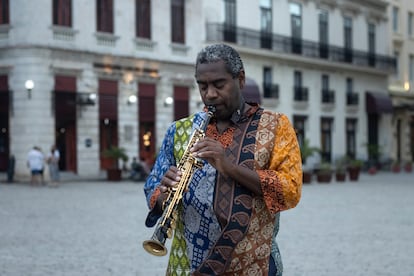
Cuba has long been under the effects of a perfect storm that shows no signs of abating. In addition to constant power outages, the high cost of living, persistent unsanitary conditions in the streets, and a tangled economic crisis that Cuban authorities seem incapable of resolving, there are now direct threats from Donald Trump’s administration, aimed at the Castro regime which has been in power for nearly 70 years. Amid this bleak landscape, a jazz festival that seeks to light up the city has sparked curiosity and enthusiasm.
For four decades, the Jazz Plaza Festival, centered in Havana, has brought together much of the most significant talent in the genre across different eras. Over the years, the festival has featured legendary figures such as Dizzy Gillespie, Max Roach, Roy Hargrove, and the commanding Chucho Valdés. For this reason, every year many Cubans look forward to the days of the festival to see international artists live, as well as compatriots who now live abroad. During the festival, some areas of the city seem more welcoming, as if the music has made daily life a little easier.

This year, from January 25 to February 1, around 286 international artists will converge in Havana alongside hundreds of Cuban musicians. More than 100 performances are scheduled across 16 venues throughout the city, including theaters, cultural centers such as the Fábrica de Arte Cubano, basilicas, and private venues. Organizers have warned that maintaining the festival’s standards is becoming increasingly difficult, largely due to the reduced presence of U.S. artists, who have been affected by travel restrictions imposed by the United States.
Víctor Rodríguez, president of the organizing committee, acknowledged at a press conference: “Every year the festival takes place under very complex conditions, but I think they have never been as complex as they are now.” Even so, he highlighted as a major achievement the fact that the event will be held simultaneously for the first time in three provinces — Villa Clara, Holguín, and Santiago de Cuba — in addition to Havana.
A country of music
Beyond its cultural value, Jazz Plaza also represents an economic opportunity for workers and entrepreneurs at a time when tourism is in sharp decline. “We’ve had cancellations from clients worried about the situation in Cuba and the geopolitical issues, but not enough to put anyone out of work,” says a tour guide who preferred to remain anonymous. Her agency expected to serve 80 clients during the festival; ultimately, the number dropped to between 60 and 70. “There’s a certain amount of paranoia among visitors. We feel compelled to provide them with daily support, sending them photos and videos so they can see that the sky in Havana isn’t falling,” she adds.
Among both audiences and artists, one question looms: will there be enough electricity for a festival that this year appears to be more ambitious than ever in organizational terms? Ernán López-Nussa, a leading figure in Cuban jazz who has taken part in Jazz Plaza since its beginnings, recalls the years when listening to jazz or rock was considered “enemy music” by the authorities. Today, jazz has become firmly established as a cultural symbol that draws international interest.
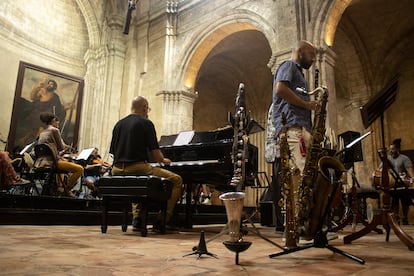
“Cuba is a country of music,” says López-Nussa. Despite the internal crisis and travel restrictions, artists such as U.S. pianists Aaron Goldberg and Arturo O’Farrill, and Cubans living in other countries like Dayramir González and Harold López-Nussa, maintain their interest in attending the festival.
Maru Gutiérrez, a 39-year-old Spanish singer with African roots from Equatorial Guinea, will premiere her first album with Cuban musicians at one of the festival’s concerts. “I wanted to come, even though many Cuban acquaintances advised me against it,” she confesses. She values the opportunity for her career and is thrilled to share the stage with renowned Cuban artists.
In the days leading up to the festival, musicians like Maru have been rehearsing at Abdala Studios in Miramar, one of the best-equipped studios on the island. But even there, they face daily power outages that affect much of the country. In Havana alone, during the week prior, power cuts of up to 12 hours were reported in several areas. Tulip Power, the festival’s sponsor, provided generators to maintain electricity for rehearsals.
“I haven’t been able to pump water for five days, and all I eat is spaghetti and pizza. I can’t take it anymore,” says a musician during a rehearsal, alluding to the precarious situation at home. The situation is so dire that even in the microcosm of the rehearsal, the conversation inevitably turns to their pressing needs. Only by playing music can they escape and, for a moment, forget the crisis surrounding them.
Sign up for our weekly newsletter to get more English-language news coverage from EL PAÍS USA Edition









































