
Red roses for the CIA in Havana
The United States is about to devour a meal that the Castro regime has diligently prepared for it
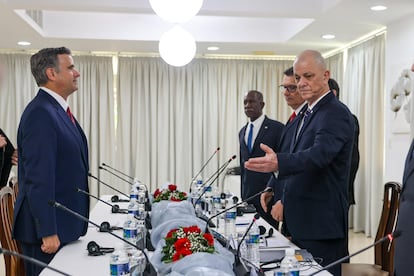
Seeing John Ratcliffe, the CIA director, in Havana might be less surprising than seeing Ramón Romero Curbelo, head of the Intelligence Directorate of Cuba’s Ministry of the Interior. His face had appeared on television before, but not in connection with his official position, and it is his position that gives such a face its expression. Images of him can be found at military events on the island, or in official delegations to Nicaragua and Vietnam, though always as part of a larger group. Another powerful military officer, which is no small matter, but not quite what we now know it to be.
In the photo the CIA published on its X account, Romero presides over a table dotted with socialist kitsch: bouquets of red roses, water bottles from small businesses, and white tablecloths from a workers’ cafeteria. Beside him are several Cuban officials, and in front of them, as if facing the entire communist platoon single-handedly, stands Ratcliffe, at attention. It is a bleak scene. What is being served at that table — and what cannot be seen — is the Cuban people. Curbelo’s hand invites his visitors to sit down and tells them they may eat. The stage has been closing in, and the United States is about to devour a menu that Castroism, chopping away here and there, diligently prepared for it, although Curbelo, in reality, does not seem entirely happy, but rather annoyed at having to share what until now they had been snacking on all by themselves.
The fact that the CIA reached the Cuban intelligence stronghold without firing a shot, after having previously killed 32 Cuban soldiers in Venezuela — stupidly sacrificed to defend a petty tyrant whom his own people had already betrayed — suggests that Castroism has no intention of self-destructing. They won’t wrap themselves in a flag and wait for the Marines on the Malecón; instead, they will try to buy more time, scraping together a way out for themselves, while meekly accepting what we might call a “soft invasion” — the formalization of the existence of big capital.
Be that as it may, the CIA seems to have already announced that it’s not willing to waste time with civilian intermediaries or second-rate scapegoats, such as, in these opaque regimes, even the country’s president himself. Perhaps Miguel Díaz-Canel’s own head is on offer at that ceremonial table, but only as decoration. The Americans didn’t go all the way to Havana to feast on so little. They went, according to their own eyewitness accounts, to see the face of Curbelo, the head of Cuban spies, and for the world to see it too.
In Spartan societies like Cuba — where kings are mere instruments of public negotiation used by the anonymous committee of the political police — the exposure of one of those faces signifies a loss of power. None of those faces are designed to become specific. They come from the people, they are among the people, they have eaten lunch at your school, slept in your shelter, gone to your university, walked through your neighborhood, and they rule and oppress with the omniscience of their ordinariness and under the guise of daily work.
Curbelo, a brigadier general, comes from Cienfuegos and is nobody’s son. In the photo, his face is stern, his brow furrowed, his head freshly shaved, and everything that could have made him a peanut vendor at a provincial train station suddenly transforms into something terrifying. Something deadly. I haven’t met, at least not consciously, any Cuban intelligence agents, but I have met several counterintelligence agents, who are in charge of surveillance within the country. They don’t use spies, but rather informants, yet the principle of the aura, of impenetrability, is the same.
Anyone who’s been through interrogations in Cuba knows that initially you’re approached by one or two individuals of considerably lower rank. Clumsy, amateurish, and brutish. Later, if you endure a couple of rounds, others may arrive, with more years of service, a more polished demeanor, and more refined methods. The violence becomes more concentrated, less hysterical, if you will. My first interrogators in Cuba, several years ago now, turned out to be, when the time came, the drivers of the second-in-command: a burly, middle-aged mulatto who called himself Saucedo and was considerably smarter and more ferocious than his subordinates. Even so, however much Saucedo seemed to be in charge, there was always a way to bring him down, and it consisted of thinking about the interrogator you hadn’t yet encountered, the one above him.
A few months ago, to make matters worse, the newspaper elToque revealed that Saucedo was actually Lieutenant Colonel Rafael Pupo Carnet of the Ministry of the Interior. They found out which neighborhood he lived in and even uncovered a video — from someone’s wedding or birthday, I don’t know whose — where he can be seen standing there, doing nothing, looking like he couldn’t care less. Part of the power of these men lies in the fact that the person being interrogated is unable to imagine them outside the interrogation room, that it seems as if they only exist there, like the anthropomorphic manifestation of a repressive machine.
In this neurotic game of opacity and masks, who, that we haven’t yet seen, might be lurking behind the head of Cuban intelligence? There’s no one left. It’s the anticlimactic end to a historic crime. For Curbelo, who believed he had spent his entire life preparing to be a general in the war against the Americans, history had reserved for him a position as a drawing-room captain.
Sign up for our weekly newsletter to get more English-language news coverage from EL PAÍS USA Edition









































