
East Africa is monitoring its borders for Ebola and urging caution among the population: ‘Why do we alone suffer epidemics?
Uganda has suspended Martyrs’ Day celebrations to prevent the arrival of pilgrims from neighboring Democratic Republic of the Congo, the origin of the current outbreak
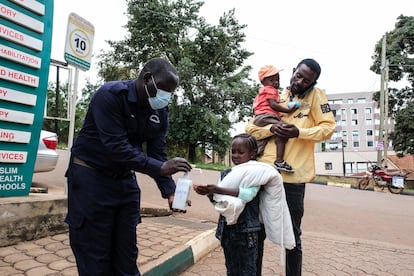
In the Democratic Republic of the Congo (DRC), a new Ebola outbreak has sparked fear and widespread concern among the local population. This marks the 17th time the DRC has faced Ebola. “We are worried to learn that a case of Ebola has just been reported in our province of Ituri. We live in fear because there is no established treatment center for this new strain,” says 28-year-old Bruce Rehema, who lives in Bunia, the capital of Ituri, and works as a motorcycle taxi driver. This province, located in the east of the country, is where the main cluster of infections has been detected.
Esther Abiba, 34, a mother of three and owner of a restaurant in Goma, wondered, heartbroken, why one tragedy after another keeps coming: “Why do we alone suffer epidemics for so many years?”
This new Ebola outbreak triggered alarms at the World Health Organization (WHO) this weekend. The newly declared international public health emergency began in the Democratic Republic of the Congo with eight confirmed cases, 246 suspected cases, and 80 deaths possibly linked to the disease. There are two confirmed cases in Uganda and one in South Sudan.
The East African Community on Monday urged its eight member states to “intensify vigilance” and strengthen cross-border coordination. Meanwhile, the U.S. Embassy in Uganda has also temporarily suspended visa services in the country due to the Ebola cases reported there.
South African President Cyril Ramaphosa, in his capacity as the African Union’s head of pandemic prevention, preparedness, and response, stated in a press release: “Ebola does not respect borders. In a region marked by high population mobility, insecurity and humanitarian movement, the risk of regional spread is significant and demands urgent, coordinated action.”
Ramaphosa urged the governments of the DRC and Uganda to maintain “strong political leadership” and to continue “working closely with frontline responders and communities in an environment of trust and transparency to stop these outbreaks at their source” in order to avoid a larger regional crisis.
Meanwhile, the Africa Centres for Disease Control and Prevention (Africa CDC) has stated that it is working with local authorities to “support a rapid and coordinated regional response,” both at the community level and along the Uganda-DRC border. “The situation requires speed, scientific rigor, and regional solidarity. We are working with the DRC, Uganda, South Sudan, and our partners to strengthen surveillance, preparedness, and response, and to help contain transmission as quickly as possible,” said Jean Kaseya, Africa CDC Director General.
In the Congolese city of Goma, another case was reported on Sunday: a woman in her thirties from Bunia. According to local authorities, her husband died from Ebola. Authorities are urging the population to strictly adhere to preventative measures to limit the spread of the deadly virus, including washing hands, avoiding contact with bodily fluids, and abstaining from consuming wild animal meat. Health Minister Roger Kamba stated, according to local media, that treatment centers are being prepared in the three most-affected areas.
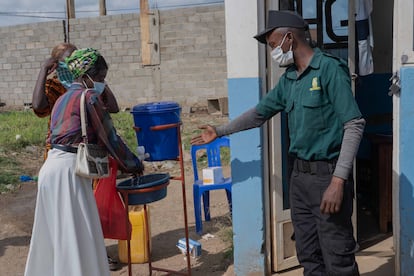
“We held a meeting to identify the entry and exit points of the city of Goma. We have gone to the main checkpoints, also between the city of Goma and Gisenyi, in Rwanda, to set up handwashing stations with soap. We have reactivated what was formerly an isolation center,” explains Shadrack Amani Bahati, deputy governor of North Kivu under the control of the M23 armed rebels.
Six days walking
“I’m going back to my village for my safety,” says Mussolini Tokwiniy, 67, who had planned to walk more than 250 miles to Namugongo, near Kampala, the Ugandan capital. Tokwiniy had been walking from his village for six days when a friend told him by phone that the government had canceled Uganda’s Martyrs’ Day celebrations.
He is “tired and heartbroken,” but he knows the relentless disease all too well. He worked as an ambulance driver in 2000 and 2001, when authorities were battling an Ebola outbreak in the northern district of Gulu, which left 400 sick and more than 100 dead. “When the government says there is no more Ebola, I will walk back to Namugongo [Martyrs’ Shrine] to thank God for keeping me alive in my retirement,” he adds.
On May 17, the Ministry of Health announced that Uganda had registered a second case of Ebola caused by the Bundibugyo strain after two Congolese citizens arrived in the East African country seeking specialized medical treatment. The Ugandan Ministry of Health has advised the public to remain calm and “strictly adhere to preventive measures.” It has also urged anyone observing signs and symptoms consistent with Ebola to alert the authorities.
On Sunday, President Yoweri Museveni met with the task force to tackle the epidemic at Uganda’s Government House in Entebbe to take measures and try to contain the virus.
Fellow Ugandans, especially the Bazzukulu, greetings.
— Yoweri K Museveni (@KagutaMuseveni) May 17, 2026
After consultations with the national epidemic response task force and religious leaders, we have decided to postpone the Martyrs' Day to a later date, which will be communicated.
This decision was made because Uganda… pic.twitter.com/KIVbrC4vXA
Later, Museveni issued a statement announcing that Uganda’s Martyrs’ Day had been postponed, citing fears of the spread of the deadly Ebola virus by pilgrims. “After consultations with the national epidemic response task force and religious leaders, we have decided to postpone the Martyrs’ Day to a later date, which will be communicated. This decision was made because Uganda receives thousands of pilgrims annually from Eastern Congo, which is currently experiencing an Ebola outbreak,” he stated on social media.
If you notice anyone with signs and symptoms consistent with #Ebola, immediately call the Ministry of Health toll free line on 0800-100-066 or send a free SMS to 6767.
— Ministry of Health- Uganda (@MinofHealthUG) May 18, 2026
The public is advised to remain calm, vigilant and strictly observe preventive measures. #Uganda remains safe… pic.twitter.com/cCVfS1X160
Uganda Martyrs’ Day is a globally recognized holiday that attracts thousands of pilgrims each year from Uganda and around the world to commemorate the killing of 45 Ugandans in the 1880s for refusing to renounce their Christian faith.
The situation requires speed, scientific rigor, and regional solidarity. We are working with the DRC, Uganda, South Sudan, and our partners to strengthen surveillance, preparedness, and response, and to help contain transmission as quickly as possibleJean Kaseya, director general of Africa CDC
“I encourage those who had begun their journey to return home, continue observing the precautionary measures, report anyone who is sick, and encourage those who are ill to seek medical care,” the president added.
Sign up for our weekly newsletter to get more English-language news coverage from EL PAÍS USA Edition









































