
Wars displace more people than floods, storms, and other natural disasters for the first time
At least 82.2 million people, almost the equivalent of the population of Germany, were forced from their homes in 2025 due to the impact of armed conflicts and the climate crisis
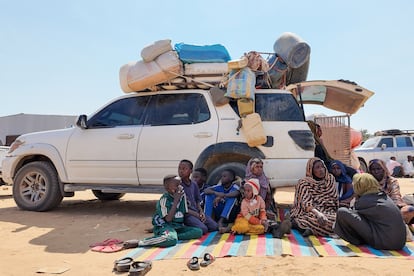

Imagine one of those dusty, precarious informal settlements that the world usually observes from afar, through photographs taken in Africa, Asia, or the Middle East: shacks and tents erected with branches, plastic sheeting, tarpaulins, and corrugated iron, where their inhabitants survive amid poverty and vulnerability, suspended in a state of perpetual uncertainty. Now imagine such a settlement that housed over 82 million people — practically the entire population of Germany. This is real, even if they are not all in the same place: it is the number of people who were internally displaced within their own countries at the end of 2025 after fleeing armed conflict or natural disasters, according to the latest estimates from the Internal Displacement Monitoring Centre (IDMC), the leading global organization for measuring and analyzing this phenomenon, which published its annual report Tuesday. This year’s findings paint a picture of a collective failure: a world unable to protect millions of people from increasingly destructive conflicts and climate disasters caused or exacerbated by human activity.
While it is true that the total number of people forced to flee their homes has decreased slightly from the record high reached in 2024 — falling to 82.2 million from 83.4 million that year — those compiling the figures insist there is nothing to celebrate and that this decrease should not be taken as positive news, but rather as misleading, warns Xiao-Fen Hernán, coordinator and lead author of the report, in a video call. “It is a drop of less than 2%, representing only small recoveries recorded in some crises. We do not believe it implies a real improvement because the situations in countries like Sudan, the Democratic Republic of the Congo (DRC), and Syria remain complex and dynamic,” says the expert, who calls for taking into account the volatility of this phenomenon, something key to the political and humanitarian agenda. In reality, the number of those affected has doubled in just a decade and remains very close to historical highs.
Each year brings a different development, but they all point in the same direction: global deterioration is worsening. For years, natural disasters — floods, storms, cyclones — caused far more population displacement than armed conflicts. In fact, 2024 was an exceptionally devastating year in terms of climate. But wars have been gaining ground in the global dynamics of forced displacement, and in 2025, for the first time since comparable global records have been kept, wars and violence caused more forced displacements within countries than natural disasters: conflicts triggered a record 32.3 million population movements (a 60% increase over the previous year), compared to 29.9 million linked to natural disasters. As of December 31, 2025, a total of 68.6 million people were living away from their homes due to war, and another 13.6 million due to climate-related events.
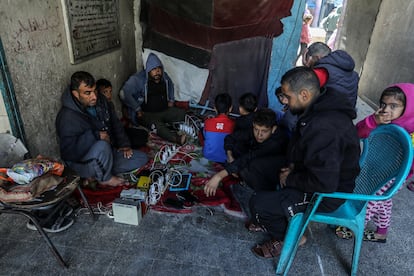
However, the report emphasizes that both crises — climate and war — are increasingly intertwined, since countries affected by conflict sometimes simultaneously suffer floods, droughts, or extreme weather events that further aggravate the vulnerability of the population.
The increase in displacement due to conflict has been particularly abrupt because wars are becoming increasingly internationalized and affecting large cities. For example, Iran and the Democratic Republic of Congo accounted for almost two-thirds of all forced population movements that year: 10 million in the former and 9.7 million in the latter.
This urban aspect, without diminishing the problems of rural areas, is worrying because of its large-scale impact. “When conflict reaches cities, the numbers are higher because there is a greater concentration of people and services. The destruction of infrastructure has an impact on the entire country and takes a long time to rebuild,” explains Hernán, whose study refers to examples of cities destroyed with hundreds of thousands of people affected, such as El Fasher in Sudan, Tehran in Iran, and Goma in the DRC.
One of the most troubling cases has been that of Iran, where the IDMC estimates some 10 million forced displacements from Tehran and other cities in the first 12 days of the military escalation in June 2025. Although many people were able to return home shortly afterward, the observatory decided to include these figures in its statistics. “The fact that a displacement is temporary doesn’t mean it has no impact,” Hernán argues. “It affects families, communities, the economy… So we count them to show the impact of the conflict, even if people are able to return home.”
Another troubling example is the Democratic Republic of the Congo, with its long history of internal violence. The offensive by armed groups in the east of the country — primarily the M23 rebels, with Rwandan support — and the capture of Goma by these militias triggered one in three internal displacements recorded worldwide in 2025. While some returns have also been recorded in the DRC, Hernán warns that not all are permanent. “A return doesn’t necessarily mean there’s a solution,” he points out. “Many people return home because they have no other option, even if there’s no housing, work, basic services, or security.”
The climate crisis in Spain
Wars are not the only phenomenon that displaces tens of millions of people from their homes; natural disasters also play a significant role, particularly the storms, floods, fires, and cyclones that struck the Earth throughout 2025, causing 29.9 million displacements. However, the number of people still displaced as of December 31 was lower: 13.6 million. This figure is 35% lower than the exceptionally high number in 2024, but remains 13% above the average for the last decade. Once again, East Asia and the Pacific accounted for the largest share: 59% of the global total, with 17.5 million displaced people, more than half of whom were in the Philippines alone. “This reflects the region’s high exposure to disasters, partly as a result of population density in risk-prone areas,” the report explains.
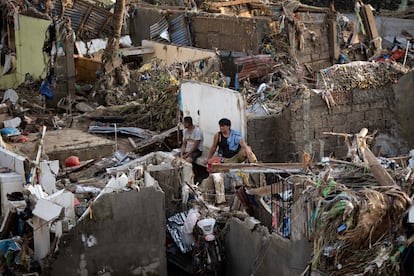
Central Asia and Europe were the regions that emerged relatively unscathed, thanks in part to their relatively low exposure to high-intensity disasters and effective risk management practices. However, this has not prevented Spain from appearing in this report as the European country with the third-most climate-related displacements — nearly 30,000 — primarily due to forest fires. This is also the second-highest figure on record and an almost sixfold increase compared to 2024. “As in previous years, most displacements occurred in August. A single forest fire in the Castile and León region triggered more than 19,000 evacuations,” the IDMC analysis states.
The invisibility of the phenomenon
“Internal displacement is a blind spot in humanitarian crises, despite affecting far more people than there are refugees,” Hernán argues. The media and political focus tends to center on those who cross international borders, and refugees, who number 43 million worldwide, are protected by international law and under the specific mandate of the United Nations High Commissioner for Refugees (UNHCR). Internally displaced persons, on the other hand, remain the responsibility of their own governments, even if these governments are unable to protect them from violence — when they are not directly responsible for it. “This often results in them receiving less international and media attention,” the expert maintains.
However, the increase in people forced to flee is not the only concern on the table; no less relevant is the growing invisibility of many crises due to a significant reduction in data availability. This is because, in war zones, monthly records or full national coverage have ceased to exist. “Many of these movements are never even recorded,” explains the report’s coordinator.
Another obstacle to highlighting the vulnerability of so many millions of people is the impact of the massive cuts to development and humanitarian aid recorded in 2025, primarily by the United States, which was the world’s largest donor, but not exclusively. “When something stops being measured, it also stops being managed,” warns Hernán, whose team had difficulty obtaining information in 15% of the monitored countries. “We are concerned that this apparent decrease will contribute to further reducing political attention and humanitarian funding,” he laments. He warns that the invisibility of this phenomenon may lead us to believe that these crises don’t exist, but nothing could be further from the truth: “It’s not an improvement, but rather a sign that, if we don’t prioritize, we will have less information to make sound decisions.”
Sign up for our weekly newsletter to get more English-language news coverage from EL PAÍS USA Edition









































