
In Argentina, professors, students and university authorities march against Milei’s cuts
The academic community is protesting this Tuesday to demand that the executive comply with the law on education funding

On Avenida Córdoba, one of Buenos Aires’ busiest avenues, one lane remains closed. With desks set up on the asphalt, about 50 economics students listen to a professor who, while sketching on a plastic whiteboard, tries to rise above the noise of cars and buses. The same scene was repeated this Monday on different streets and squares in the Argentine capital, as well as in other cities across the country.
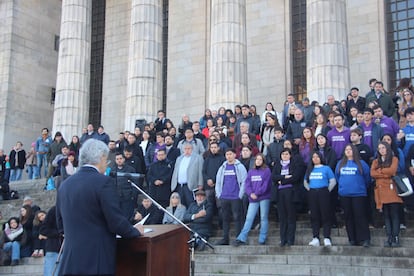
The public classes were the prelude to a new demonstration that will bring together professors, students, workers, and authorities of state universities to protest against the cuts that the government of Javier Milei continues to apply, despite a law and court rulings ordering him to increase funding for higher education.
The federal university march taking place on Tuesday will be the fourth against Milei’s so‑called “chainsaw” policies. Although there will be simultaneous rallies throughout Argentina, the main demonstration will be held in Plaza de Mayo, in front of the Casa Rosada, the presidential palace.
“Since 2023, funding for the university system has fallen by 45.6%,” said Franco Bartolacci, president of the National Interuniversity Council (CIN), in calling for the mobilization. “The most distressing and urgent issue today,” he added, “is the salary situation of teaching and non-teaching staff throughout the university system.” Among the most pressing demands, he also mentioned the need to update financial aid scholarships for students: “Many will have difficulty continuing their studies if this doesn’t happen.”
In the two years and five months since the current far-right government took office, professors and other employees at state universities have lost a third of their purchasing power, according to calculations by the National Interuniversity Council (CIN). Unions in the sector report that a growing number of professors are being forced to resign or take on additional jobs due to the sharp decline in their income. This year, union organizations have intensified their protests and industrial action, severely impacting academic activity at many institutions.
In a country where public universities enjoy broad public support, the academic community anticipates strong popular backing for Tuesday’s demonstration. “I trust it will be a peaceful, massive march, and that people will support it,” said Ricardo Gelpi, rector of the University of Buenos Aires (UBA), the country’s largest university. Speaking to Radio Mitre, he warned that “undermining education and science is mortgaging the future.”
Actors, musicians, writers, and other artists spoke out in support of the demand and called for participation in the federal march. “Let no one take away what is ours. This May 12, let’s all march together in support of public universities,” was the message supported by leading figures in Argentina such as Ca7riel, Cecilia Roth, León Gieco, Samanta Schweblin, Mariana Enríquez, Mauricio Kartun, Selva Almada, Marcos López, Martha Argerich, Gabriela Cabezón Cámara, Paco Amoroso, and many more.
The central demand of the protest is that the executive branch comply with the university funding law. That legislation is limited to updating the sector’s budgets to the real values in effect at the end of 2023, before the rollout of Milei’s cuts. It was passed last year by Congress with the backing of nearly the entire opposition, including some lawmakers who are usually allies of the government.
Milei vetoed the law, but legislators overrode the veto. The president then tried again to repeal the law through the 2026 budget, but once more Parliament voted against it. Since Milei failed to comply with the law, the universities turned to the courts. In two separate rulings, judges ordered the government to begin applying the funding approved by lawmakers. Even so, the executive branch has resisted implementing it and has appealed to the Supreme Court.
Just hours before the march, on Monday, the government announced a new round of austerity measures to maintain a fiscal surplus. The move entails cuts of at least 83 billion pesos (about $59 million), which, according to the government’s own 2026 budget, had been earmarked for investment in education. The cuts affect funding for university infrastructure works and for programs such as the national literacy plan, school equipment, management and socio‑educational policies, as well as the fund designed to offset interprovincial disparities in teachers’ salaries.
Sign up for our weekly newsletter to get more English-language news coverage from EL PAÍS USA Edition









































