
Latin Grammy 2025: Bad Bunny and Ca7riel & Paco Amoroso score big wins and soak up the celebration
The Puerto Rican star and the Argentine duo tied with five awards each. Karol G won for Song of the Year, while Alejandro Sanz took home the prize for Record of the Year


It was a big night for Latin music in Las Vegas. At the MGM Grand Arena, right on the Strip of Sin City, Spanish-language music was heard louder than ever. Mariachi, salsa, ballads, reggaeton, bachatas, regional Mexican… all reigned at the Latin Grammys, where Ca7riel & Paco Amoroso and Bad Bunny — the most-nominated artist of the night — triumphed with five awards each.
But the Puerto Rican artist took home the top prize, Album of the Year, for his hugely successful DeBÍ TiRAR MáS FOToS.
“I thank God, my mom for giving birth to me; Mom, Dad, I love you, my brothers, I love you. I love music, I love what I do, being with passionate people,” said Bad Bunny, who dedicated the award to those who worked with him. “Love as much as you can. I want to dedicate this award to all the children and young people of Latin America, and especially to those of Puerto Rico. Never stop dreaming. Never forget where you come from, but without forgetting where you are going. There are many ways to show patriotism. Puerto Rico, I love you,” he said, in the only politically charged speech of the night.
Earlier, the award for Song of the Year went to Si antes te hubiera conocido by Karol G, one of the biggest hits of recent months.
“Don’t cut me off, I’ve been thinking about something all day,” the Colombian singer said. “Lately, everyone has an opinion, professional or otherwise,” she continued. “In a way, I started to feel that everything I was doing wasn’t right anymore, and that I was losing my magic, losing my charm,” she confessed. “The only thing that remained from all of that was going back to my roots, to my intention and purpose. I’m doing what I love because I enjoy it and because I was born for this. I’m not saying this for myself; I’m saying it because there are a lot of people at home thinking they’re not good enough,” she added. “Forget about the world, live life, because you only get one.”
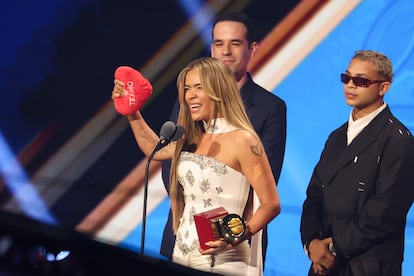
The surprise of the night was Record of the Year, which went to Palmeras en el jardín by Alejandro Sanz, who said that his new songs had restored his sense of excitement.
“Music has been my life, after so many years I’ve fallen in love with it again and I’m receiving this with the greatest excitement in the world. Benito, I stole it from you, forgive me,” the Madrid-born singer joked, since Bad Bunny — whose real name is Benito Antonio Martínez Ocasio — had been the favorite to win the award. “Thank you to the Hispanic culture, which is ours. It’s stronger than ever, and it’s not going anywhere.”
The Latin Grammys was kicked off by Maluma together with Carlos Santana, performing Oye Cómo Va, and the guitarist also played Corazón Espinado, joined by Grupo Frontera. Maluma was in charge of hosting the ceremony, along with Puerto Rican actress and singer Rosalyn Sánchez. “I invite you to look toward the future of our music with joy and optimism,” said the Colombian singer, who admitted to being a bit nervous about the job of host.
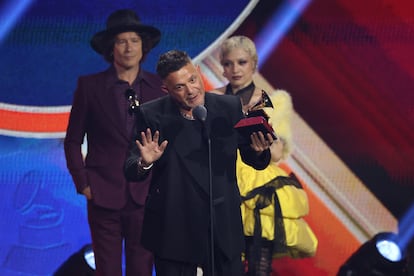
During the pre-show premiere ceremony (where 51 of the 60 awards are handed out), Bad Bunny had already taken home two for DTMF, and the third — Best Urban Music Album — was announced shortly afterward. “I get just as nervous as the first time, which means that what I do matters to me, and it matters a lot to me,” the Puerto Rican artist said, thanking his family, the Academy, “and everyone who believed in this project.”
Later in the night, Bad Bunny also won Best Urban Song for the same track that gives the album its name. “Most of the time… Well, I never practice my speech because I never think I’m going to win; if I win, I just say whatever comes to mind. I’d like you all to give the person next to you a hug.” And yes, there were hugs all around.
At the premiere ceremony, among others, Alejandro Sanz took home the award for Best Contemporary Pop Album, and Karol G and Aitana also each won a Latin Grammy. Rawayana won Best Latin Electronic Music Performance; Trueno, with Fresh, took Best Rap Song; the Best Pop/Rock Album went to Desastres Fabulosos by Jorge Drexler and Conociendo Rusia; and there was a tie in the Rock Album category between Renee (La torre) and Fito Páez (Sale el sol).
At the ceremony, awards were also given for Best Ranchero/Mariachi Album, which went to Christian Nodal for ¿Quién + Como Yo?, and Best Contemporary Mexican Music Album, which went to Carín León for Palabra de tos (seca). On stage, León said, “The nerves never go away,” and dedicated the award to Michael Jackson and Freddie Mercury: “Long live music in all its voices!”
The award for Best New Artist went to Paloma Morphy: “If you’re sad and can’t see a path forward, or find the motivation to keep going, keep going anyway, because maybe you’ll end up at the Grammys,” the young Mexican singer declared.
The Best Traditional Tropical Album was awarded to Gloria Estefan for her album Raíces. She dedicated it to the Academy, her children, and especially her husband, Emilio Estefan: “Thank you for the beautiful songs you wrote for me, the impeccable production that characterizes you, 50 years of making music together, I love you.”
Shortly after, the Cuban singer returned to the stage to demonstrate her trademark energy and brought out Nathy Peluso to perform Chirriqui Chirri. “Long live salsa!” the Argentine singer exclaimed.

With just nine awards handed out in three hours, the performances were the main highlight of the night. In addition to Maluma and Santana, Aitana performed, setting the stage on fire, followed by Alejandro Sanz and Rauw Alejandro, who opened with a bachata, explaining, “Problems are solved by dancing.” He accompanied his performance with traditional masks, percussion, and even a zapateado (a type of Mexican folk dance).
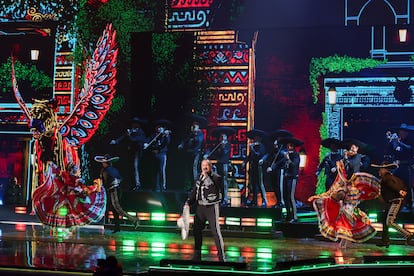
Mexican artists dominated the stage. Young artists DannyLux, Kakalo, and Iván Cornejo showcased the potential of regional Mexican music. Pepe Aguilar gave a powerful, traditional performance with mariachi and even charrería rope tricks from jaripeo (a traditional Mexican rodeo-style event). His daughter, Ángela Aguilar, cheered and sang from the audience as dancers performed jarabe tapatío and other dances from the Mexican state of Jalisco, their brightly colored skirts whirling around.
Two of Mexico’s most prominent bands also performed together: Fuerza Regida (initially all with black veils covering their faces) and Grupo Frontera, who sang Me Jalo a Medias and Marlboro Rojo. The musicians came down off the stage to the front row seating, performing among the families of Raphael and Bad Bunny.
In another performance, Carín León and Kacey Musgraves created a “Texas meets Hermosillo” blend, as Maluma described it, with their rendition of Lost in Translation.
The young Venezuelan singer Elena Rose appeared on stage wearing enormous white wings to perform Me lo merezco accompanied by a piano. After her, Maluma proudly introduced his compatriot Karol G, who, to the rhythm of a guitar and alongside Marco Antonio Solís, sang Coleccionando Heridas. The Colombian band Morat (winners of Best Pop/Rock Album for Ya es mañana) also performed their hit Faltas tú.
Next up were the Argentine duo Ca7riel & Paco Amoroso, who won five awards — all at the pre-ceremony — including Best Short-Form and Long-Form Music Video, Best Alternative Music Album for Papota, Best Alternative Song for #tetas, and Best Pop Song for El día del amigo. They had triumphed at Coachella and continue to impress wherever they go. In Las Vegas, they performed a mix of songs — El impostor, #Tetas, La que puede, puede, El día del amigo — accompanied by four muscular young men in underwear sewing cushions, which they tossed to the audience. In the press room, joking in their usual style, they told EL PAÍS that they planned to melt down their five Grammys to make a chain.
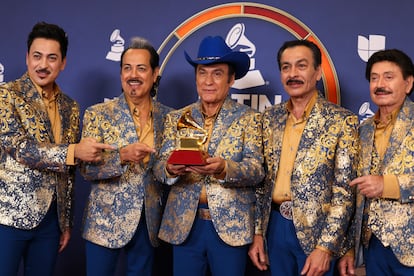
After them, Bad Bunny took the stage with the band Chuwi. The Puerto Rican artist, with his face partially hidden under the hood of his jacket and a beach with palm trees projected behind him, performed WELTiTA. Then two powerful young women, Venezuelan Joaquina and Brazilian Liniker, took the stage. Los Tigres del Norte, winners of Best Regional Mexican Song and Best Norteño Music Album for La Lotería, closed the performances with the award-winning song.
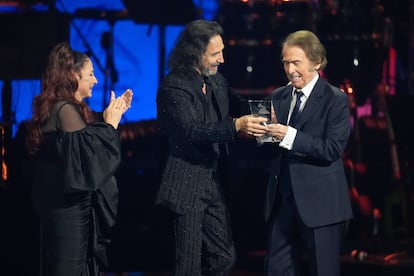
Another key figure of the night was the Spanish singer Raphael, who the previous day had received the Person of the Year award at an emotional gala. At the main ceremony, he was honored again “for being a true ambassador of music,” which brought him back to the stage. He opened with Qué sabe nadie, delivering his signature vocal power, flawless at 82 years old, even after a liver transplant in 2005 and a recent brain lymphoma. He then performed one of his most famous songs, Mi gran noche, chosen by many of the evening’s artists as their favorite Raphael song, and brought the theater to its feet.
Next, Gloria Estefan and Marco Antonio Solís presented him with the award. “There are artists who have defined eras, and then there’s you, Raphael,” Estefan said, “who has defined them all.” “You are my personal idol,” she added.
“On this new journey, I am happy to be reunited with so many friends,” Raphael said. “I solemnly promise that I will return.”
The always colorful Latin Grammys also featured their share of unusual presenters, including Sergio Ramos, who introduced the award for Best Urban Music Album, and Miguel Rojas, the Venezuelan baseball star of the Los Angeles Dodgers. Because if the Latin Grammys are anything, besides an awards ceremony, it’s basically a party.
Sign up for our weekly newsletter to get more English-language news coverage from EL PAÍS USA Edition









































