
Argentina’s Milei is struggling with the economy and losing popularity
Persistent inflation, rising unemployment, and corruption cases are creating the worst possible panorama for the president’s public image

In a scenario constructed from the official statistics promoted by the government, Javier Milei’s Argentina is a happy world: poverty is falling to its lowest level in the last seven years, economic activity is reaching record highs, and fiscal balance is being maintained. But, simultaneously, more and more people say that their present situation doesn’t align with the successes touted by the far-right president, a disconnect pointed out not only by his detractors but even by figures of economic orthodoxy aligned with his policies. Are the official figures false? No, but they are averages that fail to capture an unequal and fragmented socioeconomic reality. And they coexist with other, also official, data, such as the rise in unemployment. Or the acceleration of inflation, whose containment had been Milei’s main achievement and which now remains above 3% per month. In this context, social discontent is spreading, fueled by corruption scandals: almost all opinion polls indicate that the president’s approval rating is at its lowest point.
Indeed, economic activity is at record highs, having risen 1.9% in the last year. However, this does not appear to translate into equivalent well-being. According to a report by the consulting firm Analytica, when the data series is adjusted for population — a more representative metric of well-being — current levels are 6.8% below the peak reached in 2011. At best, activity levels per capita have returned to the pre-pandemic average, the report notes.
The key to understanding this lies in the composition of current growth, based on sectors that generate relatively few jobs, such as hydrocarbons, mining, and financial intermediation. Sectors with a high concentration of employment, such as construction, manufacturing, and commerce, are experiencing a very difficult time or — in some cases — a marked year-on-year decline.
Similarly, while household incomes have shown some improvement on average, those of public employees and retirees remain far below the levels of the past decade. Furthermore, their income is stretched further because of the increased burden on household budgets from expenses such as transportation, education, and healthcare — all of which have been hit hard by Milei’s cuts to subsidies and the public system. “In recent times, poverty metrics have improved more than economic stress: some households have higher incomes, but not necessarily greater spending power or less financial strain,” concludes a report by the Catholic University of Argentina based on a subjective question: Does your current income allow you to live the way you are accustomed to living?
The same dissonance can be seen in consumption, which has ceased to move as a homogeneous bloc. According to the consulting firm MAP Latam, the observable improvement in the statistics is driven by wealthier sectors that spend on outbound tourism, cars, and durable or imported goods, while consumption is falling in more basic areas such as food in supermarkets. Milk purchases, for example, are declining, according to the Argentine Dairy Chain Observatory (OCLA).
The unemployment rate reported by the National Institute of Statistics and Census of Argentina (INDEC) was 7.5% in the last four months of 2025, and although it rose by about one percentage point compared to a year earlier and two percentage points compared to the beginning of Milei’s administration, it masks a marked decline in the quality of employment. This figure includes both formal salaried workers — a shrinking group — and people who perform part-time or informal work, whose numbers are multiplying: app-based delivery drivers, street vendors, and recyclable material collectors. Despite the government’s success in passing labor reform — opposed by unions and currently stalled by the courts — it is difficult to imagine the situation changing in the short term, simply because there are fewer and fewer formal employers. According to the Superintendency of Occupational Risks, 22,608 companies have closed since the far-right government took office.
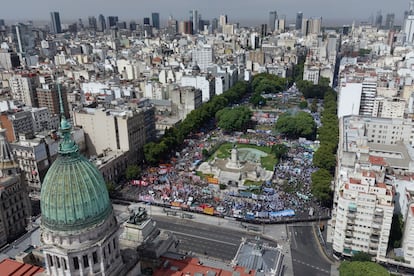
The greatest contrast between official data and social perception occurred in the last week, when Milei euphorically celebrated the publication of the latest poverty data, which showed a 13.5-point reduction since he arrived at the Casa Rosada at the end of 2023. According to experts, the number is heavily affected by the fluctuations of inflation, the outdated consumption basket, and the increase in state transfers to the most vulnerable sectors — a policy that the president spared from his austerity measures and even reinforced. According to calculations by the Center for Distributive, Labor and Social Studies (Cedlas), if these and other variables were adjusted, the reduction in poverty would be two percentage points between 2023 and 2025. In any case, the official data coexists with others that show alternative dimensions of the general situation: in the same period, the number of homeless people increased by 57% in Buenos Aires, the richest city in the country, and families are going into debt to pay for everyday expenses.
“It’s not that poverty went up or down; the poverty indicator, measured by income and cross-referenced with a specific basket of goods and services, as we measure it in Latin America, went down. Poverty is something else entirely, much more complex, because when I get off the subway and walk home at night, I still see roughly the same number of people sleeping [rough], or even more. That could be another indicator of poverty, albeit my own and not comparable to others,” notes Eduardo Donza, a researcher at the UCA Social Debt Observatory.
“There’s no contradiction; averages mask differences,” summarizes economist Marina Dal Poggetto. “There are winners and losers, but the winners, for now, have little impact on job creation; in fact, formal employment is being destroyed. Incomes are suppressed, and credit has reached its limit due to delinquency.” Herein lies, perhaps, the crack in Milei’s economic model and the central point from which discontent begins to grow.
“Expectations are deteriorating”
Since the beginning of the year, opinion polls have warned of rising social discontent and growing rejection of the president. The Brazilian consulting firm Atlas Intel, which in 2023 predicted Milei’s triumphant rise, now indicates that the president is experiencing his worst moment since taking office. In a survey of 5,037 people nationwide at the end of March, 62% expressed a negative view of Milei, while 37% expressed a positive one. Since December, the study indicates, the far-right leader’s disapproval rating has increased by almost 10 points. For most respondents, the country’s main problems are corruption (43.3%), unemployment (42.2%), inflation (35.3%), the weakening of democracy (31.4%), and the economic situation (29.6%).
Several polling firms across the country have revealed a similar trend in recent weeks, some showing higher support for Milei (around 40%) and others lower disapproval (around 50%). The Isasi-Burdman polling firm is among those that assign the president the highest approval rating, with 46%. “There isn’t much difference in our data; we also see a decline in Milei’s image,” explains sociologist Julio Burdman. “What we emphasize,” he clarifies, “is that these numbers for Milei aren’t so bad for this point in his term. When they began their third year in office, the previous presidents [Mauricio Macri and Alberto Fernández] were doing much worse.”
According to Synopsis Consultores, Milei’s disapproval rating is 56%, while his approval rating is 35%. According to its director, Lucas Romero, the decline in support for the government began in December, due to “the social perception of the microeconomy: wages are losing ground against rising inflation, consumption is not recovering, and there are consistent job losses.”
To all this was added, during the last month, a series of corruption scandals that have rocked the government, such as the president’s involvement in the alleged $Libra cryptocurrency scam and the judicial investigation into the possible illicit enrichment of the chief of staff, Manuel Adorni, among other cases. “Milei came to power saying that an economic change was necessary, one that wouldn’t be easy, but he promised that relief would soon arrive and, in the meantime, offered political change as compensation: an end to ‘the elite’ and their privileges,” says political scientist Romero. “Today, the relief hasn’t arrived, expectations are deteriorating, and there’s a flood of information about possible acts of corruption involving key figures in the government. It’s a rather complex combination that could easily damage Milei’s public image.”
Sign up for our weekly newsletter to get more English-language news coverage from EL PAÍS USA Edition









































