
Secrets, UFOs, and smokescreens: Why Washington is obsessed with extraterrestrials
The release of documents on unidentified phenomena ordered by Trump is the result of activists, politicians, and military figures who have been pushing for years to end what they denounce as a ‘truth embargo’

Let’s start with the proven facts: Disclosure Day is the most anticipated film of the summer. Its director and screenwriter, Steven Spielberg, revealed details about its plot this week on one of Stephen Colbert’s final shows: he says it tells the story of the theft by officials, “committed to the truth,” of all information held by the government “about UFOs and extraterrestrial visits,” and the system’s desperate attempts to prevent it being revealed.
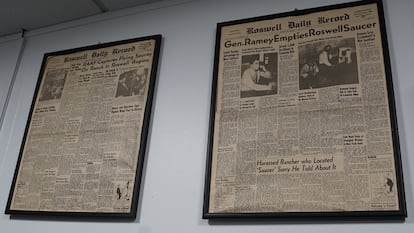
“This 79-year campaign of terror and lies has to end!” actor Colman Domingo exclaims in the trailer. That reference needs no explanation for ufology enthusiasts: 79 years have passed since the Roswell Incident, when a New Mexico farmer found metal debris from something the U.S. Army first called a “flying saucer,” a term that entered popular speech that summer of 1947, and the next day referred to as a “weather balloon.” That event launched Americans’ fascination with UFOs. Almost eight decades later, 56% of them take it for granted, according to a YouGov poll, that extraterrestrials “have already visited Earth.”
In Washington at the moment there is a sizable group of politicians, journalists, podcasters, influencers, military figures, scientists, and activists who, like Domingo’s character, believe that this “campaign of terror and lies” should not only end, but is about to.
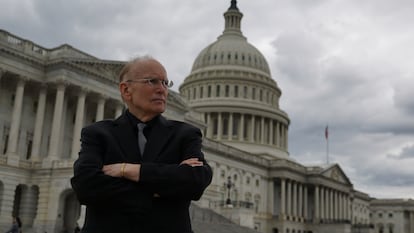
One of the movement’s longest-serving figures is Stephen Bassett. For decades he has worked as a “political activist” leading an essentially one-man organization called Paradigm Research to secure the declassification of information about “extraterrestrial life” that he is convinced the government holds. Trained as a physicist, he arrived here in the mid-1990s and soon made a name for himself as the “first registered UFO lobbyist” pressing Congress.
In a building near the White House he works from a windowless office whose walls are lined floor to ceiling with hundreds of ufology books. Hanging on one wall are the front pages of the Roswell Daily Record from those two days in 1947 when the government changed its story. Bassett, one of those characters you only find in Washington, claims a share of the paternity of the concept of “Disclosure with a capital D,” which he says he began using in the first decade of this century and which Spielberg borrows — the director of the two films that have done the most for the cause to date: Close Encounters of the Third Kind in 1977, and E.T. five years later. “I only ask for a quarter of the profits from the new one,” Bassett jokes.
Disclosure Day is scheduled to open on June 12, 2026, five weeks after the Pentagon made history on May 8 — for some as an attempt of providing the truth, for others as a smokescreen at a moment of extreme unpopularity for Donald Trump — by declassifying, by presidential order, an initial batch of 162 documents on Unidentified Anomalous Phenomena (UAP, the term adopted a few years ago for UFOs, which had acquired a stigma after decades in popular culture). On Friday another 60 items were released. The corpus includes images, videos, diplomatic cables and transcripts of eyewitness accounts that do not provide any extraordinary, let alone conclusive, revelations.
None of this would likely have been possible without Luis Elizondo, a former senior intelligence official and special agent who for years worked on a U.S. government program secretly approved by Congress to investigate UAP sightings over sensitive military installations. Those objects can be grouped into three categories: ordinary terrestrial phenomena (the vast majority: weather balloons, camera glitches, visual illusions...), extraordinary terrestrial objects (spy planes or Russian or Chinese drones capable of feats beyond the reach of the U.S. military), or extraterrestrial (the presence of aliens).
In 2017, “forced to choose between defending the Constitution and the bureaucracy,” Elizondo decided to expose it. He resigned and sent a letter to his superiors. “There were accumulating incidents with UAP near aircraft and military bases and nobody was doing anything,” the former official recalled on Thursday from Wyoming in a videoconference with EL PAÍS. “I had two options: stay and live with the frustration of being complicit in deceiving the American people, or step forward and — without revealing classified information — expose the use of taxpayer money to study UAPs, which, whatever they may be and wherever they may come from, are out there.”
When asked whether he has feared for his life during this time, Elizondo answers with a simple “yes.” He was the essential source for a 2017 article in The New York Times that marked a turning point in legitimizing public debate on a subject usually confined to films and fringe publications.
He also took part in one of the two explosive Congressional hearings held in 2023 and 2024. At those hearings, two retired senior military officers detailed encounters with aircraft whose technology they maintain did not appear to be of this world, while former intelligence officer David Grusch testified under oath that the Pentagon holds parts of alien craft and “nonhuman remains.” “Most of the time there are prosaic explanations,” Elizondo admits, “but we are not talking about when your grandmother saw some lights in the backyard. These are trained pilots who can identify in a fraction of a second whether they’re looking at an F-16 or a MiG-23 flying 20 miles away.”
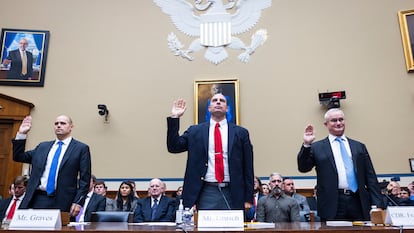
Those sessions legitimized Capitol initiatives — in the name of national security and with bipartisan support — such as the UAP Disclosure Act, promoted by Senate Democratic leader Chuck Schumer. They also paved the way over the past year for high-profile government figures such as Secretary of State Marco Rubio and Vice President J. D. Vance to come out on the UFO issue. Vance said in March on a podcast that he is “obsessed with UFOs” and believes “aliens are demons,” after former president Barack Obama caused a global stir by saying on another podcast that extraterrestrials are “real,” though they are not being guarded at the famous Area 51.
Hours later, Obama softened his remark, but it was already too late for Trump, who on February 16 — days after his predecessor’s off-script comment and a couple of weeks before launching the war on Iran — published a message ordering the head of the Pentagon, Pete Hegseth, and “other relevant departments and agencies” to begin “the process of identifying and releasing government files related to alien and extraterrestrial life, unidentified aerial phenomena (UAP), and unidentified flying objects (UFOs),” matters he added were “highly complex, but extremely interesting and important.”
“They’re testing the waters,” says Bassett, who, in light of the press-mention archive he has amassed — “more than 9,000” entries since the Times exclusives — confirms interest “has never been greater” than now. He believes it’s all part of a “process” that will culminate in the day a “head of state” goes public and “confirms the existence of nonhuman life.” “American activists would prefer for our president to make the announcement. And that would make sense because,” he clarifies, “the rest have ceded the spotlight on this issue to us over the last 80 years.” That, he says, would explain why news about alleged alien life almost always seems to originate in this dominant culture, with its unmistakable blend of innocence, enthusiasm, and paranoia.
The “Disclosure Movement”
That day will bring what the lobbyist, fond of labels, calls “the end of the truth embargo,” and inaugurate “the post-disclosure era.” Bassett also talks about the “UAP community” or the “Disclosure Movement” to refer to a constellation of believers now experiencing a mix of euphoria after decades of being ridiculed as “tin-foil-hat types,” and a certain disappointment.
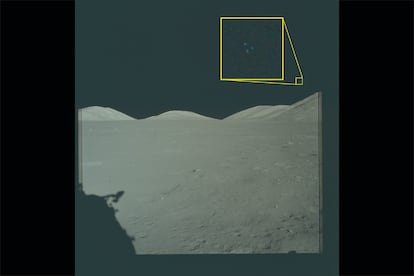
Elizondo highlights documents from the first batch related to the Apollo 12 and 17 missions: “NASA has been saying for 40 years that it has no information on UFOs... and now it turns out it does?” But he urges patience: “I don’t think [with the first declassified documents] we are at the beginning of the end of this conversation, but at the end of the beginning. There’s still a long way to go.”
Australian investigative journalist Ross Coulthart, another leading figure in that community, was harsher last week in a phone interview about the Trump administration’s handling of the issue. He called the initial release of papers from several government agencies — hosted on a Department of Defense website (war.gov/ufo) that has already exceeded one billion visits — “completely absurd.” “I know from Defense and Intelligence sources that there are many more high-resolution videos and photographs, impressive and ontologically striking,” Coulthart said, adding that there is resistance within the government and from “many private contractors” to comply with Trump’s promise.
The journalist, who laments that the White House is not “pushing hard enough,” fears the UFO file declassification will follow the pattern of other unfulfilled Trump promises: from the Epstein files, whose staggered release seems intended to distract and numb public opinion, to files on the murders of Martin Luther King Jr. or John Fitzgerald Kennedy — whose deaths Coulthart alleges, without evidence, were related to their “pressure to reveal information on UAP.”
While activists watch their screens awaiting developments, the idea is gaining traction in Washington that Trump’s decision is an unmissable opportunity to tear down the veils of what the conspiratorial tribe calls the “deep state.” Few may be as convinced as Republican Congresswoman Anna Paulina Luna of Florida.
As head of a commission called the Task Force on the Declassification of Federal Secrets, Luna pushes as hard to shed light on Jeffrey Epstein’s sexual crime network as on the MKUltra program, which — and this has been proven — saw the CIA secretly experiment with psychedelic drugs for population control. That dedication makes Luna, an outsider when she arrived in Congress in 2023, a politician in perfect tune with Trumpian Washington, a city taken over by conspiracies and smokescreens.
Representatives Eric Burlison (Missouri) and Tim Burchett (Tennessee) round out the podium of those in Congress who have turned disclosure of government UFO secrets into a personal crusade. They are not alone: a handful of Democrats have joined the mission. Elizondo calls them all “heroes.”
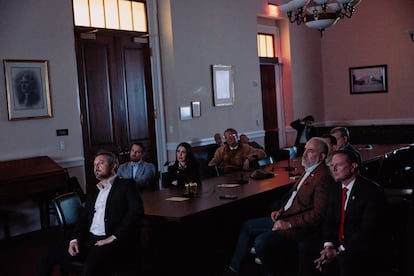
Luna, Burlison, Burchett and some of their rivals attended a screening of another milestone in this story last November: the documentary The Age of Disclosure, produced and directed by Dan Farah, a Hollywood figure who has been passionate about extraterrestrial enigmas since childhood.
It premiered with great success on Amazon and in a handful of U.S. cinemas. It is a well-financed film, far from the classic documentaries on the subject, partly because its talking heads are not fringe activists but 34 senior figures from the U.S. government, military, and intelligence community. They include members of Congress such as Burchett, a former defense secretary, and Rubio, who appears as a senator and is now, in addition to secretary of state, a national security adviser. In the film he says: “We’ve had repeated incidents of something operating in the airspace over restricted nuclear facilities, and that something is not ours.”
Together, with Elizondo as a central figure, they denounce a government “cover-up” as well as “a secret Cold War” among world powers to decipher — through reverse engineering — all the secrets of “advanced nonhuman-origin technology.” They also attribute decades of secrecy to collusion with private defense contractors.
“When we were filming the documentary I already trusted its huge impact, and that it would force the government to declassify,” the director said last week by videoconference. Farah said he was proud to have “driven the final nail into the stigma” affecting those who, like him, believe in “certain fundamental facts.” “That we are not alone in the universe, and that the U.S. government holds craft of nonhuman origin and is engaged in a competition with hostile nations to learn from their technology,” he said.
One of the documentary’s most interesting sections comes when experts ask what impact an announcement like the one the Disclosure Movement desires would have — on major religions, for example, or on the economy. If the strangling of a strait in the Persian Gulf has managed to upend it... what would happen if a head of state delivered what Farah believes would be “the most consequential news in history”?
Faced with that hypothesis, Helen McCaw, who worked as a senior analyst in financial security at the Bank of England, wrote in January to the current governor, Andrew Bailey, advising him to design contingency plans in case the White House confirms we are not alone in the universe.
So far, Trump does not seem as concerned as McCaw about the potential implications of the tap he himself opened. As proof of how seriously the U.S. president takes the matter, consider a post published last week on his Truth Social network. It is an AI-generated image showing him walking alongside the classic depiction of an extraterrestrial (humanoid figure, grayish skin, large eyes) in handcuffs. Whoever designed it added that typical smudge you see in photos taken clumsily with a cell phone. And it ended up being the most realistic part of the whole thing. Who wouldn’t mess up the shot, out of sheer nerves, when faced with the task of immortalizing Trump alongside an alien?
Sign up for our weekly newsletter to get more English-language news coverage from EL PAÍS USA Edition









































